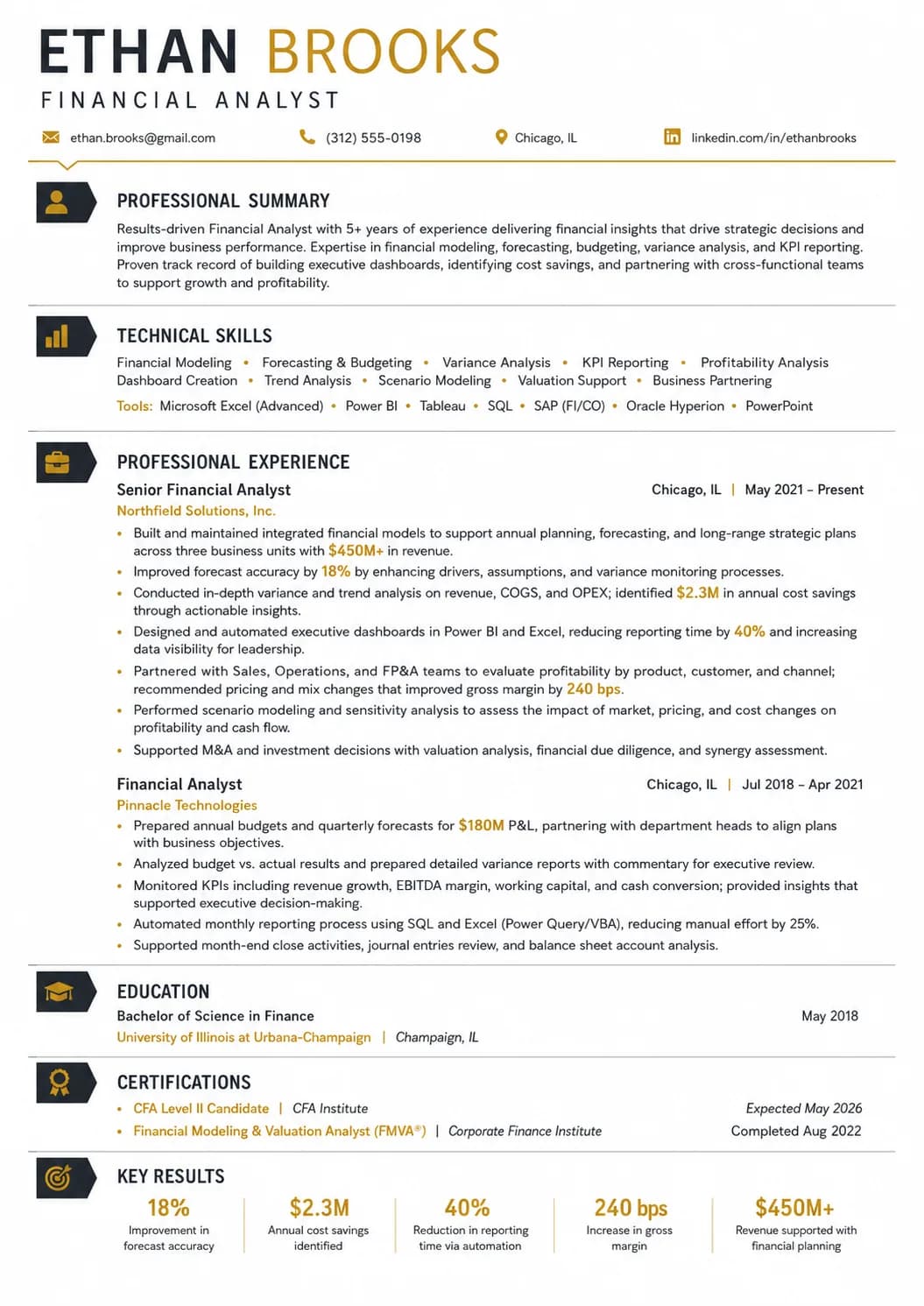
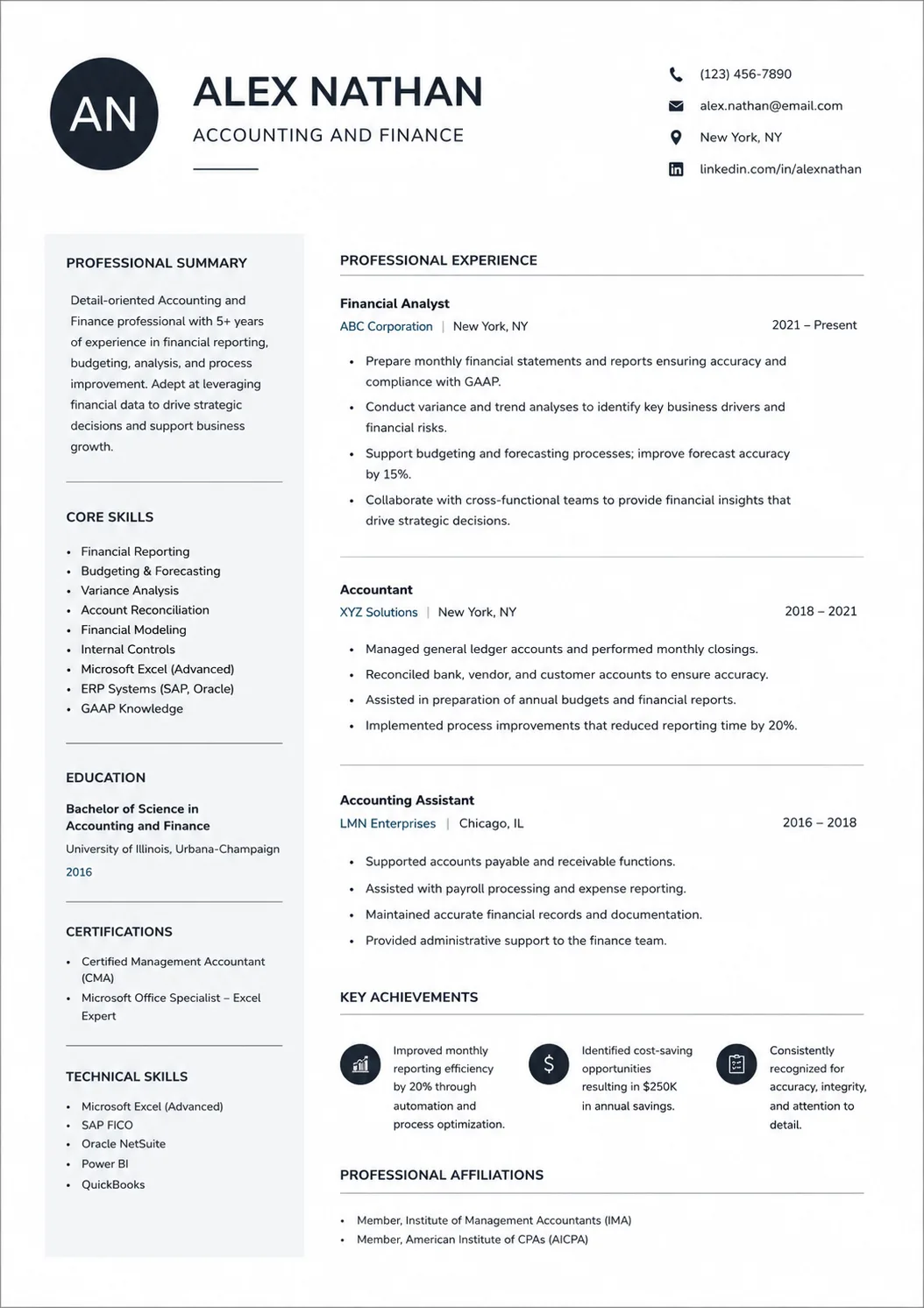
Resume ExampleAccounting & FinanceMid Level

Accounts Receivable Resume Examples & Writing Guide

Use this accounts receivable resume example to write a clear, ATS-friendly resume that shows invoicing, payment posting, collections, aging reports, reconciliations, and customer account accuracy.

Experience Level
Mid Level
Category
Accounting & Finance
Reader Rating
4.7 / 5
  • Tailor every accounts receivable resume to the AR role, industry, accounting system, and posting.
  • Use a clean layout that works for ATS tools, recruiters, accounting managers, and controllers.
  • Write a summary that shows cash flow support, account accuracy, and receivables experience.
Resume Example (Text Format)

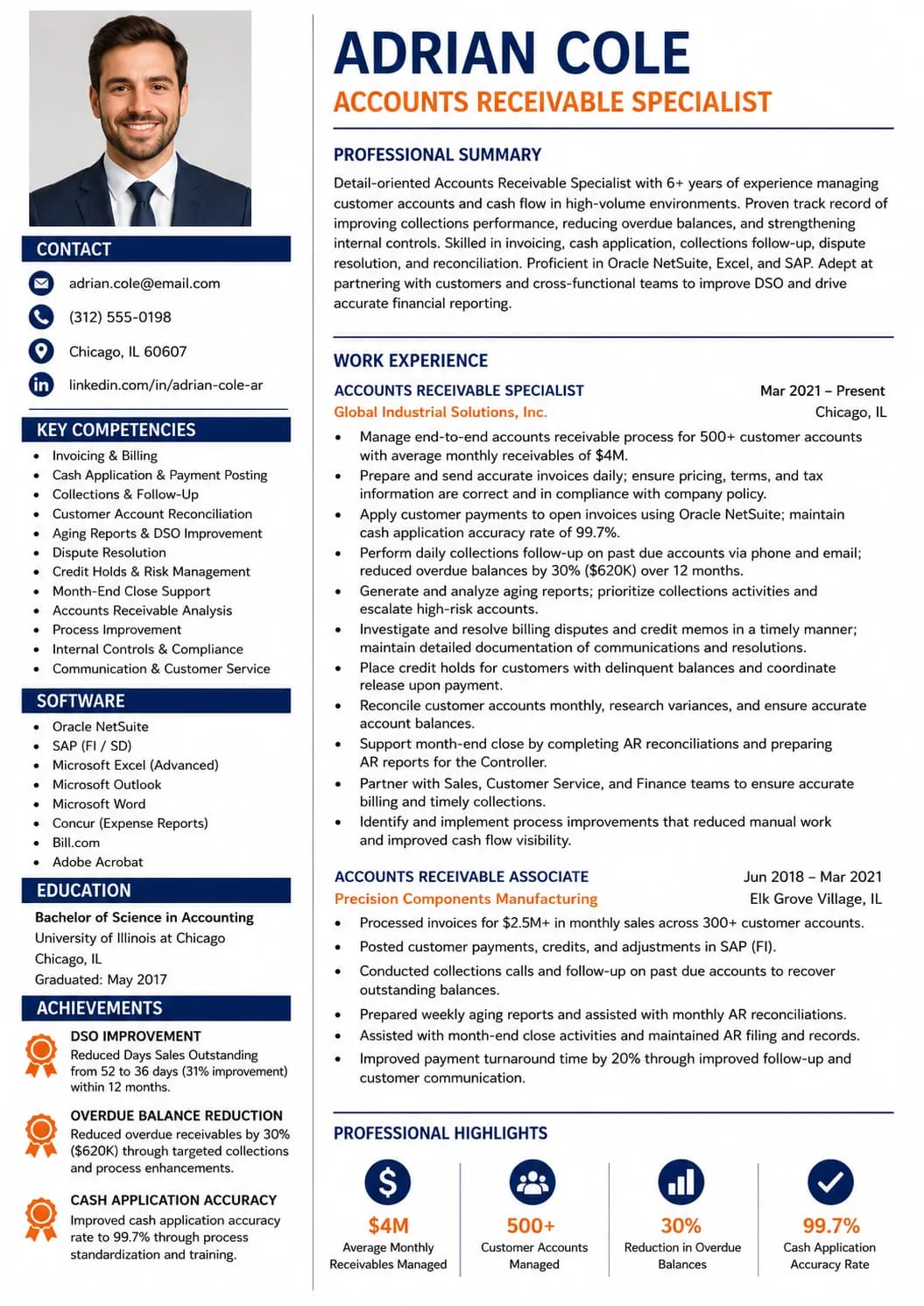
Sofia Ramirez

Accounts Receivable Specialist

sofia.ramirez@email.com | (214) 555-7138 | Dallas, Texas | linkedin.com/in/sofia-ramirez-ar

Profile

Accounts receivable specialist with 5 years of experience in invoicing, cash application, payment posting, collections follow-up, aging reports, customer account reconciliation, and month-end AR support. Skilled in Excel, NetSuite, QuickBooks, credit memos, dispute research, and audit-ready documentation.

Work Experience

Accounts Receivable Specialist, Horizon Supply Group

Dallas, Texas | Apr 2021 - Present

  • Processed daily ACH, check, credit card, and lockbox payments while researching unapplied cash and short payments in NetSuite.
  • Reviewed weekly aging reports, followed up on past-due invoices, and documented collection activity for customer accounts.
  • Prepared credit memo requests, resolved billing disputes with sales and customer service, and supported month-end AR reconciliation.

Billing and Accounting Clerk, NorthStar Services

Plano, Texas | Jun 2018 - Mar 2021

  • Generated customer invoices, updated account records, and verified billing details before sending statements.
  • Posted deposits, matched receipts to open invoices, and escalated payment discrepancies to the accounting manager.
  • Maintained Excel trackers for invoice status, customer notes, and account follow-up during month-end close.

Education

  • A.A.S. in Accounting, Dallas College | Dallas, Texas | 2018

Languages

  • English

Certifications

  • QuickBooks Online Certification | 2023
  • Advanced Excel for Accounting | 2022

Skills

  • Cash application
  • Payment posting
  • Aging reports
  • Collections follow-up
  • Account reconciliation
  • NetSuite

A strong accounts receivable resume should show that you can keep customer balances accurate, invoice correctly, apply payments, follow up on overdue accounts, and support clean financial records. This is true whether you are writing an entry-level accounts receivable resume, a mid-career accounts receivable specialist resume, or a senior AR lead resume. Employers are not only looking for someone who can enter numbers. They are looking for someone who can protect cash flow, reduce billing confusion, research payment problems, communicate with customers, and help accounting teams close the month with accurate information. That is why this accounts receivable resume example focuses on proof. It shows how to turn invoicing, payment posting, cash application, collections, aging reports, credit memos, reconciliations, and ERP work into clear resume content.

Quick breakdown

Why this accounts receivable resume works

1

It makes the candidate easy to understand in a few seconds: what AR work they handle, which systems they use, and how they protect cash flow and customer account accuracy.

2

It uses accounts receivable resume keywords naturally, so the resume can work for ATS tools and still sound clear to accounting managers and recruiters.

3

It turns daily AR tasks into proof by showing invoicing, cash application, collections, aging review, payment research, reconciliation, and dispute resolution.

4

It keeps software, metrics, accounting skills, and real finance actions easy to find instead of hiding them under vague statements about being detail-oriented.

Fast template guide

What to copy from this accounts receivable resume example

Do not copy the resume word for word. Copy the structure, the section order, and the level of detail. A strong accounts receivable resume example teaches you what to show: invoicing, cash application, payment posting, aging reports, collections, customer accounts, reconciliations, dispute research, credit memos, accounting software, and month-end support. Your own version should use your real company names, systems, invoice volume, payment methods, customer types, reporting tasks, and results. The goal is to make your AR work easy to understand and easy to trust.

A clear header and summary that name the target AR role, accounting environment, and strongest receivables skills without crowding the top of the page.

Accounts receivable experience written around invoicing, payment posting, cash application, collections, account reconciliation, dispute follow-up, and aging reports.

Software and tools such as Excel, QuickBooks, NetSuite, SAP, Oracle, Sage, Microsoft Dynamics, ERP systems, and billing platforms used in plain accounting language.

Bullets that connect AR tasks to business value, such as faster cash posting, fewer unapplied payments, cleaner aging, stronger documentation, and better month-end close support.

Certifications, accounting coursework, ERP training, and finance skills placed where employers can verify accuracy, compliance, and system experience quickly.

Build the right structure

Accounts receivable resume sections to include

A strong accounts receivable resume should include the sections employers expect to scan quickly, plus optional sections that help you prove accuracy, system knowledge, and cash flow support. The goal is not to add every possible finance section. The goal is to build a page that lets an employer understand your AR fit, verify your accounting foundation, and see the receivables work you can already do.

Must-have sections

  • Contact information
  • Accounts receivable resume summary or objective
  • Accounts receivable, billing, collections, bookkeeping, or accounting experience
  • Education
  • Certifications, accounting training, or software training
  • Accounts receivable skills

Optional sections that strengthen the resume

  • Cash application
  • Collections experience
  • Billing and invoicing projects
  • Aging report experience
  • Account reconciliation
  • Credit memo and adjustment work
  • Month-end close support
  • ERP and accounting software
  • Excel skills
  • Languages
  • Process improvement

An accounts receivable resume should not read like a generic accounting resume. Employers need to see how you support cash flow, keep customer accounts accurate, resolve billing issues, post payments correctly, and follow up on overdue invoices. For a newer AR candidate, billing, cashiering, customer service, bookkeeping, data entry, bank reconciliation, and accounting coursework can all help when they are written with clear finance details. For an experienced candidate, the resume should move faster into invoicing volume, aging reports, collections results, unapplied cash cleanup, dispute resolution, ERP systems, month-end close, and audit-ready documentation. The best accounts receivable resume example keeps these sections simple because accounting managers need to scan quickly for accuracy, system knowledge, and cash collection proof.

Smarter ordering

Best accounts receivable resume section order

The best section order depends on your experience level. A new AR candidate should not use the same structure as a senior AR lead with years of collections and cash application results. Place your strongest proof where the reader will see it first. For a new candidate, that may be accounting coursework, billing support, cashiering, data entry, and Excel. For an experienced AR specialist, it is usually invoicing, payment posting, aging reports, collections follow-up, ERP systems, reconciliations, and month-end close support.

Entry-level accounts receivable

  1. Contact information
  2. Accounts receivable resume objective or short summary
  3. Education and accounting coursework
  4. Billing, cashiering, data entry, customer service, or bookkeeping experience
  5. Certifications, training, or software knowledge
  6. Accounts receivable skills
  7. Projects, internships, or volunteer finance work

Experienced accounts receivable

  1. Contact information
  2. Accounts receivable resume summary
  3. Accounts receivable experience
  4. Certifications, accounting training, and software tools
  5. Accounts receivable skills
  6. Education
  7. Process improvement, metrics, or reporting highlights

Senior accounts receivable or AR lead

  1. Contact information
  2. Senior accounts receivable resume summary
  3. AR leadership, collections, and cash application experience
  4. ERP systems, reporting, and month-end close support
  5. Accounts receivable skills
  6. Education and certifications
  7. Team leadership, process improvement, and aging results

Put the strongest proof near the top. A new accounts receivable candidate can lead with accounting coursework, billing support, cashiering, Excel, and customer account experience. An experienced AR specialist should lead with invoice volume, cash application, aging reports, collections, reconciliations, and system knowledge. A senior AR lead should show team coordination, process improvements, DSO support, clean audit trails, and better reporting.

Choose an accounts receivable resume example by experience level

Use this template

Use this mid-career accounts receivable example to study how cash application, invoicing, collections follow-up, aging reports, reconciliations, and ERP system experience should lead the page.

Accounts Receivable Resume Playbook

A strong accounts receivable resume should show payment accuracy, cash flow support, and clean customer account records in a way an accounting team can understand quickly.

An accounting manager does not read an accounts receivable resume the same way a general office employer reads a resume. A controller, finance manager, recruiter, or AR supervisor is usually scanning for very specific proof. They want to know whether you can invoice correctly, post payments, apply cash, follow up on overdue accounts, research payment discrepancies, prepare aging reports, communicate with customers, and keep records ready for month-end close. They also want to see which systems you use, such as Excel, QuickBooks, NetSuite, SAP, Oracle, Sage, Microsoft Dynamics, Stripe, Bill.com, or another ERP or billing platform. A good accounts receivable resume example should make all of that easy to see without forcing the reader to dig through vague accounting language.

That is why this guide focuses on plain proof, not fancy finance words. You do not need dramatic wording to write a strong accounts receivable resume. You need specific AR details. Invoicing, cash application, payment posting, collections follow-up, account reconciliation, customer statements, credit memos, dispute research, and month-end AR support can all become strong resume evidence when you connect them to accuracy, cash flow, clean reporting, and customer account control. The target keyword for this page is accounts receivable resume example, but the content is written to help a real person build a better resume, not just to repeat a keyword.

  • Turn invoicing, payment posting, cash application, and collections into strong resume proof.
  • Write an accounts receivable resume summary that sounds specific, accurate, and useful.
  • Use accounts receivable resume keywords for ATS without stuffing the page.
  • Place accounting software, certifications, reconciliations, and AR results where employers can find them quickly.

How to write an accounts receivable resume

A strong accounts receivable resume should make three things clear within a few seconds: what receivables work you handle, which systems and reports you use, and why an accounting team can trust your accuracy. That means your resume should show invoicing, cash application, payment posting, aging reports, collections follow-up, customer account updates, account reconciliation, and month-end support. An accounts receivable resume example that only lists duties is weak because many AR roles share similar duties. The stronger version explains how you posted payments, researched unapplied cash, resolved billing disputes, improved aging visibility, supported close, and kept customer balances accurate.

  1. Read the job posting and highlight the AR duties, software, payment methods, reporting needs, and industry language.
  2. Match your summary, skills, and experience bullets to the receivables work the employer cares about most, as long as the match is honest.
  3. Use a clean format with standard headings so ATS tools, recruiters, and accounting managers can scan the resume quickly.

What accounting teams look for first

Most accounting teams look for proof that you can keep the receivables process accurate and moving. They want to see invoicing, payment posting, cash application, collections follow-up, aging review, account reconciliation, billing dispute research, customer communication, and software knowledge. In simple terms, they want to know that you can help the business send accurate invoices, collect money owed, apply payments to the right accounts, and report open balances correctly. For an accounts receivable resume, this proof should appear in the summary, skills, experience bullets, education, and certifications. Do not leave your best AR details trapped inside one section. Spread them naturally across the page so both ATS tools and human readers can see them.

High-priority proof points

  • Invoicing, billing, and customer account maintenance
  • Cash application, payment posting, and unapplied cash research
  • Aging reports, collections follow-up, and dispute resolution
  • Account reconciliation, credit memos, adjustments, and month-end close support
  • Accounting software such as Excel, QuickBooks, NetSuite, SAP, Oracle, Sage, Microsoft Dynamics, or ERP systems

Good proof for newer AR candidates

  • Billing assistant, cashiering, accounting clerk, customer service, or data entry experience
  • Bookkeeping coursework, accounting certificates, or Excel training
  • Receipt matching, deposits, customer account updates, and payment tracking
  • Spreadsheet reports, invoice logs, customer notes, or simple reconciliations
  • Experience answering billing questions, following procedures, and keeping records accurate

Writing for both ATS and human readers

Many employers collect accounting applications through online systems. Those systems may parse your resume, and the people reading it may also search for clear terms from the job posting. This is why an ATS-friendly accounts receivable resume should use normal accounting language: accounts receivable, invoicing, cash application, payment posting, aging reports, collections, customer statements, account reconciliation, credit memos, dispute resolution, month-end close, Excel, ERP, QuickBooks, NetSuite, SAP, Oracle, and billing systems. The goal is not to trick the system. The goal is to describe your real background with the same words employers use when they hire AR staff.

Statistical Insight

If your resume says only that you are detail-oriented, organized, or good with numbers, the reader still does not know what you can do. A better accounts receivable resume shows the work behind those qualities. Instead of saying you are accurate, show how you posted payments, reconciled accounts, corrected billing errors, or cleaned up unapplied cash. Instead of saying you communicate well, show how you followed up on past-due invoices, worked with sales to resolve disputes, or answered customer billing questions. The best accounts receivable resume example turns soft claims into finance actions.

Start with one strong master resume, then adjust it for each employer. An accounts receivable clerk resume, AR specialist resume, billing specialist resume, collections specialist resume, and senior accounts receivable lead resume should not all sound the same. The core structure can stay similar, but the wording should change based on industry, software, invoice volume, payment methods, customer type, collections process, and month-end close duties. Read the posting first, mark the repeated terms, and decide which parts of your background match honestly. Then update your summary, skills, and bullets so the employer sees fit right away.

  1. Use the posting wording for invoicing, cash application, collections, aging reports, software, payment methods, and reconciliations when it matches your experience.
  2. Use action words such as posted, invoiced, reconciled, researched, resolved, applied, collected, reviewed, documented, prepared, and improved.

A good accounts receivable resume is not a long list of every invoice, customer call, or spreadsheet you have handled. It is a focused document that helps an employer answer one question: can this person keep our receivables accurate and help us collect what we are owed? Keep the resume clear, use action words, include numbers where they are true, and connect your work to cash flow, account accuracy, reporting, or customer service. For example, invoice volume, payment type, accounting system, aging bucket, dispute type, reconciliation process, or close deadline can all make a bullet stronger. These details are simple, but they make the resume feel real.

Choosing the best accounts receivable resume format and template

The best accounts receivable resume format is clean, simple, and easy to read. AR work depends on accuracy, records, and clear follow-up, so the resume also needs to feel organized. An employer may review many accounting resumes, so your layout should help the reader find your summary, experience, education, certifications, and skills without effort. For most AR candidates, reverse-chronological order is the safest choice because it highlights recent accounting work first. If you are new to accounts receivable, you can still use that format while placing billing support, cashiering, bookkeeping, customer account work, Excel, or accounting coursework higher so your strongest proof is not buried.

For the ATS

  • Use standard headings such as Summary, Experience, Education, Certifications, and Skills.
  • Save the final resume as a PDF when the employer allows it, or follow the portal instructions exactly.
  • Spell out important AR terms, accounting software, payment methods, and certifications at least once.

For accounting managers and recruiters

  • Leave enough white space so the page does not feel crowded.
  • Keep dates, company names, job titles, systems, and results easy to find.
  • Choose a professional template that supports your AR proof instead of distracting from it.
Do

Use reverse-chronological order when you have AR or accounting experience, because your most recent finance work usually matters most.

Keep the layout straightforward so a reader can find your software, invoice work, payment posting, aging reports, and strongest results quickly.

Don't

Do not use tables, charts, text boxes, heavy graphics, or unusual fonts that can make the resume harder to read.

Do not stretch an accounts receivable resume beyond two pages unless the role asks for a detailed finance or accounting CV.

Picking the right accounts receivable resume template

Most accounts receivable candidates move faster with a tested resume template. Pick one that keeps the summary near the top, gives enough room for AR bullets, and makes software skills easy to spot. Avoid templates that use tiny fonts, heavy icons, complex columns, or design elements that take attention away from your accounting proof. An accounts receivable resume template should support the content, not compete with it. The best template for an accounts receivable resume example is usually modern, simple, and ATS-friendly, with clear headings and enough white space for quick scanning.

Browse our resume templates or open the resume builder when you are ready to turn this accounts receivable resume example into your own finished draft. Start with the structure, then replace every sentence with your real AR experience, accounting software, invoice volume, payment methods, customer account work, and receivables results.

Accounts receivable resume summary example: show AR fit fast

The accounts receivable resume summary is the short paragraph at the top of the page. It should show AR fit fast. A strong summary names the role or experience level, the accounting environment, and the receivables strengths that matter most for the job. It can also mention invoice volume, payment posting, cash application, aging reports, collections, account reconciliation, software, or years of experience when those details help. Keep it short enough to scan, but specific enough that it does not sound like every other accounting resume.

The main goals of the summary

  • Name the AR role, accounting environment, software, or customer account work you fit best.
  • Highlight the receivables strengths that matter most for the job.

Keep the tone professional and specific. Strong accounts receivable resume summaries use real accounting language, not broad claims about being careful or reliable. A new AR candidate might lead with billing support, customer payments, Excel, accounting coursework, and account updates. A mid-career AR specialist might lead with cash application, payment posting, aging reports, collections follow-up, and ERP systems. A senior AR lead might lead with team training, aging cleanup, process improvement, credit memo control, month-end close, and reporting. The summary should match the level of the candidate.

  • For a new AR candidate, mention billing support, cashiering, customer account updates, data entry, Excel, or bookkeeping coursework.
  • For an experienced AR specialist, mention years of experience, systems, payment posting, cash application, aging reports, collections, and reconciliations.
  • For a career changer, connect past customer service, banking, office administration, data entry, or bookkeeping work to AR duties.
Expert Tip

Skip empty phrases like “great attention to detail,” “works well under pressure,” or “strong with numbers” unless you prove them with accounting details. Employers expect accuracy in AR. Use the limited space to explain what you do with invoices, payments, customer accounts, aging reports, and accounting systems. A better summary says that you are an AR specialist with experience posting ACH and lockbox payments in NetSuite, or a billing assistant with Excel and invoice review experience, or a senior AR lead who manages aging cleanup and team training. This kind of wording helps both ATS tools and real hiring teams.

A simple formula works well: role or experience level + AR work type + top accounting skills + business value. For example, an entry-level accounts receivable resume summary can say that the candidate has billing support, cashiering, Excel, and customer account experience, with skills in invoice review and payment tracking. A senior accounts receivable summary can mention cash application, aging control, collections strategy, ERP cleanup, team training, and month-end close. The formula keeps the summary clear without sounding robotic.

When the posting uses clear language, mirror it. If the job asks for cash application, write cash application instead of payment handling. If it asks for aging reports, use that exact phrase when it matches your work. If it asks for QuickBooks, NetSuite, SAP, Oracle, Excel, lockbox payments, credit memos, or collections, include those terms only if you can support them with real experience. This is how you write for ATS without stuffing keywords. The resume still sounds natural because the words are connected to your real AR story.

Adaptable resume summary example

Accounts receivable specialist with 5 years of experience in invoicing, cash application, payment posting, collections follow-up, aging reports, customer account reconciliation, and month-end AR support. Skilled in Excel, NetSuite, QuickBooks, credit memos, dispute research, and audit-ready documentation.

Accounts receivable experience resume example: prove payment and collections work clearly

The experience section is where your accounts receivable resume becomes believable. It should prove that you can work with invoices, payments, customer balances, and accounting systems in real settings. For new AR candidates, this can include billing support, cashiering, customer service, bookkeeping, data entry, office administration, internships, or accounting coursework. For experienced AR specialists, it should show stronger ownership of payment posting, cash application, aging reports, collections follow-up, reconciliation, credit memos, dispute resolution, and month-end close. For senior AR leads, it should also show process improvement, reporting, team training, ERP cleanup, audit support, or cross-functional work with sales, customer service, and finance. The title matters, but the receivables work behind the title matters more.

Statistical Insight

Employers care about the work behind the title. If you prepared invoices, posted payments, researched unapplied cash, followed up on overdue accounts, reconciled customer balances, corrected billing errors, documented disputes, or supported month-end close, that experience counts. The key is to write it clearly. A bullet like “handled payments” is too thin. A stronger bullet says “posted daily ACH, check, credit card, and lockbox payments in NetSuite while researching unapplied cash and short payments.” The second version gives payment types, system, and AR action.

Use reverse-chronological order so your most recent and most relevant experience appears first. For each role, include the position title, company, location, dates, and short bullets. Start each bullet with an accounting action such as posted, invoiced, reconciled, researched, resolved, applied, prepared, reviewed, followed up, documented, or improved. Then add the AR context. Good context includes invoice volume, payment type, accounting system, aging bucket, customer account type, dispute reason, reconciliation process, or close deadline. Numbers can help, but only use them when they are true.

  • Position title
  • Company, department, or accounting team name
  • Location and dates
  • AR duties, accounting systems, customer groups, or payment types you supported
  • Short bullets that show what you invoiced, posted, collected, reconciled, researched, or improved

The best accounts receivable resume bullets use clear accounting actions. Instead of saying you helped with accounts, explain which accounts and how. Instead of saying you managed collections, explain the aging report, follow-up process, customer communication, or balance category. Instead of saying you fixed billing problems, explain the credit memo, adjustment, dispute, or account update. An accounts receivable resume example should not make the candidate sound bigger than the truth. It should make the truth easy to understand. That is what makes the experience section credible.

Adaptable resume employment history example

Accounts Receivable Specialist, Horizon Supply Group

Dallas, Texas | Apr 2021 - Present

  • Processed daily ACH, check, credit card, and lockbox payments while researching unapplied cash and short payments in NetSuite.
  • Reviewed weekly aging reports, followed up on past-due invoices, and documented collection activity for customer accounts.
  • Prepared credit memo requests, resolved billing disputes with sales and customer service, and supported month-end AR reconciliation.

Billing and Accounting Clerk, NorthStar Services

Plano, Texas | Jun 2018 - Mar 2021

  • Generated customer invoices, updated account records, and verified billing details before sending statements.
  • Posted deposits, matched receipts to open invoices, and escalated payment discrepancies to the accounting manager.
  • Maintained Excel trackers for invoice status, customer notes, and account follow-up during month-end close.

Accounts receivable skills section example: show what you do every day

The accounts receivable skills section should reflect daily AR work. It should help an accounting manager, recruiter, controller, or ATS tool see that you can invoice, post payments, apply cash, review aging, communicate with customers, reconcile accounts, and use accounting systems. Good accounts receivable skills are not random personality words. They are skills connected to actual receivables work: invoicing, cash application, payment posting, aging reports, collections follow-up, account reconciliation, credit memos, dispute resolution, Excel, QuickBooks, NetSuite, SAP, Oracle, ERP systems, customer statements, and month-end close support.

Keep a longer master list outside your resume, then choose the skills that fit each job posting. A good accounts receivable resume does not need every finance skill you have. It needs the skills that match the role, industry, software, customer account type, and payment workflow in the job description. For example, an AR clerk may highlight invoice processing, data entry, customer accounts, payment posting, and Excel. An AR specialist may highlight cash application, aging reports, collections, account reconciliation, and ERP systems. A senior AR lead may highlight team training, dispute management, credit controls, process improvement, month-end reporting, and audit support.

Statistical Insight

Accounting teams often prioritize skill groups such as:

  • Invoicing, billing accuracy, customer statements, and account maintenance
  • Cash application, payment posting, lockbox payments, ACH, checks, wires, and credit cards
  • Aging reports, collections follow-up, dispute resolution, and credit memo support
  • Account reconciliation, unapplied cash research, month-end close, and audit-ready documentation
  • Excel, QuickBooks, NetSuite, SAP, Oracle, Sage, Microsoft Dynamics, ERP systems, and payment portals

A strong accounts receivable skills section mixes accounting accuracy with customer communication and software skills. Do not separate skills in a way that makes the page confusing. Group them if your template allows it, or list the most important ones first. The most useful AR skills are usually the ones that also appear in your experience bullets. If you list cash application, show a bullet where you posted payments or researched unapplied cash. If you list aging reports, show a bullet where you reviewed past-due balances or supported collections. If you list Excel, show how you used it for trackers, reports, reconciliations, or analysis. This makes your skills believable instead of decorative.

Adaptable resume skills section example
  • Cash application
  • Payment posting
  • Aging reports
  • Collections follow-up
  • Account reconciliation
  • NetSuite

Education resume example: keep your accounting foundation easy to find

Education matters on an accounts receivable resume because employers need to verify your accounting foundation, business knowledge, software training, and ability to work with financial records. For an entry-level AR resume, education may sit near the top because it can prove readiness. Include your degree, school, location, graduation date, major, accounting certificate, bookkeeping certificate, relevant coursework, or software training when those details help. If you are still completing coursework, write the expected date clearly. Do not make the employer guess.

Once you have more AR experience, your receivables results may lead the page. But education, training, and software details still need to be easy to find. This is especially important for roles that ask for accounting coursework, bookkeeping knowledge, Excel, ERP systems, QuickBooks, NetSuite, SAP, Oracle, or month-end close support. Use exact wording for certificates, systems, and coursework when possible. A small wording mistake can create confusion, while clear wording helps both ATS tools and hiring teams confirm that you meet the role requirements.

Adaptable resume education example
  • A.A.S. in Accounting, Dallas College | Dallas, Texas | 2018

Accounting certifications and software training

Accounting teams should be able to spot useful AR training right away. Include bookkeeping certificates, accounting certificates, QuickBooks certification, Excel training, ERP training, NetSuite training, SAP Financial Accounting training, Oracle experience, NACM coursework, collections training, or other credentials that support the job. If the role asks for a certain system or certification, place it near the top of the resume or in a dedicated certifications section. If a certification is in progress, say that clearly and include the expected completion date when you have one.

  • QuickBooks Online Certification | 2023
  • Advanced Excel for Accounting | 2022

Before applying, make sure your certification wording, software names, accounting coursework, and AR terms match the posting. This matters for both ATS tools and human readers. If the employer asks for QuickBooks, NetSuite, SAP, Oracle, Excel, ERP, accounts receivable, invoicing, cash application, aging reports, collections, or account reconciliation, use the exact wording that fits your background. Do not exaggerate. Clear software and certification wording builds trust, and trust is one of the most important parts of an accounts receivable resume.

Adaptable resume certifications example
  • QuickBooks Online Certification | 2023
  • Advanced Excel for Accounting | 2022

Bullet upgrade

Weak vs strong accounts receivable resume bullets

Use the stronger version as the model: start with a clear accounting action, add AR context, and include the detail or outcome that proves the work mattered. Accounts receivable resume bullets should show what you processed, what you checked, what you reconciled, what you collected, what you researched, and how your work helped cash flow or account accuracy.

Weak

Handled customer payments.

Stronger

Posted daily ACH, check, credit card, and lockbox payments in NetSuite, researched unapplied cash, and kept customer accounts current for month-end reporting.

The stronger bullet adds payment types, system, cash application task, and why the work mattered. That is much stronger than saying you handled payments.

Weak

Worked on collections.

Stronger

Followed up on past-due invoices using aging reports, resolved billing questions with sales and customer service, and helped reduce over-60-day balances through consistent account outreach.

This version shows the AR process, the report used, the teams involved, and the collection goal. It gives the employer a clearer picture of the work.

Weak

Fixed billing issues.

Stronger

Researched invoice disputes, prepared credit memo requests, corrected customer account details, and documented each adjustment for audit-ready AR records.

The stronger version explains the issue, the accounting action, the customer account update, and the documentation value.

ATS keyword bank

Accounts receivable resume keywords for ATS

Employers, recruiters, and applicant tracking systems often scan for exact role language. Use these accounts receivable resume keywords only when they honestly match your background. Good keywords are not magic words. They are normal AR terms that help the employer understand your fit: invoicing, accounts receivable, cash application, payment posting, aging reports, collections, account reconciliation, credit memos, customer statements, ERP systems, Excel, and month-end close.

Accounts receivableInvoicingCash applicationPayment postingCollectionsAging reportsAccount reconciliationCredit memosExcelERP systems

Use accounts receivable resume keywords only when they match your real background. Do not repeat the same phrase until the resume sounds fake. The safest method is to mirror the posting language for AR duties, software, invoice volume, payment methods, reporting needs, and industry terms, then place those words naturally in your summary, skills, certifications, and experience bullets.

Matching application

Accounts receivable cover letter tips

Pair this resume with a short accounts receivable cover letter that explains why you fit the AR team, what receivables proof matters most, and how your accuracy supports cash flow. Do not repeat the whole resume. Use the cover letter to connect one or two resume details to the employer’s billing, collections, or accounting needs.

Name the AR role, accounting environment, software, or industry you are targeting in the first paragraph.

Connect one strong resume example to cash application, aging cleanup, collections follow-up, invoicing accuracy, or dispute resolution.

Explain how your communication style helps customers, sales teams, finance teams, and accounting managers resolve payment issues without repeating your summary.

Final review

Accounts receivable resume checklist before applying

Before you send your accounts receivable resume, review it against the job posting one last time. Look for missing AR terms, software names, payment methods, invoice volume, aging report language, collections details, month-end close support, and reconciliation examples. Small changes can make the resume easier to read and more relevant.

  • Did you name the exact AR role you want, such as accounts receivable clerk, AR specialist, billing specialist, collections specialist, or cash application specialist?
  • Did you mention invoicing, payment posting, cash application, account reconciliation, aging reports, and collections where they match your work?
  • Did your accounts receivable resume summary match the posting instead of sounding like a generic accounting summary?
  • Did you include honest ATS keywords from the posting, such as NetSuite, SAP, Oracle, QuickBooks, Excel, ERP, credit memos, or dispute resolution?
  • Did your experience bullets show finance actions, account accuracy, customer follow-up, payment research, month-end support, or measurable AR results?
  • Did you list tools such as Excel, QuickBooks, NetSuite, SAP, Oracle, Sage, Microsoft Dynamics, Bill.com, Stripe, or payment portals only if you use them?
  • Is the layout simple enough for an ATS, recruiter, accounting manager, or controller to scan in less than one minute?
  • Did you save the resume as a PDF unless the employer or application portal asks for another file type?

Before applying, read the accounts receivable job posting one more time and compare it with your resume. Look for repeated words about invoicing, payment posting, cash application, collections, aging reports, reconciliations, customer accounts, ERP systems, Excel, month-end close, and dispute management. A strong accounts receivable resume example is not copied word for word. It is tailored so the employer can see why your background fits this exact AR team, industry, and accounting system.

Before You Start Writing

Key takeaways

  • Tailor each accounts receivable resume to the AR role, industry, accounting system, and posting.
  • Use a clean, ATS-friendly layout that is easy to scan.
  • Write a summary that shows AR value instead of generic accounting interest.
  • Use billing, cashiering, bookkeeping, customer service, data entry, or accounting coursework as proof when you are early in your career.
  • Balance accounting accuracy, collections communication, software skills, and cash flow support.
  • Make systems, certifications, invoice volume, aging reports, and reconciliations easy to verify.

Ready to build

Build your accounts receivable resume with the same structure

Start with this accounts receivable resume example, then build a matching cover letter that speaks directly to the AR role, industry, accounting system, and payment workflow you want. The builder can help you turn the structure into a clean resume faster, but your real receivables proof is what makes the application strong.