Resume ExampleCreative and artisticMid Level

Actor Resume Examples & Writing Guide

Use this actor resume example to build a clear, casting-ready resume that shows credits, training, special skills, union status, reel links, and performance range.

Experience Level
Mid Level
Category
Creative and artistic
Reader Rating
4.8 / 5
  • Tailor every actor resume to the casting call, medium, production type, agency, or theatre submission.
  • Use a clean layout that works for casting teams, agents, theatre directors, and production staff.
  • Write a summary that shows performance range, training, reel readiness, and casting fit.
Resume Example (Text Format)

Elliot Rivera

Actor

elliot.rivera@email.com | (323) 555-1842 | Los Angeles, California | elliotrivera.com | actorsaccess.com/elliot-rivera

Profile

Actor with film, theatre, commercial, and voiceover experience across independent productions and live performance. Skilled in on-camera technique, script analysis, improvisation, self-tape auditions, dialect work, and emotional scene preparation. Brings reliable set etiquette, strong memorization, and flexible direction-taking to each production.

Work Experience

Actor, Independent Film and Theatre Projects

Los Angeles, California | 2021 - Present

  • Performed lead and supporting roles in short films, staged readings, and black box theatre productions with directors across drama, comedy, and character-driven scenes.
  • Prepared sides, monologues, self-tapes, and callback material on short timelines while applying director notes across rehearsals and takes.
  • Used improv, dialect work, movement training, and script analysis to build consistent characters for live and on-camera performances.

Commercial Actor and Voiceover Talent, Freelance

Los Angeles, California | 2019 - 2021

  • Booked principal and supporting roles for local digital ads, product demos, and branded social videos requiring clear timing and natural delivery.
  • Recorded clean voiceover auditions from a home setup and delivered character reads, narration, and short-form commercial scripts.
  • Collaborated with producers, photographers, and casting teams to maintain professional set etiquette, continuity, and quick direction changes.

Education

  • B.F.A. in Acting, California State University, Fullerton | Fullerton, California | 2019

Languages

  • Spanish

Certifications

  • SAG-AFTRA Eligible
  • Unarmed Stage Combat Workshop | 2024

Skills

  • On-camera acting
  • Scene study
  • Improvisation
  • Self-tape
  • Voiceover
  • Dialects

A strong actor resume should show what you can perform, where you have performed, and why a casting team should take you seriously. This is true whether you are writing an entry-level actor resume, a mid-career actor resume, or a senior actor resume. Casting directors are not only looking for someone who loves acting. They are looking for someone who can follow direction, prepare sides, hit marks, stay consistent across takes, work with a director, understand rehearsal notes, and bring a believable performance to the role. That is why this actor resume example focuses on proof. It shows how to turn short films, student films, theatre, commercials, voiceover work, training, and special skills into clear resume content.

Quick breakdown

Why this actor resume works

1

It makes the actor easy to understand in a few seconds: what they perform, what credits they have, and what casting type or production setting they fit.

2

It uses actor resume keywords naturally, so the resume can work for casting platforms, agency submissions, theatre applications, and production hiring without sounding stuffed.

3

It turns early and mid-level credits into proof by showing role type, medium, production setting, training, self-tape readiness, and special skills.

4

It keeps reel links, training, special skills, union status, and performance credits easy to find instead of hiding them under broad creative statements.

Fast template guide

What to copy from this actor resume example

Do not copy the resume word for word. Copy the structure, the section order, and the level of detail. A strong actor resume example teaches you what to show: credits, role type, medium, training, special skills, reel access, union status, representation, and performance range. Your own version should use your real production names, directors, studios, venues, agencies, workshops, reel links, and special skills.

A clear header that gives casting teams your name, contact details, location, reel or portfolio link, and representation without crowding the top of the page.

A short actor resume summary that explains performance range, recent credits, and casting fit instead of using vague lines about passion for acting.

Film, television, theatre, commercial, voiceover, student film, or web series credits written with role type, production name, company, director, and useful context.

Training, workshops, union status, and representation details placed where casting directors, agents, and production teams can check them quickly.

Actor resume skills such as improvisation, accents, stage combat, voiceover, movement, dance, singing, self-tape setup, teleprompter, and on-camera technique written in plain casting language.

Build the right structure

Actor resume sections to include

A strong actor resume should include the sections casting teams expect to scan quickly, plus optional sections that help you prove readiness when your credits are still growing. The goal is not to add every possible creative detail. The goal is to build a page that lets a casting director, agent, director, or producer understand your performance fit, check your reel or training, and see the acting work you can already do.

Must-have sections

  • Contact information
  • Actor resume summary or profile
  • Film, television, theatre, commercial, voiceover, or performance credits
  • Training
  • Special skills, languages, accents, or movement skills
  • Reel, portfolio, casting profile, union status, or representation details

Optional sections that strengthen the resume

  • Film credits
  • Television credits
  • Theatre credits
  • Commercial work
  • Voiceover credits
  • Student films
  • Web series or digital projects
  • Improv and comedy training
  • Stage combat or stunt basics
  • Languages
  • Dialects and accents

An actor resume should not read like a normal office resume. Casting teams need to see credits, role type, training, special skills, reel access, and the kind of performance work you can handle. For a new actor, student films, short films, theatre, workshops, community productions, background upgrades, voiceover practice, and training can all count when written clearly. For an experienced actor, the resume should move faster into screen credits, stage credits, commercial bookings, voice work, union status, representation, and special skills. The best actor resume example keeps the page simple because casting directors, agents, producers, and theatre teams scan quickly.

Smarter ordering

Best actor resume section order

The best section order depends on your experience level. A new actor should not use the same structure as a senior actor with years of credits. Place your strongest proof where the reader will see it first. For a new actor, that may be training, student films, short films, workshops, and self-tape work. For an experienced actor, it is usually credits, reel links, special skills, union status, and production experience.

Entry-level actor

  1. Contact information
  2. Actor resume objective or short profile
  3. Training and workshops
  4. Student film, short film, theatre, or community credits
  5. Actor skills
  6. Reel, casting profiles, or portfolio links
  7. Special skills, languages, accents, or movement training

Experienced actor

  1. Contact information
  2. Actor resume summary
  3. Film, TV, theatre, commercial, or voiceover credits
  4. Training, union status, and representation
  5. Actor skills
  6. Education
  7. Awards, festivals, press, or notable productions

Career-change actor

  1. Contact information
  2. Transferable actor resume summary
  3. Acting training and workshops
  4. Performance-related experience
  5. Transferable experience
  6. Actor skills
  7. Reel, self-tape setup, special skills, or creative portfolio

Put the strongest casting proof near the top. A new actor can lead with training and short credits because those details prove readiness. An experienced actor should lead with screen, stage, commercial, or voiceover credits. A career-change actor should connect past work to performance duties such as public speaking, presenting, dance, music, athletics, languages, dialects, customer-facing work, or live audience experience, then show acting training clearly.

Choose an actor resume example by experience level

Use this template

Use this mid-career actor example to study how credits, reel readiness, training depth, commercial work, and audition discipline take priority over basic training details.

Actor Resume Playbook

A strong actor resume should show credits, training, special skills, and casting fit in a way a production team can understand quickly.

A casting team does not read an actor resume the same way a normal employer reads a resume. A casting director, agent, theatre director, producer, or creative team is scanning for very specific proof. They want to know your performance range, credits, training, special skills, union status, reel access, and whether your background fits the role. They also want to see if you can prepare quickly, follow direction, handle rehearsals, work on set, and stay consistent across takes or live shows. A good actor resume example should make all of that easy to see without forcing the reader to dig.

That is why this guide focuses on plain proof, not dramatic language. You do not need big claims to write a strong actor resume. You need specific performance details. Student films, short films, regional theatre, community theatre, commercials, voiceover, improv, staged readings, web series, workshops, and professional credits can all become strong resume evidence when you connect them to role type, medium, training, production discipline, director notes, and special skills. The target keyword for this page is actor resume example, but the content is written to help a real actor build a better resume, not just to repeat a keyword.

  • Turn student films, theatre, commercials, voiceover, and training into strong resume proof.
  • Write an actor resume summary that sounds specific, casting-ready, and useful.
  • Use actor resume keywords for casting platforms and submissions without stuffing the page.
  • Place reel links, training, union status, representation, and special skills where casting teams can find them quickly.

How to write an actor resume

A strong actor resume should make three things clear within a few seconds: what you perform, where you have performed, and why the casting team can trust you in the role. That means your resume should show screen, stage, commercial, or voiceover fit; relevant credits; training; special skills; reel access; and professional habits. An actor resume example that only lists old roles is weak because many actors have similar short credits early on. The stronger version explains role type, medium, production context, director collaboration, rehearsal discipline, self-tape readiness, and the skills that make the actor castable.

  1. Read the casting call, audition notice, agency request, or production brief and highlight the medium, role type, accent, movement, union status, and special skills.
  2. Match your summary, skills, and credit descriptions to the acting work the project cares about most, as long as the match is honest.
  3. Use a clean format with standard headings so casting platforms, agents, theatre teams, and production staff can scan the resume quickly.

What casting teams look for first

Most casting teams look for proof that you can serve the role and handle the work. They want to see credits, training, medium, role type, range, special skills, reel access, and professional readiness. In simple terms, they want to know that you can prepare sides, understand the tone, take direction, work with a camera or live audience, and deliver usable work. For an actor resume, this proof should appear in the summary, skills, credits, training, and special skills. Do not leave your best performance details trapped inside one section. Spread them naturally across the page so casting tools and human readers can see them.

High-priority proof points

  • Film, TV, theatre, commercial, or voiceover credits
  • Role type, production title, company, and director
  • Training in scene study, improv, voice, movement, or on-camera work
  • Reel, portfolio, casting profile, representation, or union status
  • Special skills such as dialects, singing, dance, stage combat, sports, or instruments

Good proof for new actors

  • Student films and short films
  • Community theatre, staged readings, and workshops
  • Improv shows, monologues, and scene study
  • Self-tape practice and casting profile links
  • Dance, music, athletics, languages, dialects, or public speaking

Writing for casting platforms and human readers

Many actors submit through casting platforms, agency forms, theatre portals, or production email. Those systems may search your resume, and the people reading the resume may also look for clear terms from the breakdown. This is why a casting-friendly actor resume should use normal performance language: on-camera acting, theatre performance, voiceover, commercial acting, improvisation, self-tape, audition preparation, scene study, stage combat, dialects, singing, dance, movement, teleprompter, ADR, home studio, or union status. The goal is not to trick the system. The goal is to describe your real background with the same words casting teams use when they hire actors.

Statistical Insight

If your resume says only that you are passionate, creative, or hardworking, the reader still does not know what you can perform. A better actor resume shows the work behind those qualities. Instead of saying you love acting, show a lead short film credit, a theatre run, a commercial booking, a voiceover demo, or a training program. Instead of saying you are versatile, name the mediums, styles, dialects, movement skills, or character types you can handle. The best actor resume example turns broad claims into casting proof.

Start with one strong master resume, then adjust it for each submission. A screen actor resume, theatre actor resume, voice actor resume, commercial actor resume, musical theatre resume, and stunt-focused resume should not all sound the same. The core structure can stay similar, but the wording should change based on medium, production type, role needs, and special skills. Read the breakdown first, mark the repeated terms, and decide which parts of your background match honestly. Then update your summary, skills, and credits so the casting fit is clear.

  1. Use the casting call wording for medium, role type, accent, movement, union status, and special skills when it matches your experience.
  2. Use action words such as performed, portrayed, recorded, rehearsed, improvised, collaborated, prepared, booked, filmed, and delivered.

A good actor resume is not a long list of every creative thing you have ever done. It is a focused document that helps a casting team answer one question: can this person fit the role and work professionally? Keep the resume clear, use honest credits, include reel links where useful, and connect your training and skills to real performance settings. For example, role type, production title, director, venue, festival, commercial campaign, voiceover category, dialect, or stage combat training can all make a credit stronger. These details are simple, but they make the resume feel real.

Choosing the best actor resume format and template

The best actor resume format is clean, compact, and easy to read. Acting is a creative career, but the resume still needs a professional structure. A casting team may review many submissions in one session, so your layout should help the reader find your credits, training, reel, skills, and contact details without effort. For most actors, grouped credits are safer than a normal job-history format. Group by Film, Television, Theatre, Commercial, Voiceover, Digital, or Training based on your strongest work. If you are a new actor, place training and early credits higher so your strongest proof is not buried.

For casting platforms

  • Use standard headings such as Credits, Training, Special Skills, Education, and Representation.
  • Save the final resume as a PDF when allowed, or follow the casting portal instructions exactly.
  • Spell out important performance terms, union status, special skills, and reel links at least once.

For casting directors and agents

  • Leave enough white space so the page does not feel crowded.
  • Keep production titles, role types, directors, venues, and dates easy to find.
  • Choose a professional template that supports your credits instead of distracting from them.
Do

Use grouped credits when you have acting experience, because casting teams usually care more about medium and role type than normal job history.

Keep the layout straightforward so a reader can find your reel, training, union status, special skills, and strongest credits quickly.

Don't

Do not use heavy graphics, unusual fonts, or crowded columns that make the resume harder to read.

Do not stretch an actor resume beyond one page unless a theatre, agency, or portfolio submission specifically asks for a longer CV.

Picking the right actor resume template

Most actors move faster with a simple resume template. Pick one that keeps your name, contact details, reel link, casting profiles, and representation near the top, gives enough room for credits, and makes training easy to spot. Avoid templates that use tiny fonts, heavy icons, complex columns, or design elements that take attention away from your performance proof. An actor resume template should support the credits, not compete with them. The best template for an actor resume example is usually modern, simple, and casting-friendly, with clear headings and enough white space for quick scanning.

Browse our resume templates or open the resume builder when you are ready to turn this actor resume example into your own finished draft. Start with the structure, then replace every sentence with your real credits, training, reel links, casting profiles, union status, and actor resume skills.

Actor resume summary example: show casting fit fast

The actor resume summary is the short profile at the top of the page. It should show casting fit fast. A strong summary names the performance focus, strongest mediums, useful training, and special skills that matter most for the submission. It can also mention union status, reel readiness, self-tape setup, voiceover ability, movement background, dialects, or years of experience when those details help. Keep it short enough to scan, but specific enough that it does not sound like every other actor resume.

The main goals of the summary

  • Name the medium, performance style, role type, or casting lane you fit best.
  • Highlight the acting strengths that matter most for the submission.

Keep the tone professional and specific. Strong actor resume summaries use real performance language, not broad claims about passion or talent. A new actor might lead with training, self-tape readiness, student films, short films, and improv. A mid-career actor might lead with film, theatre, commercial, voiceover, and on-camera technique. A senior actor might lead with major credits, union status, character range, rehearsal leadership, voiceover depth, or awards. The summary should match the level of the actor.

  • For a new actor, mention training, workshops, short films, theatre, improv, or self-tape practice.
  • For an experienced actor, mention credits, medium, production type, reel, representation, union status, and performance range.
  • For a career changer, connect past public speaking, music, dance, sports, languages, presenting, or live audience work to acting.
Expert Tip

Skip empty phrases like “born to perform,” “natural talent,” or “works well under pressure.” Casting teams expect preparation, focus, and professionalism. Use the limited space to explain what you can actually do. A better summary says that you are a screen actor with short film and commercial credits, or a theatre actor with regional stage experience, or a voice actor with home studio recording and character reads. This kind of wording helps casting platforms and real creative teams.

A simple formula works well: actor type or experience level + medium fit + top performance skills + casting value. For example, an entry-level actor resume summary can say that the candidate has training in scene study, improv, and self-tape auditions, with student film and staged reading experience. A senior actor resume summary can mention principal roles, theatre runs, voiceover work, union status, and rehearsal leadership. The formula keeps the summary clear without sounding robotic.

When the breakdown uses clear language, mirror it. If the role asks for on-camera comedy, write on-camera comedy when it matches your work. If it asks for voiceover, dialects, stage combat, dance, singing, teleprompter, or self-tape, include those terms only if you can support them with real experience. This is how you write for casting platforms without stuffing keywords. The resume still sounds natural because the words are connected to your real credits and training.

Adaptable resume summary example

Actor with film, theatre, commercial, and voiceover experience across independent productions and live performance. Skilled in on-camera technique, script analysis, improvisation, self-tape auditions, dialect work, and emotional scene preparation. Brings reliable set etiquette, strong memorization, and flexible direction-taking to each production.

Actor experience resume example: prove performance work clearly

The experience section is where your actor resume becomes believable. It should prove that you can perform in real settings. For new actors, this can include student films, short films, staged readings, community theatre, workshops, improv shows, background upgrades, voiceover practice, or digital projects. For experienced actors, it should show stronger credits, role size, medium, production quality, commercial bookings, theatre runs, voice work, and director collaboration. For senior actors, it should also show union work, major credits, professional range, rehearsal leadership, mentoring, or repeat producer relationships. The title matters, but the performance work behind the title matters more.

Statistical Insight

Casting teams care about the work behind the credit. If you prepared sides, performed a lead role, handled emotional close-ups, completed a long theatre run, recorded clean voiceover, used dialect coaching, rehearsed fight choreography, or delivered multiple usable takes, that experience counts. The key is to write it clearly. A credit like “short film” is too thin. A stronger credit says “played the lead in an independent short film, completed two overnight shoots, and delivered emotional close-up scenes under director notes.” The second version gives medium, role type, work setting, and performance demand.

Use grouped credits or reverse-chronological order depending on the submission. For each credit, include the production title, role type, company or director, medium, venue, festival, or useful context. Start each bullet with a performance action such as performed, portrayed, booked, filmed, recorded, rehearsed, improvised, collaborated, prepared, or delivered. Then add the production context. Good context includes role type, genre, production length, shoot conditions, theatre run, director notes, audience size, campaign type, or skill used. Numbers can help, but only use them when they are true.

  • Production title or project name
  • Role type, medium, company, director, or venue
  • Location and dates when useful
  • Film, TV, theatre, commercial, voiceover, or digital category
  • Short bullets that show what you performed, prepared, recorded, rehearsed, or delivered

The best actor resume bullets use clear performance actions. Instead of saying acted in a project, explain what role you played and what the production required. Instead of saying did commercials, explain the delivery style, campaign type, teleprompter use, timing, or on-set professionalism. Instead of saying improved as an actor, explain the training, workshop, director feedback, or performance setting that built skill. An actor resume example should not make the actor sound bigger than the truth. It should make the truth easy to understand. That is what makes the experience section credible.

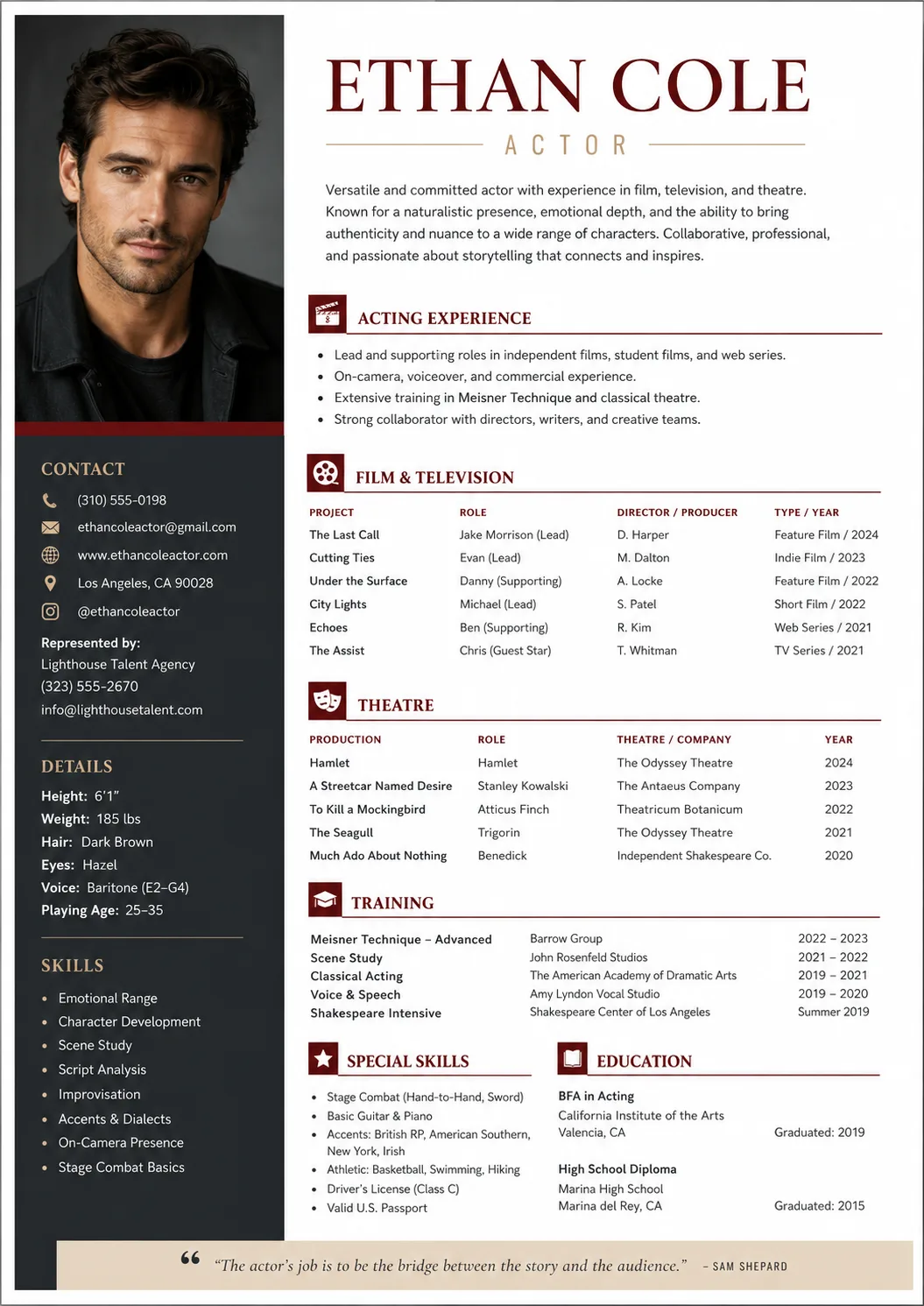
Adaptable resume employment history example

Actor, Independent Film and Theatre Projects

Los Angeles, California | 2021 - Present

  • Performed lead and supporting roles in short films, staged readings, and black box theatre productions with directors across drama, comedy, and character-driven scenes.
  • Prepared sides, monologues, self-tapes, and callback material on short timelines while applying director notes across rehearsals and takes.
  • Used improv, dialect work, movement training, and script analysis to build consistent characters for live and on-camera performances.

Commercial Actor and Voiceover Talent, Freelance

Los Angeles, California | 2019 - 2021

  • Booked principal and supporting roles for local digital ads, product demos, and branded social videos requiring clear timing and natural delivery.
  • Recorded clean voiceover auditions from a home setup and delivered character reads, narration, and short-form commercial scripts.
  • Collaborated with producers, photographers, and casting teams to maintain professional set etiquette, continuity, and quick direction changes.

Actor skills section example: show what you can perform

The actor skills section should reflect real performance ability. It should help a casting director, agent, theatre team, or casting platform see that you can serve the role. Good actor resume skills are not random personality words. They are skills connected to performance: on-camera acting, theatre performance, voiceover, improvisation, self-tape setup, scene study, dialects, accents, singing, dance, stage combat, movement, teleprompter, ADR, horse riding, sports, instruments, or languages.

Keep a longer master list outside your resume, then choose the skills that fit each submission. A good actor resume does not need every skill you have. It needs the skills that match the casting call, production type, and role needs. For example, a commercial actor may highlight teleprompter, natural delivery, product demo, and friendly improv. A theatre actor may highlight voice projection, Shakespeare, movement, singing, and stage combat. A voice actor may highlight home studio, narration, character voice, accents, and clean audio delivery.

Statistical Insight

Casting teams often prioritize skill groups such as:

  • On-camera acting, audition technique, and self-tape setup
  • Theatre performance, voice projection, movement, and stage combat
  • Voiceover, narration, character voice, and home studio recording
  • Dialects, accents, languages, singing, dance, and instruments
  • Improvisation, comedy timing, emotional range, and director collaboration

A strong actor skills section mixes performance skills with special skills that can help casting. Do not list skills you cannot demonstrate. If you list stage combat, be ready to explain the training. If you list dialects, be ready to perform them. If you list singing or dance, name the style when useful. The most useful actor resume skills are usually the ones that also appear in your credits or training. If you list voiceover, show a demo or recording credit. If you list improv, show improv training or performance experience. This makes your skills believable instead of decorative.

Adaptable resume skills section example
  • On-camera acting
  • Scene study
  • Improvisation
  • Self-tape
  • Voiceover
  • Dialects

Training resume example: keep education and workshops easy to find

Training matters on every actor resume because casting teams, agents, and theatre directors want to see how you built your craft. For an entry-level actor resume, training may sit near the top because it is one of the strongest signals of readiness. Include degree programs, conservatories, studios, acting teachers, scene study, on-camera classes, improv, voice, movement, dance, singing, stage combat, audition technique, dialect coaching, and voiceover training when those details help. If you are still training, write the program or expected completion clearly. Do not make the reader guess.

Once you have more acting experience, your credits may lead the page. But training, union status, and special skills still need to be easy to find. This is especially important for theatre roles, musical theatre, voiceover, stunt-adjacent roles, dialect-heavy roles, and agency submissions. Use exact wording for training methods, instructors, workshops, union status, and special skills when possible. A small wording mistake can create confusion, while clear wording helps casting teams confirm that you meet the role requirements.

Adaptable resume education example
  • B.F.A. in Acting, California State University, Fullerton | Fullerton, California | 2019

Acting training and certifications

Casting teams should be able to spot useful training and status details right away. Include acting degrees, conservatory programs, on-camera intensives, improv programs, stage combat certifications, dialect coaching, voiceover training, dance training, singing lessons, movement work, firearms safety for screen if properly trained, or any other credential that supports the role. If the submission asks for union status, place it near the top of the resume or in a clear profile line. If you are SAG-AFTRA eligible, Equity eligible, non-union, or union, say that clearly only when it is accurate.

  • SAG-AFTRA Eligible
  • Unarmed Stage Combat Workshop | 2024

Before submitting, make sure your training wording, union status, special skills, reel link, and representation details match the casting notice. This matters for both casting platforms and human readers. If the project asks for on-camera comedy, stage combat, dialects, voiceover, singing, dance, or self-tape ability, use the exact wording that fits your background. Do not exaggerate. Clear training and special-skill wording builds trust, and trust is one of the most important parts of an actor resume.

Adaptable resume certifications example
  • SAG-AFTRA Eligible
  • Unarmed Stage Combat Workshop | 2024

Bullet upgrade

Weak vs strong actor resume bullets

Use the stronger version as the model: start with a clear performance action, add production context, and include the detail that proves the work mattered. Actor resume bullets should show what you performed, the medium, the role type, the production setting, and the skill that made the credit useful.

Weak

Acted in a play.

Stronger

Performed a supporting role in a 12-show regional theatre run, using scripted scene work, live timing, and consistent blocking under director notes.

The stronger bullet adds role type, production setting, run length, performance method, and collaboration with the director. That is much stronger than saying you acted in a play.

Weak

Did a short film.

Stronger

Played the lead in an independent short film, completed two overnight shoots, handled emotional close-up scenes, and delivered usable takes under a tight production schedule.

This version shows medium, role size, working conditions, emotional range, and set discipline. It gives the casting team a clearer picture of the actor’s readiness.

Weak

Good at accents.

Stronger

Performed character scenes using standard American, Southern, and British RP dialects, with dialect coaching and consistent accent control across rehearsals and takes.

The stronger version names the accents, explains training or coaching, and shows consistency. Special skills are more valuable when they are specific and believable.

Casting keyword bank

Actor resume keywords for casting platforms

Casting platforms, agents, production teams, and theatre hiring teams often search for clear role language. Use these actor resume keywords only when they honestly match your background. Good keywords are not magic words. They are normal casting terms that help the reader understand your fit: on-camera acting, theatre performance, voiceover, commercial acting, improvisation, self-tape, stage combat, dialects, singing, dance, and scene study.

On-camera actingTheatre performanceCommercial actingVoiceoverImprovisationSelf-tapeAudition preparationScene studyStage combatDialects

Use actor resume keywords only when they match your real background. Do not repeat the same phrase in every section. The safest method is to mirror the casting call or job posting language for medium, role type, union status, accents, special skills, training, and production tools, then place those words naturally in your summary, skills, training, and credit descriptions.

Matching submission

Actor cover letter tips

Pair this resume with a short actor cover letter or submission note that explains why you fit the role, what credit or training matters most, and why your look, voice, energy, or skill set matches the project. Do not repeat the whole resume. Use the note to connect one or two resume details to the casting breakdown.

Name the role, medium, genre, casting type, production company, or theatre you are targeting in the first paragraph.

Connect one strong resume example to the role, such as on-camera drama, comedy timing, dialect work, stage combat, voiceover, or live theatre experience.

Explain why your performance range fits the project instead of repeating your actor resume summary.

Final review

Actor resume checklist before submitting

Before you send your actor resume, review it against the casting call, audition notice, agent request, or production brief one last time. Look for missing reel links, role type, union status, training, accent details, special skills, self-tape readiness, and contact details. Small changes can make the resume easier to scan and more relevant.

  • Did you name the exact acting focus, such as screen actor, stage actor, commercial actor, voice actor, or musical theatre performer?
  • Did you include your reel, portfolio, casting profile, representation, or union status if it helps the submission?
  • Did your actor resume summary match the casting call, agency submission, theatre audition, or production need instead of sounding generic?
  • Did you include honest actor resume keywords from the role, such as on-camera acting, improvisation, voiceover, stage combat, dialects, or self-tape?
  • Did your credit bullets show medium, role type, production name, director, venue, festival, campaign, or performance context?
  • Did you mention tools or platforms such as self-tape setup, casting profiles, teleprompter, ADR, home studio, or editing basics only if you use them?
  • Is the layout simple enough for casting teams and production staff to scan in less than one minute?
  • Did you save the resume as a PDF unless the casting notice, theatre, agent, or production portal asks for another file type?

Before submitting, read the casting notice or audition breakdown one more time and compare it with your resume. Look for repeated words about age range, performance style, medium, accent, movement, voice, comedy, drama, self-tape, union status, and special skills. A strong actor resume example is not copied word for word. It is tailored so the casting team can see why your training, credits, and skills fit this exact role.

Before You Start Writing

Key takeaways

  • Tailor each actor resume to the casting call, medium, production type, agency, or theatre submission.
  • Use a clean, casting-friendly layout that is easy to scan.
  • Write a summary that shows performance range instead of generic passion.
  • Use short films, student films, theatre, improv, voiceover, workshops, or self-tape projects as proof when you are early in your career.
  • Balance acting skills, training, credits, reel links, representation, and special skills.
  • Make union status, training, special skills, reel links, and casting profiles easy to verify.

Ready to build

Build your actor resume with the same structure

Start with this actor resume example, then build a matching cover letter or submission note that speaks directly to the casting call, agency, theatre, production company, or creative role you want. The builder can help you turn the structure into a clean resume faster, but your real credits, training, and reel are what make the application strong.