Resume ExampleSport & FitnessMid Level

Athletic Trainer Resume Example: Sample & Writing Guide

Use this athletic trainer resume example to write a clear, ATS-friendly resume that shows injury evaluation, emergency care, rehabilitation, taping, documentation, and athlete safety.

Experience Level
Mid Level
Category
Sport & Fitness
Reader Rating
4.7 / 5
  • Tailor every athletic trainer resume to the setting, sport coverage, patient group, and posting.
  • Use a clean layout that works for ATS tools, clinic managers, athletic directors, and sports medicine teams.
  • Write a summary that shows clinical value, athlete safety, certification status, and documentation strength.
Resume Example (Text Format)

Riley Bennett

Athletic Trainer

riley.bennett@email.com | (303) 555-1948 | Denver, Colorado | linkedin.com/in/riley-bennett-atc

Profile

Certified athletic trainer with 5+ years of experience supporting high school and collegiate athletes through injury evaluation, emergency care, taping, rehabilitation programs, return-to-play communication, and EHR documentation. Skilled in sideline coverage, concussion protocols, athlete education, and collaboration with physicians, coaches, and physical therapists.

Work Experience

Athletic Trainer, Mountain View Sports Medicine

Denver, Colorado | Aug 2021 - Present

  • Provide athletic training coverage for football, soccer, basketball, track, and volleyball programs, including practice preparation and game-day sideline care.
  • Evaluate acute and overuse injuries, document treatment notes, and coordinate referrals with the supervising physician and physical therapy team.
  • Build and progress rehabilitation plans for ankle sprains, knee pain, shoulder instability, and return-to-play conditioning.

Assistant Athletic Trainer, Front Range High School

Aurora, Colorado | Jun 2018 - Jul 2021

  • Prepared taping stations, emergency equipment, hydration support, and field kits before practices, games, and tournament coverage.
  • Assisted with concussion baseline records, injury follow-up notes, parent updates, and return-to-play communication.
  • Educated student-athletes on recovery habits, warm-up routines, brace use, hydration, and early injury reporting.

Education

  • M.S. in Athletic Training, University of Northern Colorado | Greeley, Colorado | 2018

Languages

  • English

Certifications

  • BOC Certified Athletic Trainer (ATC) | 2018
  • Colorado Athletic Trainer License; CPR/AED Certified

Skills

  • Injury evaluation
  • Emergency care
  • Taping and bracing
  • Rehabilitation programs
  • Concussion management
  • EHR documentation

A strong athletic trainer resume should show that you can evaluate injuries, respond to emergencies, support rehabilitation, document care, educate athletes, and work with physicians, coaches, and other healthcare staff. This is true whether you are writing an entry-level athletic trainer resume, a mid-career athletic trainer resume, or a senior athletic trainer resume. Employers are not only looking for someone who likes sports. They are looking for someone who can protect athlete health, follow state practice rules, manage sideline pressure, and communicate clearly about injury status and return-to-play decisions. That is why this athletic trainer resume example focuses on proof. It shows how to turn clinical rotations, internships, athletic event coverage, outpatient clinic work, and full-time athletic training roles into clear resume content.

Quick breakdown

Why this athletic trainer resume works

1

It makes the candidate easy to understand quickly: where they have worked, who they support, and which athletic training duties they can handle safely.

2

It uses athletic trainer resume keywords naturally, so the resume can work for ATS tools and still sound credible to sports medicine, clinic, and school hiring teams.

3

It turns daily athletic training work into proof by showing injury evaluation, treatment plans, taping, rehabilitation, event coverage, documentation, and collaboration with physicians or coaches.

4

It keeps ATC certification, state licensure, CPR/AED, education, clinical skills, and real patient-care actions easy to find instead of hiding them behind generic sports terms.

Fast template guide

What to copy from this athletic trainer resume example

Do not copy the resume word for word. Copy the structure, the section order, and the level of detail. A strong athletic trainer resume example teaches you what to show: injury evaluation, emergency response, taping, rehabilitation support, event coverage, documentation, athlete education, physician collaboration, and certification status. Your own version should use your real clinical placements, teams, sports, settings, systems, and patient-care results.

A clear header and summary that name the athletic training setting, certification status, patient group, and strongest sports medicine skills.

Experience bullets that show injury evaluation, emergency care, taping, bracing, rehabilitation support, return-to-play communication, and documentation.

Clinical and sideline work written with real context, such as teams covered, athlete volume, event coverage, physician collaboration, and injury prevention duties.

Licensure, BOC certification, CPR/AED, first aid, concussion training, and continuing education details placed where employers can verify them quickly.

Athletic trainer skills such as orthopedic assessment, therapeutic exercise, modality use, EHR documentation, emergency action plans, and athlete education written in plain healthcare language.

Build the right structure

Athletic trainer resume sections to include

A strong athletic trainer resume should include the sections employers expect to scan quickly, plus optional sections that help you prove readiness when your experience is still growing. The goal is not to add every possible section. The goal is to build a page that lets an employer understand your sports medicine fit, verify your education and credentials, and see the athlete-care work you can already do.

Must-have sections

  • Contact information
  • Athletic trainer resume summary or objective
  • Athletic training, clinical, sideline, or sports medicine experience
  • Education
  • BOC certification, state licensure, CPR/AED, or eligibility
  • Athletic trainer skills

Optional sections that strengthen the resume

  • Clinical rotations
  • Athletic training internships
  • Team or event coverage
  • Rehabilitation experience
  • Emergency care training
  • Concussion management
  • Relevant coursework
  • Continuing education
  • Sports medicine technology
  • Languages
  • Professional memberships

An athletic trainer resume should not read like a general fitness resume. Employers need to see healthcare-level proof: injury evaluation, emergency response, rehabilitation support, documentation, athlete education, physician collaboration, and certification or licensure status. For a new athletic trainer, clinical rotations, internships, event coverage, lab work, and supervised patient care can all count when you write them with clear sports medicine details. For an experienced athletic trainer, the resume should move faster into independent coverage, treatment planning, injury prevention, return-to-play communication, EHR documentation, and leadership across teams or clinics. The best athletic trainer resume example keeps these sections simple because hiring teams need to confirm safety, credentials, and practical patient-care skills quickly.

Smarter ordering

Best athletic trainer resume section order

The best section order depends on your experience level. A new athletic trainer should not use the same structure as a senior candidate with years of independent coverage and leadership. Place your strongest proof where the reader will see it first. For a new athletic trainer, that may be education, clinical rotations, supervised event coverage, and certification eligibility. For an experienced athletic trainer, it is usually injury evaluation, rehabilitation, documentation, event coverage, and athlete safety results.

Entry-level athletic trainer

  1. Contact information
  2. Athletic trainer resume objective or short summary
  3. Education and certification eligibility
  4. Clinical rotations, internships, event coverage, or supervised athletic training experience
  5. Athletic trainer skills
  6. Relevant coursework, labs, volunteer coverage, or sports medicine projects
  7. CPR/AED, first aid, concussion training, or continuing education

Experienced athletic trainer

  1. Contact information
  2. Athletic trainer resume summary
  3. Athletic training experience
  4. BOC certification, state licensure, and emergency care credentials
  5. Athletic trainer skills
  6. Education
  7. Event coverage, team leadership, injury prevention, or clinical achievements

Career-change athletic trainer

  1. Contact information
  2. Transferable athletic trainer resume summary
  3. Sports medicine, healthcare, coaching, rehabilitation, or clinic experience
  4. Transferable experience
  5. Education and certification pathway
  6. Athletic trainer skills
  7. Volunteer coverage, observation hours, CPR/AED, or clinical projects

Put the strongest proof near the top. A new athletic trainer can lead with education, certification eligibility, clinical rotations, and supervised patient-care experience because those details prove readiness. An experienced athletic trainer should lead with real coverage, injury evaluation, treatment plans, rehabilitation progress, documentation, and athlete safety outcomes. A career-change candidate should connect past work to athletic training duties such as patient communication, coaching, emergency response, exercise instruction, documentation, anatomy knowledge, or healthcare coordination, then show the certification pathway clearly.

Choose an athletic trainer resume example by experience level

Use this template

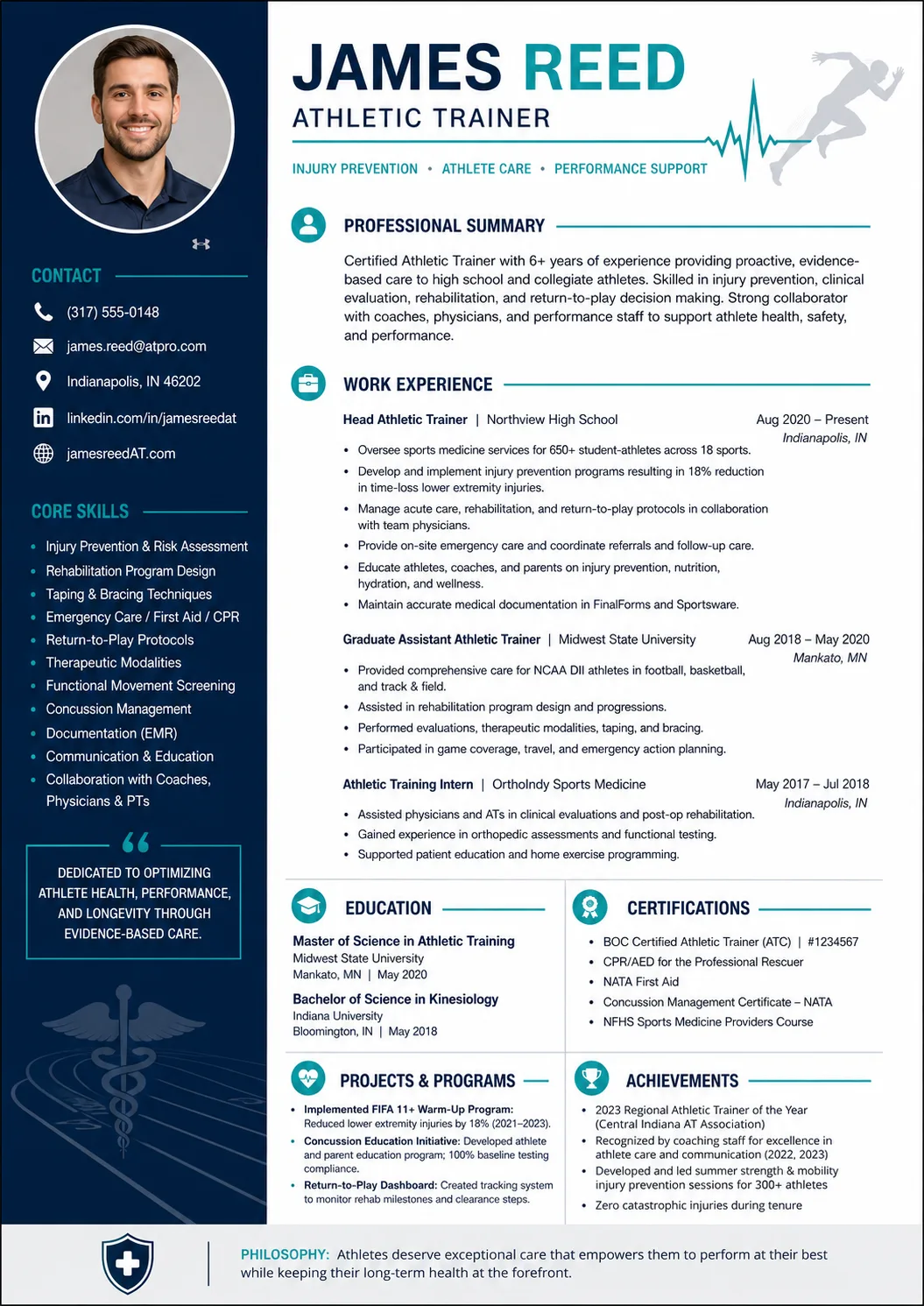
Use this mid-career athletic trainer example to study how independent coverage, injury evaluation, rehabilitation planning, documentation, and communication with coaches and physicians should lead the page.

Athletic Trainer Resume Playbook

A strong athletic trainer resume should show clinical judgment, athlete safety, and clear certification status in a way an employer can understand quickly.

An athletic trainer hiring team does not read a resume like a general fitness resume. A sports medicine director, athletic director, orthopedic clinic manager, physician group, school district, college program, or industrial wellness employer is usually scanning for very specific proof. They want to know the setting you have supported, the athletes or patients you have worked with, the injuries you can evaluate, the emergency care you can provide, and whether your certification or state license is clear. They also want to see if you can document care, communicate with coaches and physicians, support rehabilitation, educate athletes, and make safe return-to-play decisions. A good athletic trainer resume example should make all of that easy to see without forcing the reader to dig.

That is why this guide focuses on plain proof, not fancy sports language. You do not need dramatic wording to write a strong athletic trainer resume. You need specific clinical details. Clinical rotations, internships, game coverage, practice coverage, outpatient rehabilitation, orthopedic clinic support, team travel, emergency drills, and full-time athletic training can all become strong resume evidence when you connect them to injury evaluation, emergency care, taping, bracing, rehabilitation, documentation, athlete education, and physician collaboration. The target keyword for this page is athletic trainer resume example, but the content is written to help a real person build a better resume, not just to repeat a keyword.

  • Turn clinical rotations, internships, event coverage, and sports medicine support into strong resume proof.
  • Write an athletic trainer resume summary that sounds specific, safe, and clinically useful.
  • Use athletic trainer resume keywords for ATS without stuffing the page.
  • Place education, ATC certification, state licensure, CPR/AED, and continuing education where employers can find them quickly.

How to write an athletic trainer resume

A strong athletic trainer resume should make three things clear within a few seconds: what setting you support, what patient-care skills you bring, and why the employer can trust you with athlete safety. That means your resume should show injury evaluation, emergency care, taping, bracing, therapeutic exercise, rehabilitation support, documentation, communication, and certification status. An athletic trainer resume example that only lists duties is weak because many athletic trainers share similar duties. The stronger version explains how you evaluated injuries, prepared emergency equipment, supported rehabilitation progress, documented treatment, educated athletes, and coordinated care with physicians or coaches.

  1. Read the job posting and highlight the setting, patient group, certification, license, emergency care needs, documentation systems, and sport coverage.
  2. Match your summary, skills, and experience bullets to the athletic training work the employer cares about most, as long as the match is honest.
  3. Use a clean format with standard headings so ATS tools and sports medicine hiring teams can scan the resume quickly.

What employers look for first

Most employers look for proof that you can protect athlete health in real settings. They want to see injury evaluation, emergency preparedness, taping and bracing, rehabilitation support, athlete education, documentation, and communication with physicians, coaches, parents, and administrators. In simple terms, they want to know that you can respond under pressure, make safe observations within your scope, record care accurately, and help athletes return safely. For an athletic trainer resume, this proof should appear in the summary, skills, experience bullets, education, and certifications. Do not leave your best sports medicine details trapped inside one section. Spread them naturally across the page so both ATS tools and human readers can see them.

High-priority proof points

  • Injury evaluation and immediate care
  • Emergency action plans, CPR/AED, and first aid
  • Taping, bracing, therapeutic exercise, and rehabilitation support
  • Concussion management, return-to-play communication, and athlete education
  • BOC certification, ATC credential, state licensure, or eligibility

Good proof for new athletic trainers

  • Clinical rotations and internships
  • High school, college, club, camp, or tournament coverage
  • Outpatient rehabilitation or orthopedic clinic support
  • EHR documentation, injury tracking, and treatment notes
  • Emergency equipment preparation and supervised sideline care

Writing for both ATS and human readers

Many schools, clinics, hospitals, teams, and sports medicine organizations collect applications through online systems. Those systems may parse your resume, and the people reading the resume may also search for clear terms from the job posting. This is why an ATS-friendly athletic trainer resume should use normal sports medicine language: injury evaluation, emergency care, CPR/AED, ATC, BOC certification, state licensure, rehabilitation programs, therapeutic exercise, taping and bracing, concussion management, return-to-play protocols, EHR documentation, physician collaboration, and athlete education. The goal is not to trick the system. The goal is to describe your real background with the same words employers use when they hire athletic trainers.

Statistical Insight

If your resume says only that you are hard-working, passionate about sports, or a strong communicator, the reader still does not know what you can do. A better athletic trainer resume shows the work behind those qualities. Instead of saying you care about athletes, show how you evaluated injuries, prepared emergency equipment, documented treatment notes, supported a rehabilitation plan, or communicated return-to-play updates. Instead of saying you are organized, show injury logs, treatment schedules, supply management, medical kits, EHR notes, or event coverage preparation. The best athletic trainer resume example turns soft claims into clinical actions.

Start with one strong master resume, then adjust it for each employer. A high school athletic trainer resume, college athletic trainer resume, clinic outreach resume, industrial athletic trainer resume, and professional team resume should not all sound the same. The core structure can stay similar, but the wording should change based on setting, patient population, sport coverage, documentation needs, and healthcare team. Read the posting first, mark the repeated terms, and decide which parts of your background match honestly. Then update your summary, skills, and bullets so the employer sees fit right away.

  1. Use the posting wording for setting, certification, licensure, emergency care, documentation, rehabilitation, and sports coverage when it matches your experience.
  2. Use action words such as evaluated, treated, documented, taped, braced, educated, coordinated, monitored, progressed, referred, and communicated.

A good athletic trainer resume is not a long list of every treatment, practice, or game you have ever covered. It is a focused document that helps an employer answer one question: can this person support safe, organized, and well-documented athlete care in this setting? Keep the resume clear, use action words, include numbers where they are true, and connect your work to athlete safety. For example, team count, sport type, athlete volume, injury type, documentation system, rehabilitation phase, tournament coverage, or physician communication routine can all make a bullet stronger. These details are simple, but they make the resume feel real.

Choosing the best athletic trainer resume format and template

The best athletic trainer resume format is clean, simple, and easy to read. Athletic training is hands-on healthcare, but the resume still needs a professional structure. An employer may have many applications, so your layout should help the reader find your summary, experience, education, certifications, and skills without effort. For most athletic trainers, reverse-chronological order is the safest choice because it highlights recent clinical and coverage work first. If you are a new athletic trainer, you can still use that format while placing education, clinical rotations, internships, event coverage, or certification eligibility higher so your strongest proof is not buried.

For the ATS

  • Use standard headings such as Summary, Experience, Education, Certifications, and Skills.
  • Save the final resume as a PDF when the employer allows it, or follow the portal instructions exactly.
  • Spell out important credentials and tools such as BOC Certified Athletic Trainer, ATC, state license, CPR/AED, EHR, and return-to-play at least once.

For sports medicine hiring teams

  • Leave enough white space so the page does not feel crowded.
  • Keep dates, employers, settings, job titles, teams, and credentials easy to find.
  • Choose a professional template that supports clinical proof instead of distracting from it.
Do

Use reverse-chronological order when you have athletic training experience, because your most recent patient-care work usually matters most.

Keep the layout straightforward so a reader can find your certification, licensure, setting, sports covered, and strongest experience quickly.

Don't

Do not use tables, charts, text boxes, heavy graphics, or unusual fonts that can make the resume harder to read.

Do not stretch an athletic trainer resume beyond two pages unless the employer asks for a full clinical CV, academic CV, or detailed professional portfolio.

Picking the right athletic trainer resume template

Most athletic trainers move faster with a tested resume template. Pick one that keeps the summary near the top, gives enough room for clinical bullets, and makes credentials easy to spot. Avoid templates that use tiny fonts, heavy icons, complex columns, or design elements that take attention away from athlete-care proof. An athletic trainer resume template should support the content, not compete with it. The best template for an athletic trainer resume example is usually modern, simple, and ATS-friendly, with clear headings and enough white space for quick scanning.

Browse our resume templates or open the resume builder when you are ready to turn this athletic trainer resume example into your own finished draft. Start with the structure, then replace every sentence with your real clinical experience, setting, certification details, licensure status, and athletic trainer skills.

Athletic trainer resume summary example: show clinical fit fast

The athletic trainer resume summary is the short paragraph at the top of the page. It should show clinical fit fast. A strong summary names the role or experience level, the setting or patient group, and the athletic training strengths that matter most for the job. It can also mention certification, licensure, emergency care, documentation, rehabilitation, concussion management, or years of experience when those details help. Keep it short enough to scan, but specific enough that it does not sound like every other athletic trainer resume.

The main goals of the summary

  • Name the setting, athlete group, clinical environment, or sports coverage you fit best.
  • Highlight the athletic training strengths that matter most for the job.

Keep the tone professional and specific. Strong athletic trainer resume summaries use real sports medicine language, not broad claims about loving athletics or working well with people. A new athletic trainer might lead with clinical rotations, supervised event coverage, taping, emergency preparation, and documentation. A mid-career athletic trainer might lead with event coverage, injury evaluation, rehabilitation programs, concussion management, and physician collaboration. A senior athletic trainer might lead with sports medicine leadership, emergency action planning, staff mentoring, return-to-play workflows, and athlete safety systems. The summary should match the level of the candidate.

  • For a new athletic trainer, mention clinical rotations, internships, event coverage, taping, emergency preparation, or documentation support.
  • For an experienced athletic trainer, mention years of experience, setting, sports covered, injury evaluation, rehabilitation, and collaboration with healthcare staff.
  • For a career changer, connect past healthcare, coaching, exercise science, rehabilitation, or patient communication work to athletic training.
Expert Tip

Skip empty phrases like “sports-focused professional,” “hard worker,” or “great with athletes.” Employers expect energy, care, and communication. Use the limited space to explain what you do in the athletic training room, clinic, or sideline setting. A better summary says that you are a certified athletic trainer with high school coverage experience in injury evaluation, taping, concussion protocols, EHR documentation, and return-to-play communication. This kind of wording helps both ATS tools and real hiring teams.

A simple formula works well: role or experience level + setting or athlete group + top clinical skills + athlete safety value. For example, an entry-level athletic trainer resume summary can say that the candidate has supervised clinical rotation experience in high school athletics and outpatient sports medicine, with skills in taping, emergency equipment preparation, therapeutic exercise, and documentation. A senior athletic trainer resume summary can mention sports medicine leadership, emergency action plans, staff mentoring, rehabilitation oversight, and physician collaboration. The formula keeps the summary clear without sounding robotic.

When the posting uses clear language, mirror it. If the job asks for injury evaluation, write injury evaluation instead of sports assessment. If it asks for return-to-play protocols, use that exact phrase when it matches your work. If it asks for EHR documentation, concussion management, CPR/AED, orthopedic clinic support, or team coverage, include those terms only if you can support them with real experience. This is how you write for ATS without stuffing keywords. The resume still sounds natural because the words are connected to your real athletic training story.

Adaptable resume summary example

Certified athletic trainer with 5+ years of experience supporting high school and collegiate athletes through injury evaluation, emergency care, taping, rehabilitation programs, return-to-play communication, and EHR documentation. Skilled in sideline coverage, concussion protocols, athlete education, and collaboration with physicians, coaches, and physical therapists.

Athletic trainer experience resume example: prove patient-care work clearly

The experience section is where your athletic trainer resume becomes believable. It should prove that you can support athletes and patients in real settings. For new athletic trainers, this can include clinical rotations, internships, tournament coverage, outpatient clinic support, team travel, volunteer event coverage, or supervised athletic training room work. For experienced athletic trainers, it should show stronger independent coverage, injury evaluation, rehabilitation planning, documentation, emergency response, and physician communication. For senior athletic trainers, it should also show leadership, staff mentoring, emergency action planning, scheduling, program improvement, or coordination across multiple teams. The title matters, but the patient-care work behind the title matters more.

Statistical Insight

Employers care about the work behind the title. If you evaluated injuries, prepared emergency equipment, taped ankles, fitted braces, progressed rehabilitation exercises, documented care, educated athletes, updated coaches, or referred athletes for medical evaluation, that experience counts. The key is to write it clearly. A bullet like “helped athletes recover” is too thin. A stronger bullet says “progressed ankle sprain rehabilitation for student-athletes using mobility work, strengthening exercises, balance drills, taping support, and return-to-play communication.” The second version gives injury type, treatment approach, and communication context.

Use reverse-chronological order so your most recent and most relevant experience appears first. For each role, include the position title, employer or clinical site, location, dates, and short bullets. Start each bullet with an athletic training action such as evaluated, treated, taped, braced, documented, educated, monitored, referred, progressed, coordinated, prepared, covered, or communicated. Then add the care context. Good context includes setting, sport, patient group, injury type, documentation system, rehab phase, event size, emergency equipment, physician communication, or return-to-play goal. Numbers can help, but only use them when they are true.

  • Position title
  • School, clinic, team, hospital, or organization name
  • Location and dates
  • Sports, settings, athletes, patients, or clinical groups you supported
  • Short bullets that show what you evaluated, treated, documented, educated, or improved

The best athletic trainer resume bullets use clear clinical actions. Instead of saying helped athletes, explain how you helped them. Instead of saying covered games, explain the preparation, emergency care, taping, sideline response, and documentation you handled. Instead of saying improved recovery, explain the therapeutic exercise, treatment progression, communication, or return-to-play process that supported progress. An athletic trainer resume example should not make the candidate sound bigger than the truth. It should make the truth easy to understand. That is what makes the experience section credible.

Adaptable resume employment history example

Athletic Trainer, Mountain View Sports Medicine

Denver, Colorado | Aug 2021 - Present

  • Provide athletic training coverage for football, soccer, basketball, track, and volleyball programs, including practice preparation and game-day sideline care.
  • Evaluate acute and overuse injuries, document treatment notes, and coordinate referrals with the supervising physician and physical therapy team.
  • Build and progress rehabilitation plans for ankle sprains, knee pain, shoulder instability, and return-to-play conditioning.

Assistant Athletic Trainer, Front Range High School

Aurora, Colorado | Jun 2018 - Jul 2021

  • Prepared taping stations, emergency equipment, hydration support, and field kits before practices, games, and tournament coverage.
  • Assisted with concussion baseline records, injury follow-up notes, parent updates, and return-to-play communication.
  • Educated student-athletes on recovery habits, warm-up routines, brace use, hydration, and early injury reporting.

Athletic trainer skills section example: show what you do every day

The athletic trainer skills section should reflect daily sports medicine work. It should help a clinic manager, athletic director, sports medicine recruiter, or ATS tool see that you can evaluate injuries, respond to emergencies, support rehabilitation, document care, communicate with athletes and staff, and promote safe participation. Good athletic trainer resume skills are not random personality words. They are skills connected to actual care: injury evaluation, emergency action plans, CPR/AED, taping and bracing, therapeutic exercise, concussion management, rehabilitation progression, return-to-play communication, EHR documentation, athlete education, physician collaboration, and equipment preparation.

Keep a longer master list outside your resume, then choose the skills that fit each job posting. A good athletic trainer resume does not need every skill you have. It needs the skills that match the setting, sports covered, patient population, and care needs in the job description. For example, a high school athletic trainer may highlight sideline coverage, emergency care, taping, concussion protocols, parent communication, and coach updates. A college athletic trainer may highlight team travel, athlete load management, rehabilitation progression, physician clinics, documentation, and return-to-play decisions. A clinic outreach athletic trainer may highlight orthopedic support, patient education, injury tracking, referral coordination, and customer service.

Statistical Insight

Employers often prioritize skill groups such as:

  • Injury evaluation, immediate care, and emergency action plans
  • Taping, bracing, therapeutic exercise, and rehabilitation support
  • Concussion management, return-to-play protocols, and athlete education
  • EHR documentation, injury tracking, treatment notes, and referral coordination
  • Communication with athletes, coaches, parents, physicians, physical therapists, and administrators

A strong athletic trainer skills section mixes clinical skills with communication, documentation, and safety skills. Do not separate skills in a way that makes the page confusing. Group them if your template allows it, or list the most important ones first. The most useful athletic trainer skills are usually the ones that also appear in your experience bullets. If you list concussion management, show a bullet where you supported concussion documentation or return-to-play communication. If you list EHR documentation, show a bullet where you completed treatment notes or injury logs. This makes your skills believable instead of decorative.

Adaptable resume skills section example
  • Injury evaluation
  • Emergency care
  • Taping and bracing
  • Rehabilitation programs
  • Concussion management
  • EHR documentation

Education resume example: keep your degree and credentials easy to find

Education matters on every athletic trainer resume because employers need to verify your accredited athletic training program, certification path, clinical preparation, and licensure readiness. For an entry-level athletic trainer resume, education may sit near the top because it is one of the strongest signals of readiness. Include your degree, university, location, graduation date, athletic training program, clinical rotations, relevant coursework, honors, or field placement when those details help. If you are still completing certification or waiting on licensure, write the expected date or eligibility clearly. Do not make the employer guess.

Once you have more athletic training experience, your patient-care results may lead the page. But education, certification, and license details still need to be easy to find. This is especially important for schools, colleges, hospitals, orthopedic clinics, industrial settings, and sports medicine outreach roles. Use exact wording for the credential, license, state, and certification status when possible. A small wording mistake can create confusion, while clear wording helps both ATS tools and hiring teams confirm that you meet the role requirements.

Adaptable resume education example
  • M.S. in Athletic Training, University of Northern Colorado | Greeley, Colorado | 2018

Athletic trainer certifications and licensure

Employers should be able to spot your athletic training credentials right away. Include BOC certification, ATC credential, state athletic trainer license, CPR/AED, first aid, emergency cardiac care, concussion training, bloodborne pathogens training, or any other certification that supports the job. If the role requires a certain license or credential, place it near the top of the resume or in a dedicated certifications section. If your certification or license is pending, eligible, or in progress, say that clearly and include the expected completion date when you have one.

  • BOC Certified Athletic Trainer (ATC) | 2018
  • Colorado Athletic Trainer License; CPR/AED Certified

Before applying, make sure your credential wording, state license, certification status, and emergency care training match the posting. This matters for both ATS tools and human readers. If the employer asks for ATC, BOC certification, licensed athletic trainer, CPR/AED, concussion training, emergency cardiac care, or state licensure, use the exact wording that fits your background. Do not exaggerate. Clear credential wording builds trust, and trust is one of the most important parts of an athletic trainer resume.

Adaptable resume certifications example
  • BOC Certified Athletic Trainer (ATC) | 2018
  • Colorado Athletic Trainer License; CPR/AED Certified

Bullet upgrade

Weak vs strong athletic trainer resume bullets

Use the stronger version as the model: start with a clear clinical action, add sports medicine context, and include the detail or outcome that proves the work mattered. Athletic trainer resume bullets should show what you evaluated, who you supported, how you documented care, how you helped rehabilitation progress, and how your work supported safer participation.

Weak

Helped athletes with injuries.

Stronger

Evaluated acute ankle, knee, and shoulder injuries during practices and games, documented findings in the injury tracking system, and coordinated follow-up with the team physician when needed.

The stronger bullet names the injury types, setting, documentation, and physician collaboration. That is much stronger than saying you helped athletes.

Weak

Provided treatment and rehab.

Stronger

Built and progressed rehabilitation plans for post-sprain and overuse injuries using therapeutic exercise, mobility work, taping, and return-to-play communication with coaches.

This version shows treatment skills, rehab progression, modalities, and communication. It gives the employer a clearer picture of safe athletic training practice.

Weak

Worked at sports events.

Stronger

Covered football, soccer, basketball, and track events by preparing emergency equipment, performing pre-event taping, responding to sideline injuries, and completing post-event documentation.

The stronger version explains what event coverage included and why it mattered. Athletic event coverage is more valuable when it is tied to preparation, response, and documentation.

ATS keyword bank

Athletic trainer resume keywords for ATS

Schools, clinics, hospitals, teams, and applicant tracking systems often scan for exact role language. Use these athletic trainer resume keywords only when they honestly match your background. Good keywords are not magic words. They are normal sports medicine terms that help the employer understand your fit: injury evaluation, emergency care, rehabilitation programs, taping and bracing, concussion management, return-to-play protocols, CPR/AED, EHR documentation, athlete education, and ATC certification.

Injury evaluationEmergency careRehabilitation programsTaping and bracingConcussion managementReturn-to-play protocolsCPR/AEDEHR documentationAthlete educationATC certification

Use athletic trainer resume keywords only when they match your real background. Do not stuff the page with the same phrase again and again. The safest method is to mirror the posting language for setting, patient population, certification, licensure, emergency care, rehabilitation, documentation, and sports medicine tools, then place those words naturally in your summary, skills, certifications, and experience bullets.

Matching application

Athletic trainer cover letter tips

Pair this resume with a short athletic trainer cover letter that explains why you fit the employer, what athlete-care proof matters most, and why your clinical style fits the setting. Do not repeat the whole resume. Use the cover letter to connect one or two resume details to the job’s safety, coverage, and documentation needs.

Name the setting, sport coverage, patient population, or clinic type you are targeting in the first paragraph.

Connect one strong resume example to injury evaluation, emergency care, rehabilitation, documentation, or return-to-play communication.

Explain why your athletic training style fits the employer instead of repeating your resume summary.

Final review

Athletic trainer resume checklist before applying

Before you send your athletic trainer resume, review it against the job posting one last time. Look for missing setting terms, license wording, certification language, sport coverage, emergency care needs, documentation systems, and physician collaboration details. Small changes can make the resume easier to read and more relevant.

  • Did you name the exact setting, such as high school athletics, college athletics, clinic outreach, orthopedic clinic, industrial sports medicine, performing arts, or professional sports?
  • Did you list BOC certification, ATC credential, state licensure, CPR/AED, first aid, or certification eligibility in clear words?
  • Did your athletic trainer resume summary match the posting instead of sounding like a general fitness profile?
  • Did you include honest ATS keywords from the posting, such as injury evaluation, rehabilitation, emergency care, taping, bracing, or EHR documentation?
  • Did your experience bullets show patient-care actions, athlete safety, physician collaboration, event coverage, documentation, and return-to-play communication?
  • Did you mention tools or systems such as EHR software, injury tracking systems, modality equipment, concussion testing platforms, or scheduling tools only if you use them?
  • Is the layout simple enough for an ATS, athletic director, clinic manager, sports medicine director, or HR recruiter to scan quickly?
  • Did you save the resume as a PDF unless the employer, hospital, school district, or application portal asks for another file type?

Before applying, read the athletic trainer job posting one more time and compare it with your resume. Look for repeated words about certification, licensure, emergency care, injury evaluation, rehabilitation, sport coverage, documentation, physician collaboration, concussion management, and patient population. A strong athletic trainer resume example is not copied word for word. It is tailored so the employer can see why your clinical training, sideline experience, and safety judgment fit this exact role.

Before You Start Writing

Key takeaways

  • Tailor each athletic trainer resume to the setting, patient group, sport coverage, and posting.
  • Use a clean, ATS-friendly layout that is easy to scan.
  • Write a summary that shows clinical value instead of generic interest in sports.
  • Use clinical rotations, internships, event coverage, or sports medicine support work as proof when you are early in your career.
  • Balance clinical skills, communication skills, documentation, athlete safety, and emergency response.
  • Make education, ATC certification, state licensure, CPR/AED, and continuing education easy to verify.

Ready to build

Build your athletic trainer resume with the same structure

Start with this athletic trainer resume example, then build a matching cover letter that speaks directly to the school, clinic, team, college program, industrial site, or sports medicine opening you want. The builder can help you turn the structure into a clean resume faster, but your real clinical proof is what makes the application strong.