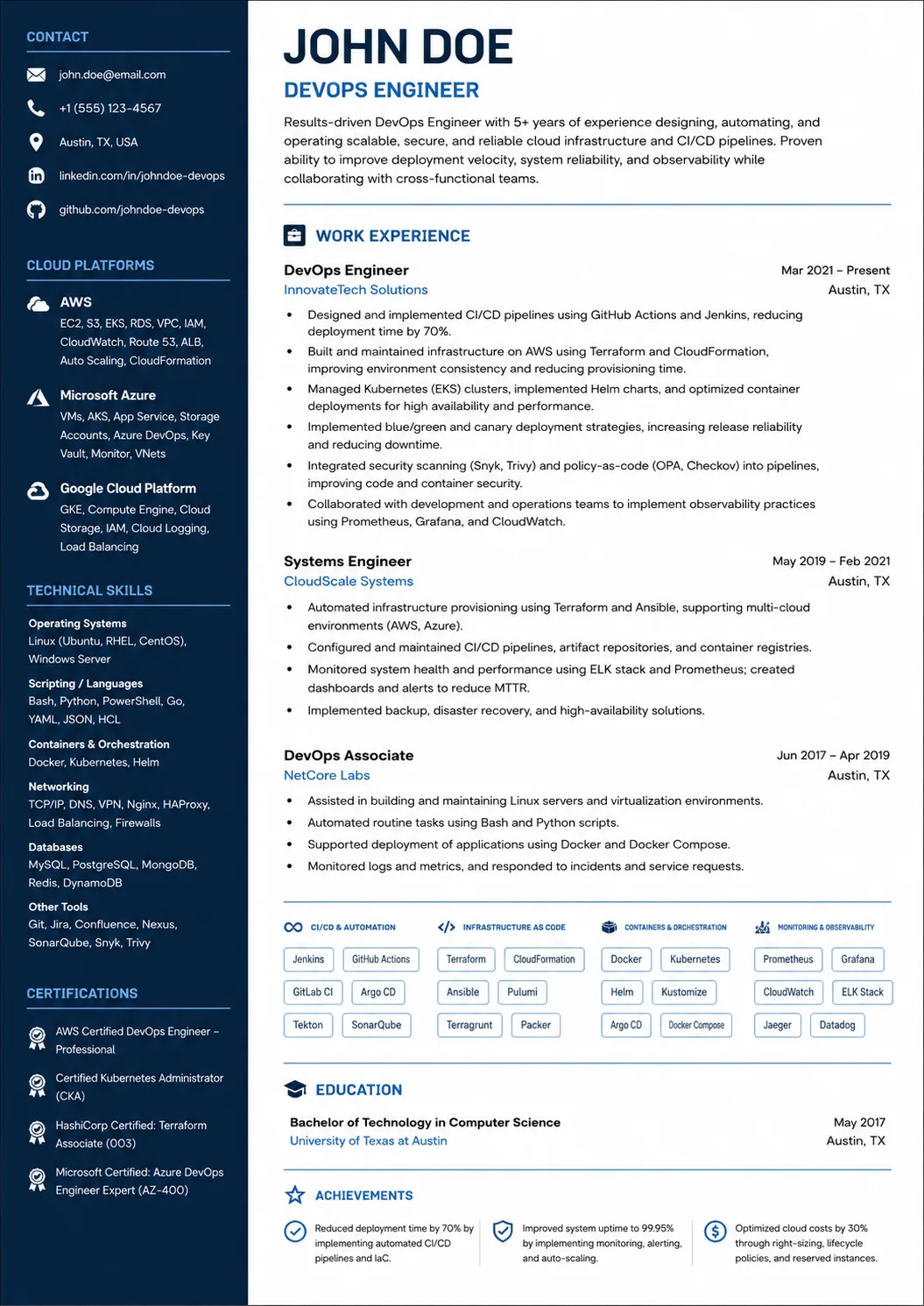
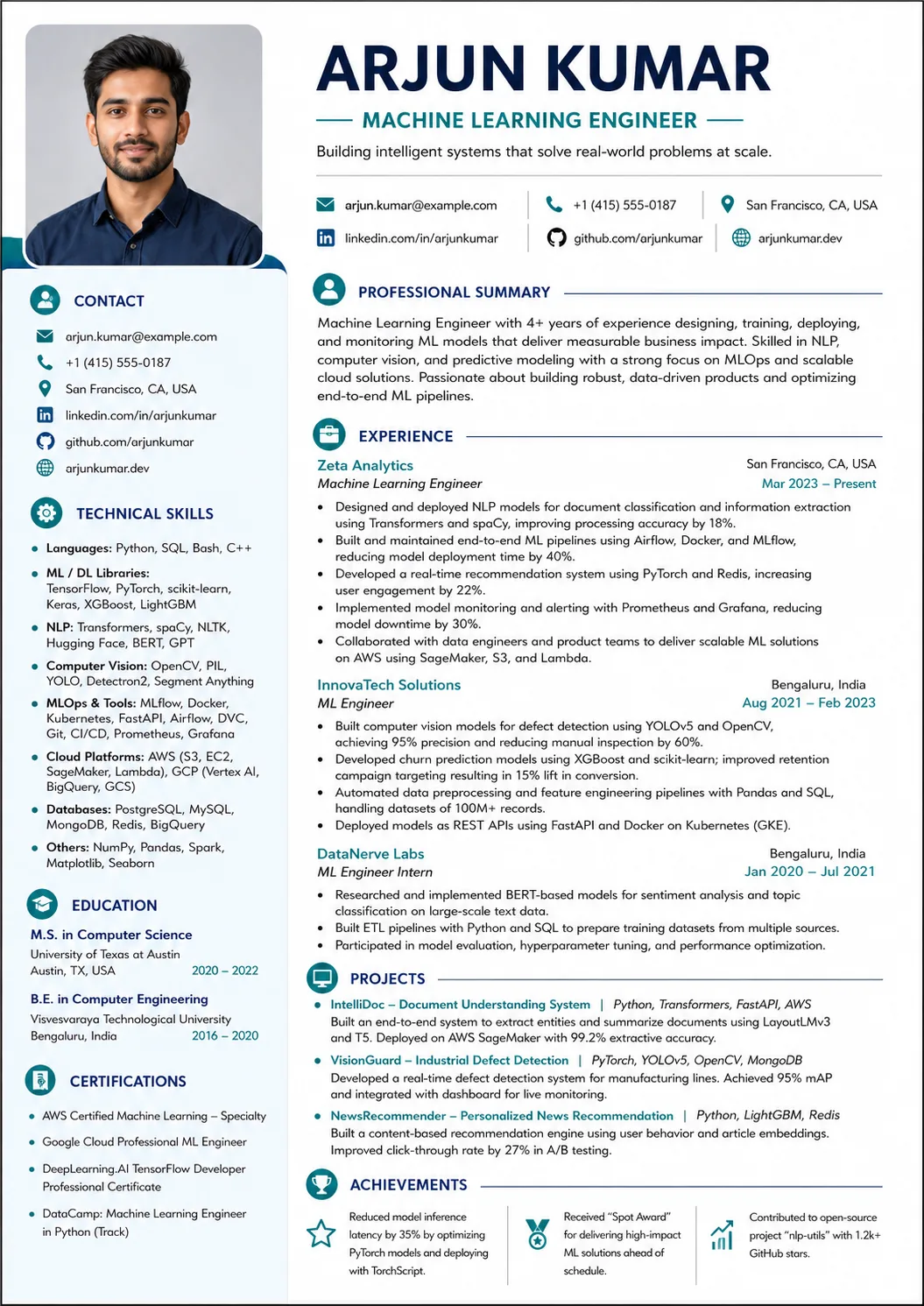
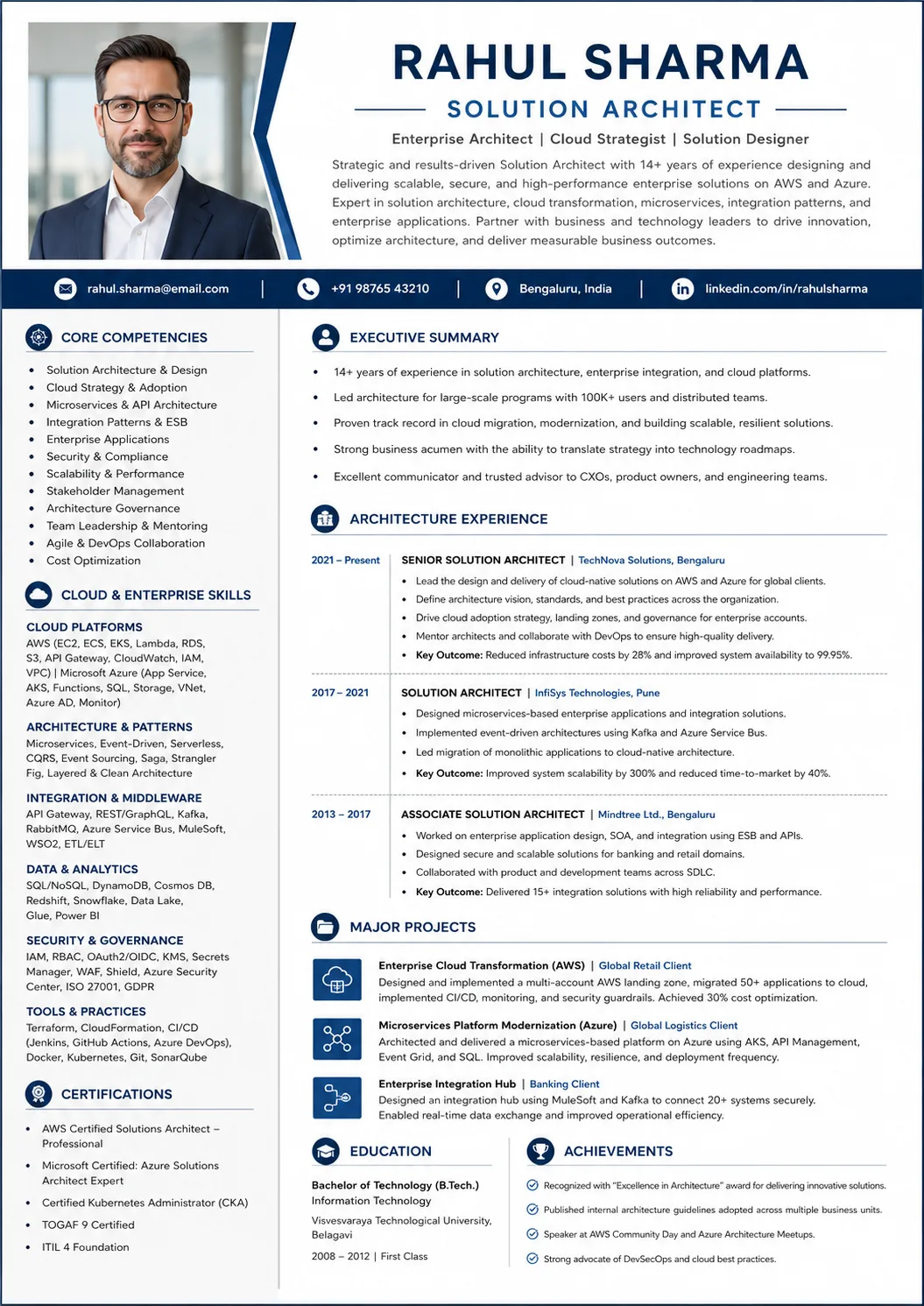
Resume ExampleInformation Technology (IT)Mid Level

AWS Data Engineer Resume Examples & Writing Guide

Use this AWS Data Engineer resume example to write a clear, ATS-friendly resume that shows data pipeline work, AWS Glue, S3, Redshift, SQL, Python, Spark, data quality, and cloud data delivery.

Experience Level
Mid Level
Category
Information Technology (IT)
Reader Rating
4.7 / 5
  • Tailor every AWS Data Engineer resume to the AWS services, data platform, company, and posting.
  • Use a clean layout that works for ATS tools, recruiters, data engineering managers, and cloud architects.
  • Write a summary that shows pipeline ownership, technical stack, data quality, and production impact.
Resume Example (Text Format)

Daniel Kim

AWS Data Engineer

daniel.kim@email.com | Seattle, Washington | (206) 555-2841 | linkedin.com/in/daniel-kim-data

Profile

AWS Data Engineer with 5+ years of experience building production batch and near-real-time pipelines across Amazon S3, AWS Glue, Redshift, Lambda, Step Functions, SQL, Python, PySpark, and CloudWatch. Strong background in data modeling, data quality, pipeline monitoring, and analytics-ready dataset delivery.

Work Experience

AWS Data Engineer, CloudMart Analytics

Seattle, Washington | Mar 2021 - Present

  • Built AWS Glue and PySpark pipelines that processed daily e-commerce events from S3 into curated Redshift fact and dimension tables.
  • Added data quality checks, retry logic, and CloudWatch alerts that reduced failed morning dashboard refreshes for finance and operations teams.
  • Partnered with BI analysts and product managers to define source-to-target mappings, data definitions, and release notes for new datasets.

Data Engineer, NorthPeak Software

Bellevue, Washington | Jul 2018 - Feb 2021

  • Developed SQL transformations and Python scripts for subscription, billing, and customer activity datasets.
  • Migrated manual reporting extracts into scheduled pipeline jobs with documented ownership and error handling.
  • Supported Redshift query tuning, schema changes, and production data issue investigations.

Education

  • B.S. in Computer Science, University of Washington | Seattle, Washington | 2018

Languages

  • English

Certifications

  • AWS Certified Data Engineer - Associate | 2025
  • AWS Certified Solutions Architect - Associate | 2023

Skills

  • AWS Glue
  • Redshift
  • Amazon S3
  • Python
  • PySpark
  • Data modeling

A strong AWS Data Engineer resume should show that you can build data pipelines, move data from source systems into cloud storage, transform raw data into trusted datasets, and support analytics or machine learning teams with reliable data. This is true whether you are writing an entry-level cloud data engineer resume, a mid-career AWS Data Engineer resume, or a senior resume for platform and architecture roles. Employers are not only looking for someone who knows AWS service names. They are looking for someone who can design practical data flows, write SQL and Python, use services such as S3, Glue, Redshift, Lambda, Athena, Kinesis, and CloudWatch, and keep production data accurate, secure, and usable. That is why this AWS Data Engineer resume example focuses on proof: projects, data volume, pipeline tools, transformations, monitoring, governance, and business impact.

Quick breakdown

Why this AWS Data Engineer resume works

1

It leads with production data pipeline proof, which is the core signal employers expect from an AWS Data Engineer resume example.

2

It balances AWS services, programming skills, SQL, data modeling, governance, monitoring, and stakeholder impact without sounding like a keyword dump.

3

It shows the full data lifecycle: ingestion, transformation, storage, orchestration, testing, deployment, monitoring, and handoff to analytics users.

4

It gives recruiters, ATS tools, data engineering managers, and cloud teams enough detail to understand project scope, tools, and measurable results quickly.

Fast template guide

What to copy from this AWS Data Engineer resume example

Do not copy the resume word for word. Copy the structure, the section order, and the level of technical detail. A strong AWS Data Engineer resume example teaches you what to show: AWS services, pipeline type, programming languages, storage layer, transformation logic, data quality checks, monitoring, security, and the business users who depend on the data. Your own version should use your real services, datasets, tools, teams, project scale, and outcomes.

A clear header and summary that name AWS data engineering, not just general data work or software support.

Pipeline bullets that show ingestion, transformation, orchestration, data quality, monitoring, and business use instead of vague task lists.

AWS services such as S3, Glue, Redshift, Lambda, Step Functions, Kinesis, Athena, IAM, Lake Formation, and CloudWatch used naturally where they fit.

Technical skills written in a way recruiters and engineering managers can scan quickly: SQL, Python, PySpark, Spark, ETL, ELT, data modeling, and CI/CD.

Certifications, cloud training, and project results placed where hiring teams can verify AWS knowledge and production delivery quickly.

Build the right structure

AWS Data Engineer resume sections to include

A strong AWS Data Engineer resume should include the sections employers expect to scan quickly, plus optional sections that help prove cloud data depth. The goal is not to add every possible AWS service. The goal is to build a page that lets a company understand your data engineering fit, verify your AWS training, and see the production or project work you can actually explain.

Must-have sections

  • Contact information
  • AWS Data Engineer resume summary or profile
  • Data engineering experience
  • Education
  • AWS certifications and technical training
  • AWS Data Engineer skills

Optional sections that strengthen the resume

  • Cloud data projects
  • Data pipeline portfolio
  • AWS services
  • Programming projects
  • Data modeling work
  • Data quality projects
  • ETL or ELT tools
  • DevOps or IaC tools
  • Languages
  • Open-source work
  • Architecture notes

An AWS Data Engineer resume should not read like a general IT resume. Employers need to see proof that you can build, test, monitor, and maintain cloud data pipelines on AWS. That means showing data sources, pipeline tools, storage layers, transformations, orchestration, quality checks, access control, and analytics handoffs. For a newer candidate, project work with S3, Glue, Lambda, Athena, Redshift, SQL, Python, and PySpark can show readiness. For a mid-level candidate, the resume should move faster into production pipelines, cost control, data quality, monitoring, security, and stakeholder-facing results. Keep the structure simple because recruiters and engineering managers often scan for service names, programming languages, and pipeline outcomes before reading every bullet.

Smarter ordering

Best AWS Data Engineer resume section order

The best section order depends on your experience level. A new AWS Data Engineer should not use the same structure as a senior cloud data platform engineer. Put your strongest proof where the reader will see it first. For a newer candidate, that may be projects, certifications, SQL, Python, and AWS labs. For an experienced engineer, it is usually production pipelines, data platform impact, data quality, monitoring, and architecture decisions.

Entry-level AWS Data Engineer

  1. Contact information
  2. AWS Data Engineer resume objective or short summary
  3. Education and cloud training
  4. Cloud data projects, internships, or analyst work
  5. AWS Data Engineer skills
  6. Relevant coursework, SQL projects, or Python projects
  7. Certifications or technical labs

Experienced AWS Data Engineer

  1. Contact information
  2. AWS Data Engineer resume summary
  3. Data engineering experience
  4. AWS certifications and technical training
  5. AWS Data Engineer skills
  6. Education
  7. Pipeline achievements or architecture highlights

Career-change AWS Data Engineer

  1. Contact information
  2. Transferable AWS Data Engineer resume summary
  3. Data, analytics, software, or cloud-adjacent experience
  4. Transferable experience
  5. Education and certification pathway
  6. AWS Data Engineer skills
  7. Portfolio projects, labs, or migration work

Put the strongest AWS data proof near the top. A new candidate can lead with certifications, labs, SQL, Python, and cloud projects. An experienced data engineer should lead with production pipelines, datasets, tools, monitoring, and outcomes. A career changer from BI, software, database administration, DevOps, or analytics should connect past work to data engineering skills such as SQL, Python, automation, data modeling, dashboard support, cloud storage, access control, and pipeline troubleshooting.

Choose an AWS Data Engineer resume example by experience level

Use this template

Use this mid-career AWS Data Engineer example to study how production pipeline ownership, AWS services, data quality, monitoring, SQL, Python, and stakeholder impact should lead the page.

AWS Data Engineer Resume Playbook

A strong AWS Data Engineer resume should show pipeline ownership, AWS service fluency, and data reliability in a way hiring teams can understand quickly.

A company hiring an AWS Data Engineer is usually not looking for a generic cloud user. The hiring team wants to know whether you can move raw data into the right AWS storage layer, transform it into trusted datasets, monitor the pipeline, secure access, and support the analysts, applications, or machine learning teams that use the data. Recruiters may scan for AWS Glue, Amazon S3, Redshift, Athena, SQL, Python, PySpark, Spark, Lambda, Kinesis, Step Functions, MWAA, IAM, KMS, Lake Formation, Terraform, and CloudWatch. Engineering managers look deeper. They want to see how you handled schema changes, partitioning, failed loads, backfills, cost, query performance, and data quality. A good AWS Data Engineer resume example makes these details easy to see without turning the page into a service list.

That is why this guide focuses on plain technical proof, not buzzwords. You do not need to list every AWS product. You need specific project details. A pipeline that ingests files from S3, transforms them with Glue and PySpark, stores them as Parquet, catalogs them with Glue Data Catalog, queries them with Athena, and sends alerts through CloudWatch is more valuable than a broad statement about cloud data experience. The target keyword for this page is AWS Data Engineer resume example, but the content is written to help a real candidate build a better resume, not just repeat a keyword.

  • Turn AWS Glue, S3, Redshift, Athena, Lambda, Kinesis, and data lake projects into strong resume proof.
  • Write an AWS Data Engineer resume summary that sounds technical, specific, and useful.
  • Use AWS Data Engineer resume keywords for ATS without stuffing the page.
  • Place education, AWS certifications, cloud training, and project outcomes where employers can find them quickly.

How to write an AWS Data Engineer resume

A strong AWS Data Engineer resume should make three things clear within a few seconds: what data you work with, which AWS services and engineering tools you use, and why your pipelines can be trusted in production. That means your resume should show AWS data storage, ingestion, transformation, orchestration, data modeling, validation, monitoring, security, and analytics delivery. An AWS Data Engineer resume example that only lists service names is weak because many candidates can list AWS tools. The stronger version explains how you used those tools to solve real data problems, such as late dashboard refreshes, unreliable source files, slow Redshift queries, missing audit logs, or manual data cleanup.

  1. Read the job posting and highlight the AWS services, pipeline tools, programming languages, data stores, and governance needs.
  2. Match your summary, skills, and experience bullets to the data engineering work the employer cares about most, as long as the match is honest.
  3. Use a clean format with standard headings so ATS tools, recruiters, data managers, and cloud architects can scan the resume quickly.

What employers look for first

Most employers look for proof that you can build and support reliable data pipelines. They want to see SQL, Python, AWS services, transformation logic, data quality, monitoring, and business use. In simple terms, they want to know that you can take messy source data, move it safely, clean it, model it, test it, and make it usable for analytics or applications. For an AWS Data Engineer resume, this proof should appear in the summary, skills, experience bullets, education, certifications, and project sections. Do not leave your strongest AWS details trapped inside one section. Spread them naturally across the page so both ATS tools and human readers can see them.

High-priority proof points

  • AWS Glue, Amazon S3, Redshift, Athena, Lambda, Kinesis, EMR, MWAA, or Step Functions
  • SQL, Python, PySpark, Spark, dbt, Airflow, and data modeling
  • ETL and ELT pipelines, data lakes, warehouses, and curated datasets
  • Data quality checks, monitoring, CloudWatch alerts, backfills, and incident support
  • IAM, KMS, Lake Formation, encryption, access control, and governance

Good proof for newer data engineers

  • AWS labs, portfolio projects, internships, bootcamp projects, or capstone data pipelines
  • SQL transformations, Python scripts, S3 data lake work, and Athena query projects
  • Glue crawlers, Glue jobs, Data Catalog tables, and partitioned Parquet datasets
  • Dashboard support, reporting automation, data cleaning, or analyst-to-engineer transition work
  • Certifications such as AWS Certified Data Engineer - Associate or AWS Certified Cloud Practitioner

Writing for both ATS and human readers

Many companies collect resumes through online systems that parse job titles, technical tools, cloud services, programming languages, and certifications. This is why an ATS-friendly AWS Data Engineer resume should use normal cloud data language: AWS Glue, Amazon S3, Redshift, Athena, SQL, Python, PySpark, Spark, ETL, ELT, data lake, data warehouse, Lambda, Step Functions, Kinesis, CloudWatch, IAM, KMS, Lake Formation, Terraform, Airflow, dbt, data modeling, and data quality. The goal is not to trick the system. The goal is to describe your real background with the same words data engineering teams use when they hire.

Statistical Insight

If your resume says only that you are a hard-working cloud professional, the reader still does not know what you can build. A better AWS Data Engineer resume shows the work behind the claim. Instead of saying you support data pipelines, show how you built Glue jobs, wrote SQL models, handled schema drift, improved partitioning, added CloudWatch alerts, or reduced failed dashboard refreshes. Instead of saying you know AWS, show the services, data flow, quality checks, security controls, and users connected to your work. The best AWS Data Engineer resume example turns broad claims into cloud data actions.

Start with one strong master resume, then adjust it for each job. An AWS Data Engineer resume for a Redshift warehouse role should not sound exactly like one for a streaming Kinesis role, a data lake governance role, or a Glue migration role. The core structure can stay similar, but the wording should change based on the data stack, AWS services, industry, and level of production responsibility. Read the posting first, mark the repeated terms, and decide which parts of your background match honestly. Then update your summary, skills, and bullets so the employer sees fit right away.

  1. Use the posting wording for AWS services, programming languages, data stores, orchestration tools, and governance needs when it matches your experience.
  2. Use action words such as built, designed, automated, transformed, modeled, orchestrated, validated, monitored, optimized, secured, migrated, and documented.

A good AWS Data Engineer resume is not a long list of every tool you have touched. It is a focused document that helps an employer answer one question: can this person build and support the data pipelines we need? Keep the resume clear, use action words, include numbers where they are true, and connect technical work to data users. For example, data volume, number of pipelines, refresh time, failed job reduction, query speed, cost savings, table count, source systems, or dashboard users can all make a bullet stronger. These details are simple, but they make the resume feel real.

Choosing the best AWS Data Engineer resume format and template

The best AWS Data Engineer resume format is clean, simple, and easy to scan. Data engineering is technical work, but the resume still needs a professional structure. A company may receive many resumes for one cloud data role, so your layout should help the reader find your summary, experience, education, certifications, and skills without effort. For most AWS data engineers, reverse-chronological order is the safest choice because it highlights recent pipeline work first. If you are newer to the field, you can still use that format while placing AWS projects, certifications, SQL, Python, and cloud labs higher so your strongest proof is not buried.

For the ATS

  • Use standard headings such as Summary, Experience, Education, Certifications, and Skills.
  • Save the final resume as a PDF when the employer allows it, or follow the portal instructions exactly.
  • Spell out important tools such as AWS Glue, Amazon S3, Redshift, Athena, PySpark, SQL, Python, and CloudWatch at least once.

For data engineering teams

  • Leave enough white space so service names, tools, and outcomes are easy to read.
  • Keep company names, dates, project scope, pipelines, datasets, and tools consistent across sections.
  • Choose a professional template that supports technical proof instead of distracting from it.
Do

Use reverse-chronological order when you have data engineering experience, because your most recent production pipeline work usually matters most.

Keep the layout straightforward so a reader can find AWS services, SQL, Python, certifications, and strongest data engineering results quickly.

Don't

Do not use tables, charts, text boxes, heavy graphics, or unusual fonts that can make the resume harder to parse.

Do not stretch the resume by listing every AWS service. Focus on services you used in real projects and can explain in an interview.

Picking the right AWS Data Engineer resume template

Most AWS data engineers move faster with a tested resume template. Pick one that keeps the summary near the top, gives enough room for project bullets, and makes certifications and tools easy to spot. Avoid templates that use tiny fonts, heavy icons, complex columns, or design elements that take attention away from your pipeline proof. An AWS Data Engineer resume template should support the content, not compete with it. The best template for an AWS Data Engineer resume example is usually modern, simple, and ATS-friendly, with clear headings and enough white space for quick scanning.

Browse our resume templates or open the resume builder when you are ready to turn this AWS Data Engineer resume example into your own finished draft. Start with the structure, then replace every sentence with your real AWS services, pipelines, data sources, transformations, certifications, and results.

AWS Data Engineer resume summary example: show pipeline fit fast

The AWS Data Engineer resume summary is the short paragraph at the top of the page. It should show cloud data fit fast. A strong summary names the role or experience level, the AWS services you use, the programming languages you rely on, and the pipeline strengths that matter most for the job. It can also mention data quality, monitoring, data modeling, governance, Redshift, S3, Glue, Python, SQL, PySpark, or certifications when those details help. Keep it short enough to scan, but specific enough that it does not sound like every other data resume.

The main goals of the summary

  • Name the AWS data environment, pipeline type, or data platform you fit best.
  • Highlight the data engineering strengths that matter most for the job.

Keep the tone technical and practical, but stay specific. Strong AWS Data Engineer resume summaries use real cloud data language, not broad claims about loving data. A new candidate might lead with AWS labs, SQL, Python, S3, Glue, and Athena projects. A mid-career engineer might lead with production ETL pipelines, Redshift models, PySpark transformations, CloudWatch alerts, and stakeholder datasets. A senior engineer might lead with data lake architecture, governance, reusable pipeline frameworks, cost optimization, and mentoring. The summary should match the level of the candidate.

  • For a new AWS Data Engineer, mention AWS labs, internships, projects, SQL, Python, Glue, S3, Athena, or certification progress.
  • For an experienced AWS Data Engineer, mention years of experience, pipeline ownership, AWS services, data volume, reliability, and business users.
  • For a career changer, connect past analytics, BI, software, DevOps, database, or reporting work to cloud data engineering.
Expert Tip

Skip empty phrases like “data-driven professional,” “quick learner,” or “strong problem solver” unless you prove them with technical context. Employers expect data engineers to solve problems and learn tools. Use the limited space to explain what you build. A better summary says that you build batch pipelines with AWS Glue and PySpark, model Redshift tables for analytics, validate data quality with SQL checks, and monitor failures with CloudWatch. This kind of wording helps both ATS tools and real hiring teams.

A simple formula works well: role or experience level + AWS services + programming languages + pipeline value. For example, an entry-level AWS Data Engineer resume summary can say that the candidate has AWS project experience in S3, Glue, Athena, SQL, and Python. A senior AWS Data Engineer resume summary can mention data lake architecture, Redshift optimization, governance, Spark frameworks, Terraform, and platform reliability. The formula keeps the summary clear without sounding robotic.

When the posting uses clear language, mirror it. If the job asks for AWS Glue, write AWS Glue instead of cloud ETL tool. If it asks for Redshift, use that exact term when it matches your work. If it asks for PySpark, Airflow, Kinesis, Lake Formation, Terraform, or data quality, include those terms only if you can support them with real experience. This is how you write for ATS without stuffing keywords. The resume still sounds natural because the words are connected to your real data engineering story.

Adaptable resume summary example

AWS Data Engineer with 5+ years of experience building production batch and near-real-time pipelines across Amazon S3, AWS Glue, Redshift, Lambda, Step Functions, SQL, Python, PySpark, and CloudWatch. Strong background in data modeling, data quality, pipeline monitoring, and analytics-ready dataset delivery.

AWS Data Engineer experience resume example: prove cloud data work clearly

The experience section is where your AWS Data Engineer resume becomes believable. It should prove that you can work with production data, not only follow tutorials. For new data engineers, this can include AWS labs, internships, analytics automation, database work, or portfolio projects. For experienced engineers, it should show stronger ownership of ingestion, transformation, orchestration, data quality, monitoring, security, and analytics handoffs. For senior engineers, it should also show architecture, governance, platform standards, mentoring, cost control, and cross-team influence. The title matters, but the pipeline work behind the title matters more.

Statistical Insight

Employers care about the work behind the title. If you built Glue jobs, wrote SQL transformations, created S3 partitions, tuned Redshift queries, added CloudWatch alerts, secured data with IAM and KMS, managed schema changes, or helped analysts trust new datasets, that experience counts. The key is to write it clearly. A bullet like “worked with AWS data” is too thin. A stronger bullet says “built AWS Glue and PySpark jobs that transformed daily application logs from S3 into partitioned Parquet tables for Athena queries.” The second version gives service names, data type, transformation method, data format, and user outcome.

Use reverse-chronological order so your most recent and most relevant experience appears first. For each role, include the position title, company, location, dates, and short bullets. Start each bullet with a technical action such as built, designed, automated, transformed, modeled, orchestrated, validated, optimized, monitored, secured, migrated, documented, or reduced. Then add the cloud data context. Good context includes source system, AWS service, data format, table type, pipeline schedule, monitoring method, business user, or data quality result. Numbers can help, but only use them when they are true.

  • Position title
  • Company, product, platform, or data team name
  • Location and dates
  • AWS services, datasets, sources, destinations, or pipeline patterns you supported
  • Short bullets that show what you built, transformed, monitored, optimized, or secured

The best AWS Data Engineer resume bullets use clear technical actions. Instead of saying handled data pipelines, explain what the pipeline did. Instead of saying improved performance, explain whether you improved Redshift queries, Athena partitions, Spark job runtime, failed loads, or dashboard refresh time. Instead of saying supported stakeholders, explain which teams used the dataset and why it mattered. An AWS Data Engineer resume example should not make the candidate sound bigger than the truth. It should make the truth easy to understand. That is what makes the experience section credible.

Adaptable resume employment history example

AWS Data Engineer, CloudMart Analytics

Seattle, Washington | Mar 2021 - Present

  • Built AWS Glue and PySpark pipelines that processed daily e-commerce events from S3 into curated Redshift fact and dimension tables.
  • Added data quality checks, retry logic, and CloudWatch alerts that reduced failed morning dashboard refreshes for finance and operations teams.
  • Partnered with BI analysts and product managers to define source-to-target mappings, data definitions, and release notes for new datasets.

Data Engineer, NorthPeak Software

Bellevue, Washington | Jul 2018 - Feb 2021

  • Developed SQL transformations and Python scripts for subscription, billing, and customer activity datasets.
  • Migrated manual reporting extracts into scheduled pipeline jobs with documented ownership and error handling.
  • Supported Redshift query tuning, schema changes, and production data issue investigations.

AWS Data Engineer skills section example: show what you build and maintain

The AWS Data Engineer skills section should reflect daily cloud data work. It should help a recruiter, hiring manager, ATS tool, or cloud architect see that you can build, test, monitor, secure, and improve data pipelines. Good AWS Data Engineer skills are not random technology words. They are skills connected to actual delivery: AWS Glue, Amazon S3, Redshift, Athena, Lambda, Kinesis, Step Functions, MWAA, SQL, Python, PySpark, Spark, Airflow, dbt, data modeling, data quality, partitioning, CloudWatch monitoring, IAM, KMS, Lake Formation, Terraform, Git, and CI/CD.

Keep a longer master list outside your resume, then choose the skills that fit each posting. A good AWS Data Engineer resume does not need every skill you have. It needs the skills that match the company’s data platform, AWS services, data volume, and business needs. For example, a data lake role may highlight S3, Glue Data Catalog, Athena, Parquet, partitioning, Lake Formation, and IAM. A warehouse role may highlight Redshift, SQL tuning, data modeling, dbt, dimensional models, and BI support. A streaming role may highlight Kinesis, Lambda, MSK, EventBridge, near-real-time processing, and monitoring.

Statistical Insight

Employers often prioritize skill groups such as:

  • AWS data services such as Glue, S3, Redshift, Athena, Lambda, EMR, Kinesis, MWAA, Step Functions, and Lake Formation
  • Programming and transformation skills such as SQL, Python, PySpark, Spark, dbt, and data modeling
  • Data quality, testing, validation, partitioning, schema management, monitoring, and troubleshooting
  • Security and governance skills such as IAM, KMS, encryption, access control, data cataloging, and audit-ready documentation
  • Engineering workflow skills such as Git, CI/CD, Terraform, CloudFormation, Docker, CloudWatch, and production runbooks

A strong AWS Data Engineer skills section mixes AWS services, programming languages, pipeline methods, governance, and production support skills. Do not separate skills in a way that makes the page confusing. Group them if your template allows it, or list the most important ones first. The most useful AWS Data Engineer resume skills are usually the ones that also appear in your experience bullets. If you list AWS Glue, show a bullet where you built or improved a Glue job. If you list Redshift, show a bullet where you modeled, loaded, tuned, or supported warehouse tables. This makes your skills believable instead of decorative.

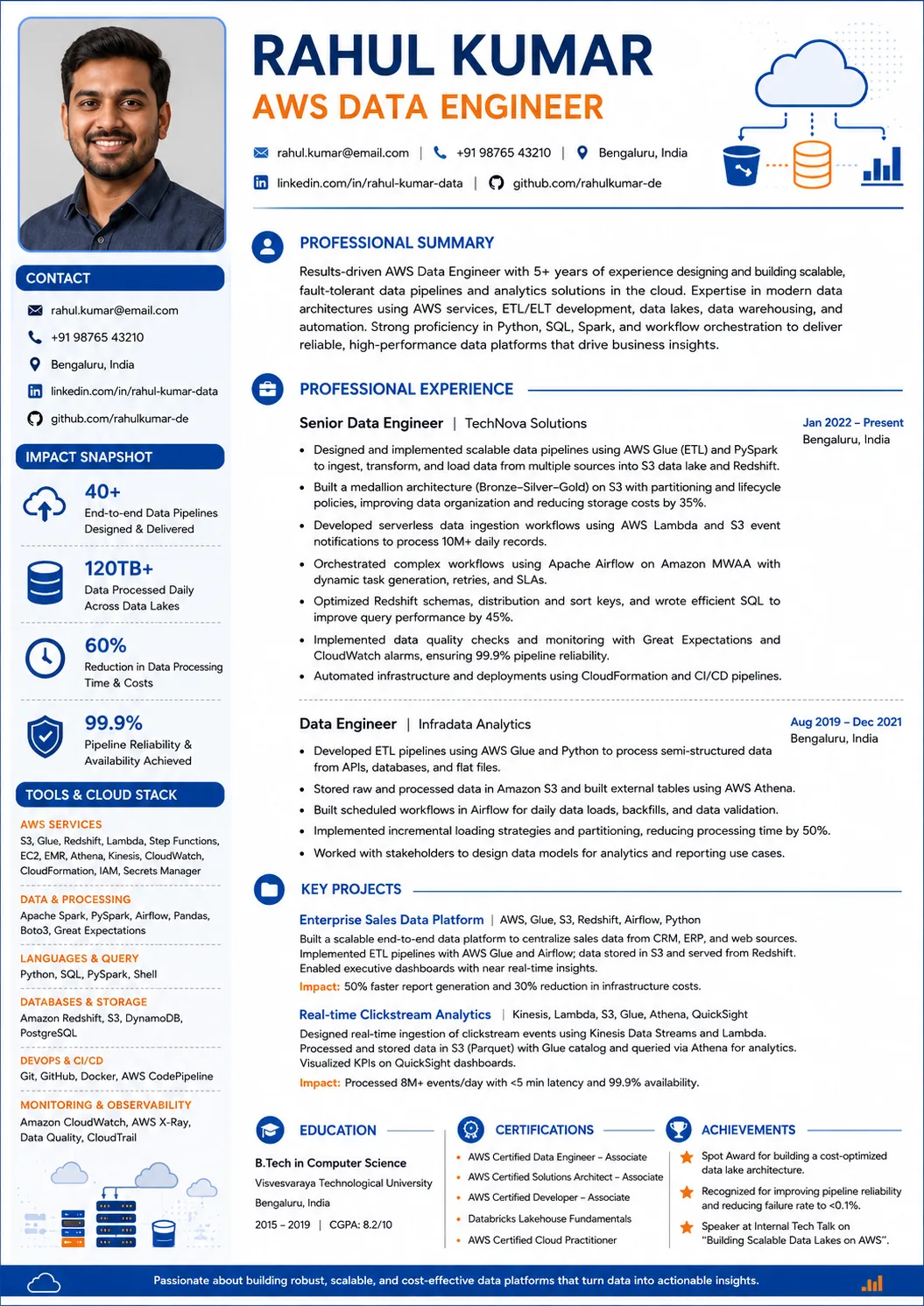
Adaptable resume skills section example
  • AWS Glue
  • Redshift
  • Amazon S3
  • Python
  • PySpark
  • Data modeling

Education resume example: keep your degree and cloud training easy to find

Education matters on an AWS Data Engineer resume because it can support your foundation in computer science, information systems, data engineering, databases, statistics, software engineering, or cloud computing. For an entry-level AWS Data Engineer resume, education may sit near the top because it is one of the strongest signals of readiness. Include your degree, university, location, graduation date, major, minor, relevant coursework, capstone, or cloud project when those details help. If you are still completing a degree or certification, write the expected date clearly. Do not make the employer guess.

Once you have more data engineering experience, production results may lead the page. But education, AWS certifications, and technical training still need to be easy to find. This is especially important for roles that ask for cloud engineering, data warehousing, data lake design, security, governance, or production support. Use exact wording for certifications and AWS services when possible. A small wording mistake can create confusion, while clear wording helps both ATS tools and hiring teams confirm that you meet the role requirements.

Adaptable resume education example
  • B.S. in Computer Science, University of Washington | Seattle, Washington | 2018

AWS certifications and technical training

Employers should be able to spot your cloud and data credentials quickly. Include AWS Certified Data Engineer - Associate, AWS Certified Solutions Architect - Associate, AWS Certified Developer - Associate, AWS Certified Cloud Practitioner, Databricks, SnowPro, data engineering bootcamps, or other training that supports the role. If the job asks for a specific AWS certification, place it near the top of the resume or in a dedicated certifications section. If a certification is in progress, say that clearly and include the expected date when you have one.

  • AWS Certified Data Engineer - Associate | 2025
  • AWS Certified Solutions Architect - Associate | 2023

Before applying, make sure your certification names, AWS service names, programming languages, and data platform wording match the posting. This matters for both ATS tools and human readers. If the job asks for AWS Glue, Redshift, S3, Athena, Lambda, Kinesis, SQL, Python, PySpark, Airflow, data quality, or Terraform, use the exact wording when it fits your background. Do not exaggerate. Clear technical wording builds trust, and trust is one of the most important parts of an AWS Data Engineer resume.

Adaptable resume certifications example
  • AWS Certified Data Engineer - Associate | 2025
  • AWS Certified Solutions Architect - Associate | 2023

Bullet upgrade

Weak vs strong AWS Data Engineer resume bullets

Use the stronger version as the model: start with a clear technical action, add cloud data context, and include the detail or outcome that proves the work mattered. AWS Data Engineer resume bullets should show what data moved, where it came from, how it was transformed, where it landed, how quality was checked, and who used it.

Weak

Worked on AWS data pipelines.

Stronger

Built AWS Glue and PySpark ETL jobs that moved daily application logs from S3 into partitioned Parquet tables, improving Athena query speed for product analytics users.

The stronger bullet names the AWS services, data format, transformation method, and user-facing result. That is much stronger than saying you worked on pipelines.

Weak

Managed data warehouse tasks.

Stronger

Optimized Redshift SQL models and load jobs for finance reporting, reducing late refresh failures by adding validation checks, retry logic, and CloudWatch alerts.

This version shows the platform, data use case, technical fix, and reliability result. It gives the hiring team a clearer picture of production data work.

Weak

Communicated with stakeholders.

Stronger

Partnered with BI analysts, product managers, and DevOps teams to define data requirements, document source-to-target mappings, and release tested datasets for weekly KPI dashboards.

The stronger version explains who was involved, what was delivered, and how communication supported analytics work. Stakeholder communication is more valuable when it is tied to data delivery.

ATS keyword bank

AWS Data Engineer resume keywords for ATS

Recruiters, data leaders, and applicant tracking systems often scan for exact role language. Use these AWS Data Engineer resume keywords only when they honestly match your background. Good keywords are not magic words. They are normal cloud data terms that help the employer understand your fit: AWS Glue, Amazon S3, Redshift, Athena, SQL, Python, PySpark, Spark, ETL, ELT, data lake, data warehouse, Lambda, Step Functions, CloudWatch, IAM, KMS, Lake Formation, and data quality.

AWS GlueAmazon S3Amazon RedshiftSQLPythonPySparkETL pipelinesData modelingAWS LambdaCloudWatch monitoring

Use AWS Data Engineer resume keywords only when they match your real background. Do not stuff the page with every AWS service you have heard of. The safest method is to mirror the posting language for AWS services, programming languages, pipeline tools, governance, monitoring, data quality, and orchestration, then place those words naturally in your summary, skills, certifications, and experience bullets.

Matching application

AWS Data Engineer cover letter tips

Pair this resume with a short cover letter that explains what kind of AWS data work you have done, which data problems you solve, and how your pipelines help teams make decisions. Do not repeat the whole resume. Use the cover letter to connect one or two strong resume details to the company’s data platform needs.

Name the data platform or AWS service mix you fit, such as S3, Glue, Redshift, Athena, Lambda, Kinesis, EMR, MWAA, or Lake Formation.

Connect one strong resume example to business value, such as faster dashboards, fewer failed loads, cleaner datasets, lower cost, or better governance.

Explain how you work with analysts, software engineers, DevOps, security, product, and business teams without repeating every technical bullet.

Final review

AWS Data Engineer resume checklist before applying

Before you send your AWS Data Engineer resume, review it against the job posting one last time. Look for missing AWS services, programming languages, data tools, governance words, orchestration tools, and outcome metrics. Small changes can make the resume easier to read and more relevant to the role.

  • Did you name the exact AWS services used, such as S3, Glue, Redshift, Athena, Lambda, Step Functions, Kinesis, EMR, MWAA, Lake Formation, IAM, KMS, or CloudWatch?
  • Did you show data pipeline work, not only dashboards, reports, or general database tasks?
  • Did your AWS Data Engineer resume summary match the posting instead of sounding like a generic data professional summary?
  • Did you include honest ATS keywords from the posting, such as ETL, ELT, data lake, data warehouse, PySpark, SQL, Python, Airflow, or Terraform?
  • Did your experience bullets show data sources, transformations, orchestration, quality checks, monitoring, and business impact?
  • Did you mention tools such as dbt, Git, GitHub Actions, Jenkins, Terraform, CloudFormation, Docker, Snowflake, Databricks, or Spark only if you use them?
  • Is the layout simple enough for ATS tools, recruiters, data engineering managers, and cloud architects to scan quickly?
  • Did you save the resume as a PDF unless the company, recruiter, or application portal asks for another file type?

Before applying, compare your AWS Data Engineer resume with the job posting one more time. Look for repeated words about AWS services, data pipeline patterns, programming languages, orchestration tools, data quality, governance, CI/CD, and cloud security. A strong AWS Data Engineer resume example is not copied word for word. It is tailored so the employer can see why your background fits their data platform, data lake, warehouse, reporting environment, and production support needs.

Before You Start Writing

Key takeaways

  • Tailor each AWS Data Engineer resume to the data platform, AWS services, industry, and posting.
  • Use a clean, ATS-friendly layout that is easy to scan for service names, languages, and outcomes.
  • Write a summary that shows pipeline ownership instead of generic cloud interest.
  • Use projects, labs, internships, analytics work, or database work as proof when you are early in your data engineering career.
  • Balance AWS services, programming skills, SQL, data quality, monitoring, governance, and stakeholder communication.
  • Make certifications, cloud tools, data sources, transformations, and production outcomes easy to verify.

Ready to build

Build your AWS Data Engineer resume with the same structure

Start with this AWS Data Engineer resume example, then build a matching cover letter that speaks directly to the AWS services, pipeline types, data platform, and business goals in the role you want. The builder can help you turn the structure into a clean resume faster, but your real cloud data proof is what makes the application strong.