BCBA skills section example: show what you do every day
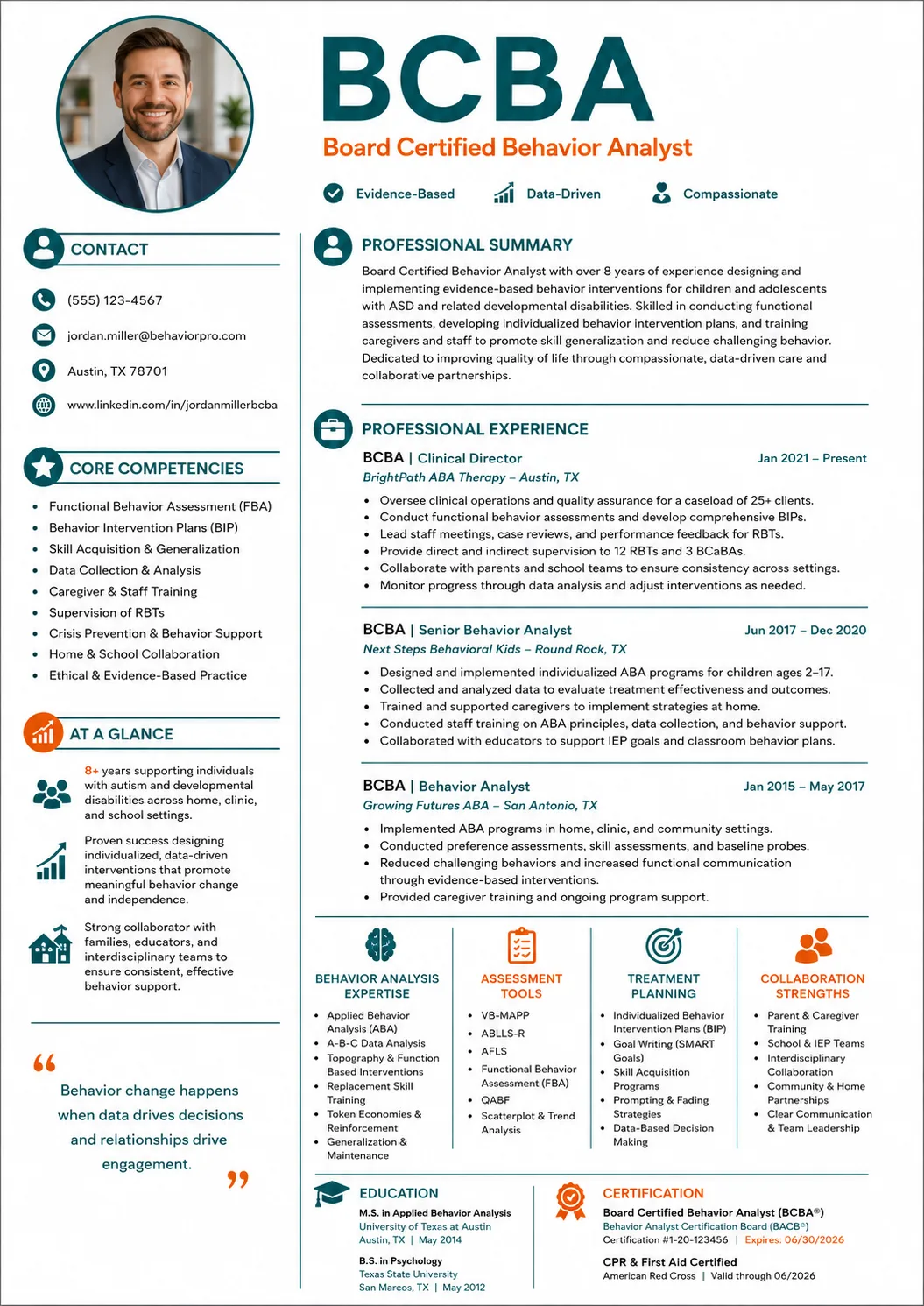
The BCBA skills section should reflect daily clinical work. It should help a clinical director, healthcare recruiter, school administrator, or ATS tool see that you can assess, plan, supervise, document, communicate, and support clients. Good BCBA resume skills are not random personality words. They are skills connected to actual ABA practice: functional behavior assessment, behavior intervention planning, skill acquisition, behavior reduction, data analysis, progress monitoring, parent training, caregiver coaching, RBT supervision, treatment fidelity, ethical documentation, CentralReach, Catalyst, and interdisciplinary collaboration.
Keep a longer master list outside your resume, then choose the skills that fit each job posting. A good BCBA resume does not need every skill you have. It needs the skills that match the service setting, client population, and job description. For example, an early intervention BCBA may highlight caregiver training, natural environment teaching, communication goals, play-based teaching, and parent coaching. A school-based BCBA may highlight FBA, BIP writing, classroom behavior support, IEP collaboration, and teacher consultation. A clinic supervisor may highlight RBT supervision, treatment fidelity, data review, and documentation quality.
A strong BCBA skills section mixes hard clinical skills with supervision and communication skills. Do not separate skills in a way that makes the page confusing. Group them if your template allows it, or list the most important ones first. The most useful BCBA resume skills are usually the ones that also appear in your experience bullets. If you list functional behavior assessment, show a bullet where you supported or completed an FBA. If you list RBT supervision, show a bullet where you coached staff or reviewed treatment fidelity. This makes your skills believable instead of decorative.