Resume ExampleOther examplesMid Level

Canadian Resume Format: Resume Examples & Writing Guide

Use these Canadian resume format examples to build a clear, ATS-friendly resume for Canadian employers, with the right sections, wording, layout, and details to include or leave out.

Experience Level
Mid Level
Category
Other examples
Reader Rating
4.7 / 5
  • Use a clean Canadian resume format with no photo or unnecessary personal details.
  • Tailor your summary, skills, and work experience to each Canadian job posting.
  • Show achievements with clear action, scope, tools, numbers, and results.
Resume Example (Text Format)

Nadia Patel

Operations Coordinator

nadia.patel@email.com | (416) 555-2841 | Toronto, Ontario | linkedin.com/in/nadia-patel

Profile

Operations coordinator with 4+ years of experience supporting scheduling, customer service, vendor follow-up, Excel reporting, and office administration. Skilled in organizing records, tracking deadlines, preparing reports, and supporting managers with clear communication and accurate documentation.

Work Experience

Operations Coordinator, Maple North Services

Toronto, Ontario | Mar 2021 - Present

  • Coordinated weekly schedules, vendor follow-ups, and service records for a 25-person operations team across three locations.
  • Built Excel tracking sheets that improved visibility into late invoices, open work orders, and customer follow-up tasks.
  • Prepared monthly reports, meeting notes, and shared documentation for managers using Outlook, Teams, and SharePoint.

Administrative Assistant, Lakeside Community Centre

Mississauga, Ontario | Jun 2018 - Feb 2021

  • Handled front-desk inquiries, booking requests, payment records, and email follow-ups for community programs.
  • Updated client records in the database and prepared weekly attendance reports for program coordinators.
  • Supported event setup, volunteer communication, and supply tracking during high-volume seasonal programs.

Education

  • Diploma in Business Administration, George Brown College | Toronto, Ontario | 2018

Languages

  • English

Certifications

  • WHMIS | 2024
  • First Aid / CPR | 2023

Skills

  • Customer service
  • Scheduling
  • Microsoft Excel
  • SharePoint
  • Vendor follow-up
  • Documentation

A strong Canadian resume should show your target role, relevant skills, work experience, education, and credentials in a simple format that employers can scan quickly. This Canadian resume format example is written for job seekers who want a practical, ATS-friendly structure for Canada. The goal is not to add every detail about your life. The goal is to show how your background matches the job posting. In Canada, most resumes are one to two pages, use clear headings, and focus on professional qualifications. You should not include a photo, age, marital status, religion, Social Insurance Number, or detailed personal information. Instead, use the space for a focused summary, skills, work history, achievements, tools, certifications, and education.

Quick breakdown

Why this Canadian resume format works

1

It follows the Canadian resume style most employers expect: simple layout, clear headings, relevant skills, and work history that is easy to scan.

2

It avoids personal details that do not belong on a Canadian resume, such as photo, age, marital status, SIN, religion, and immigration status.

3

It uses natural Canadian resume format keywords without stuffing the page or making the resume sound fake.

4

It works for newcomers, students, career changers, and experienced applicants because the section order can change while the core structure stays clear.

Fast template guide

What to copy from this Canadian resume format example

Do not copy the sample resume word for word. Copy the structure, section order, clean layout, and level of detail. A strong Canadian resume format example shows the right contact details, a targeted summary, skills matched to the posting, reverse-chronological work history, education, and relevant certifications. Your version should use your real job titles, employers, tools, locations, achievements, and credentials.

A clean contact header with name, city and province, phone number, professional email, and LinkedIn or portfolio link when useful.

A short professional summary that names the target role, strongest skills, and clear value for a Canadian employer.

A skills section that mirrors the job posting with honest keywords, tools, certifications, and work methods.

Work experience written in reverse-chronological order with action verbs, numbers, scope, and results instead of only duties.

Education, Canadian credentials, foreign credential details, licenses, certificates, and training placed where employers can verify them quickly.

Build the right structure

Canadian resume sections to include

A Canadian resume should include the sections employers expect to scan quickly. The exact order can change based on your experience level, but the main purpose stays the same: show your fit for the job without adding personal details that do not help the employer make a work-related decision. Use standard headings so ATS tools can read the page.

Must-have sections

  • Contact information
  • Professional summary
  • Key skills or skills highlights
  • Work experience
  • Education and credentials
  • Certifications, licences, or training

Optional sections that strengthen the resume

  • Volunteer experience
  • Canadian experience or local projects
  • Foreign credential evaluation
  • Professional development
  • Technical tools
  • Languages
  • Awards
  • Portfolio link
  • Selected projects
  • Community involvement
  • Availability or work authorization only if the posting asks

A Canadian resume should be clear, focused, and easy to scan. It should show what job you want, what skills match the posting, where you worked, what you achieved, and what education or credentials support your fit. It should not include a photo, age, marital status, religion, Social Insurance Number, detailed immigration status, or references on the resume unless the employer specifically asks. For newcomers, international experience is valuable, but it should be written in a way Canadian employers can understand. Add city and country when needed, translate job titles into plain language, explain tools or industries briefly, and show results with numbers where possible. The best Canadian resume format example is not the fanciest design. It is the one that helps a recruiter quickly see why you match the job.

Smarter ordering

Best Canadian resume section order

The best section order depends on your background. Entry-level applicants may place education, projects, and part-time work higher. Experienced applicants should lead with work results. Newcomers and career changers should connect transferable skills and international experience to the Canadian job posting in plain language.

Entry-level Canadian resume

  1. Contact information
  2. Professional summary or career objective
  3. Skills highlights
  4. Education and recent training
  5. Part-time work, internships, volunteer work, or projects
  6. Certifications, licences, or technical tools
  7. Languages or community involvement

Experienced Canadian resume

  1. Contact information
  2. Professional summary
  3. Skills highlights
  4. Work experience
  5. Certifications, licences, or credentials
  6. Education
  7. Selected achievements or projects

Newcomer or career-change Canadian resume

  1. Contact information
  2. Targeted professional summary
  3. Transferable skills
  4. Relevant Canadian or international experience
  5. Education and credential evaluation
  6. Certifications, licences, or training
  7. Volunteer work, projects, or local references when useful

Put the strongest proof near the top. A student or entry-level applicant can lead with education, skills, projects, and part-time work. An experienced applicant should lead with results and work history. A newcomer or career changer should connect international or previous experience to the Canadian job posting, use plain job titles, show transferable skills, and include credential evaluation or Canadian training only when it helps the employer understand the background.

Choose a Canadian resume format example by experience level

Use this template

Use this mid-level Canadian resume example to study how recent work experience, measurable achievements, tools, skills, education, and certifications should lead the page.

Canadian Resume Format Playbook

A strong Canadian resume should be clear, focused, ATS-friendly, and free from personal details that do not belong.

Canadian employers usually want a resume that gets to the point quickly. They are looking for contact details, a targeted summary, skills that match the posting, recent work experience, education, credentials, and clear achievements. They do not need a photo, date of birth, marital status, religion, Social Insurance Number, or a long personal profile. The Canadian resume format is close to the United States resume style, but it is important to write for Canadian hiring expectations: plain language, standard headings, one to two pages for most roles, and examples that show what you can do for the employer. A good Canadian resume format example should help the reader find your fit in less than a minute.

This guide focuses on practical resume writing, not fancy design. You need a clean layout, strong matching keywords, and proof from your work history. If you are new to Canada, your international experience still matters. The key is to explain it in language that Canadian employers understand. Use simple job titles, clear industries, tools, results, and transferable skills. If you are a student or entry-level applicant, part-time work, volunteer roles, projects, co-op placements, and training can all support your application when written clearly. The target keyword for this page is Canadian resume format resume example, but the content is written to help a real job seeker build a better resume, not to repeat a keyword unnaturally.

  • Write a Canadian resume with the right contact information, sections, and layout.
  • Avoid personal details that do not belong on a resume in Canada.
  • Use ATS-friendly keywords from the job posting without stuffing the page.
  • Turn local, international, volunteer, student, and career-change experience into clear resume proof.

How to write a Canadian resume

A strong Canadian resume should make three things clear within a few seconds: what role you are targeting, what skills you bring, and what proof you have. This is why the best Canadian resume format starts with a clean header, a focused summary, key skills, recent work experience, education, and certifications. The resume should be direct and easy to scan. Avoid long paragraphs about your background and avoid personal information that is not related to the job. The stronger version gives the employer job-related evidence: achievements, tools, customer types, team size, sales numbers, accuracy, speed, safety record, cost savings, or project results.

  1. Read the Canadian job posting and highlight the role title, required skills, tools, certifications, and repeated keywords.
  2. Match your summary, skills, and experience bullets to the work the employer cares about most, as long as the match is honest.
  3. Use a clean format with standard headings so ATS tools and hiring teams can scan your resume quickly.

What Canadian employers look for first

Most employers look for a quick match between the posting and your resume. They want to see whether you have the required skills, work experience, tools, credentials, and communication ability. They also want to know whether your experience is recent and relevant. For a Canadian resume, proof should appear in the summary, skills, work experience bullets, education, and certifications. Do not leave your strongest fit hidden near the bottom. If the posting asks for Excel, customer service, warehouse safety, bookkeeping, Salesforce, bilingual communication, or a licence, make sure the right section shows it clearly.

High-priority proof points

  • Target role and professional summary
  • Skills matched to the job posting
  • Reverse-chronological work experience
  • Measurable results, tools, and achievements
  • Education, certifications, licences, or credential evaluation

Good proof for newcomers or entry-level applicants

  • Part-time work, internships, co-op placements, or projects
  • Volunteer work that shows Canadian workplace skills
  • International experience written in plain hiring language
  • Recent training, bridge programs, or safety certificates
  • Language skills, tools, and customer-facing experience

Writing for both ATS and human readers

Many Canadian employers collect applications through online systems. These systems may parse your resume before a recruiter reads it. That means standard headings, simple formatting, and relevant keywords matter. Use exact role terms, tools, software, certifications, and skills from the posting when they truly match your background. Do not use hidden text, keyword lists that do not match your experience, or repeated phrases that make the resume sound unnatural. ATS-friendly writing should still help a human reader. A strong bullet says what you did, what tool or process you used, and what result you supported.

Statistical Insight

If your resume says only that you are hardworking, reliable, or motivated, the reader still does not know what you can do. A better Canadian resume shows the work behind those qualities. Instead of saying you are organized, show how you scheduled appointments, updated records, reconciled invoices, prepared reports, or managed files. Instead of saying you are a team player, show how you supported a team, trained new staff, handled customer issues, or coordinated with other departments. The best Canadian resume format example turns soft claims into work-related actions.

Start with one strong master resume, then adjust it for each job. A customer service resume, accounting resume, warehouse resume, administrative resume, tech resume, and healthcare resume should not all sound the same. The core Canadian resume structure can stay similar, but the examples should change based on the employer, industry, skills, tools, and required certifications. Read the posting first, mark repeated terms, and decide which parts of your background match honestly.

  1. Use the posting wording for role title, skills, tools, software, certifications, and industry terms when it matches your experience.
  2. Use action words such as coordinated, supported, prepared, improved, handled, tracked, resolved, trained, organized, and delivered.

A good Canadian resume is not a long list of every task you have ever done. It is a focused document that helps an employer answer one question: does this applicant match the job enough to interview? Keep the resume clear, use action words, include numbers where they are true, and connect your work to the employer’s needs. Numbers can include customers served, reports prepared, calls handled, invoices processed, sales increased, errors reduced, team size, or project scope. These details are simple, but they make the resume feel real.

Choosing the best Canadian resume format and template

The best Canadian resume format is clean, simple, and easy to read. Most job seekers should use reverse-chronological order because recent work experience usually matters most. This format lists your latest role first and moves backward. It is familiar to recruiters and works well with ATS tools. A combination format can also work when you are changing careers, returning to work, or moving from international experience into the Canadian market. In that case, place key skills and relevant achievements high on the page, but still include work history with dates. Avoid designs that use photos, large icons, complicated columns, or visual charts because they can distract from your qualifications and may not parse well.

For the ATS

  • Use standard headings such as Summary, Skills, Work Experience, Education, Certifications, and Licences.
  • Keep formatting simple and avoid photos, tables, charts, or text boxes that can confuse resume scanning tools.
  • Spell out important tools, certifications, provinces, licences, and software at least once when they match the posting.

For Canadian hiring teams

  • Leave enough white space so the page does not feel crowded.
  • Keep job titles, employer names, cities, provinces, dates, and results easy to find.
  • Choose a professional template that supports your content instead of distracting from your work history.
Do

Use reverse-chronological order when your recent experience matches the job.

Keep the layout straightforward so a reader can find your summary, skills, work experience, education, and credentials quickly.

Don't

Do not include a photo, age, marital status, SIN, religion, or other personal details that are not needed for the job.

Do not stretch the resume with old or unrelated experience when recent and relevant proof is stronger.

Picking the right Canadian resume template

Most job seekers move faster with a tested resume template. Pick one that keeps the summary near the top, gives enough room for work experience bullets, and makes skills and credentials easy to scan. The template should not force you to use a photo or design-heavy sidebar. Canadian employers usually care more about job fit than decoration. A good template should support short bullets, clear dates, standard headings, and easy editing for each job application.

Browse our resume templates or open the resume builder when you are ready to turn this Canadian resume format example into your own finished draft. Start with the structure, then replace every sentence with your real target role, skills, work experience, education, credentials, and achievements.

Canadian resume summary example: show fit fast

The Canadian resume summary is the short paragraph at the top of the page. It should help the employer see your fit quickly. A strong summary names the type of role you want, the work you have done, and the skills or tools that match the posting. It can also include years of experience, industry, certifications, language skills, or local experience when those details help. Keep it short enough to scan, but specific enough that it does not sound like every other resume.

The main goals of the summary

  • Name the target role, industry, or work setting you fit best.
  • Highlight the strongest skills, tools, results, or credentials that match the job.

Keep the tone professional and specific. Strong Canadian resume summaries use real work language, not broad claims. An entry-level applicant might lead with customer service, education, part-time work, volunteer experience, and tools. A mid-level applicant might lead with years of experience, industry, software, reporting, service results, or coordination. A senior applicant might lead with leadership scope, team size, budget, process improvement, operations, or business results. The summary should match the level of the candidate.

  • For a student or entry-level applicant, mention education, part-time work, volunteer experience, projects, and job-ready skills.
  • For an experienced applicant, mention years of experience, industry, tools, achievements, and scope.
  • For a newcomer or career changer, connect transferable skills and international experience to the Canadian job posting.
Expert Tip

Skip empty phrases like “hardworking professional,” “team player,” or “looking for a challenging role” unless you support them with proof. Employers expect effort and teamwork. Use the limited space to explain what you can do. A better summary says you are an operations coordinator with Excel reporting and scheduling experience, or a customer service associate with POS, CRM, and high-volume support experience, or an accountant with reconciliation and month-end reporting experience.

A simple formula works well: target role + experience level + strongest skills + work setting or result. For example, an entry-level Canadian resume summary can mention part-time service work, Excel, POS, volunteer experience, and communication skills. A senior resume summary can mention team leadership, process improvement, budget tracking, and reporting tools. The formula keeps the summary clear without sounding robotic.

When the posting uses clear language, mirror it. If the job asks for Microsoft Excel, write Microsoft Excel instead of spreadsheet software. If it asks for customer service, CRM, QuickBooks, forklift certification, bilingual communication, or scheduling, include those terms only if they match your background. This is how you write for ATS without stuffing keywords. The resume still sounds natural because the words are connected to your real experience.

Adaptable resume summary example

Operations coordinator with 4+ years of experience supporting scheduling, customer service, vendor follow-up, Excel reporting, and office administration. Skilled in organizing records, tracking deadlines, preparing reports, and supporting managers with clear communication and accurate documentation.

Canadian work experience resume example: prove your results clearly

The experience section is where your Canadian resume becomes believable. It should prove that you can do the work in the job posting. For entry-level applicants, this can include part-time jobs, internships, co-op placements, volunteer work, projects, or family business experience when it is relevant. For experienced applicants, it should show recent work history, scope, tools, and results. For newcomers, it should show international experience in plain language and connect it to Canadian employer needs. The job title matters, but the work behind the title matters more.

Statistical Insight

Employers care about the work behind the title. If you handled customers, prepared reports, used software, trained staff, tracked orders, reconciled accounts, cleaned service areas, managed schedules, supported a team, or improved a process, that experience can belong on your resume. The key is to write it clearly. A bullet like “responsible for office tasks” is too thin. A stronger bullet says “prepared weekly Excel reports, updated shared files, and tracked vendor follow-ups for a 12-person operations team.” The second version gives task, tool, team size, and context.
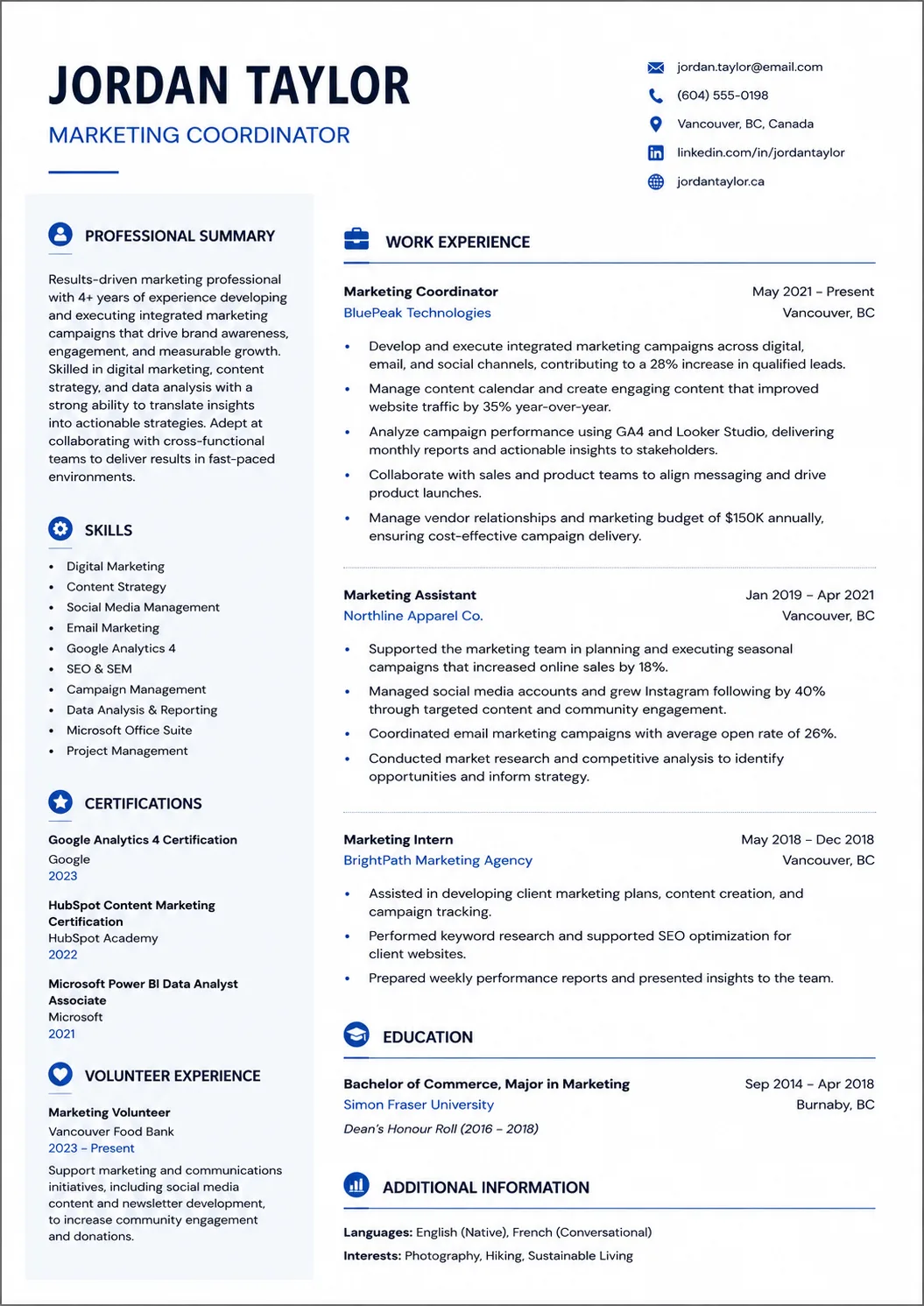
Use reverse-chronological order so your most recent and relevant experience appears first. For each role, include the position title, employer, city and province or country, dates, and short bullets. Start each bullet with an action word such as handled, prepared, coordinated, processed, supported, trained, improved, tracked, resolved, delivered, or maintained. Then add the work context. Good context includes customer volume, tools, team size, sales value, number of files, accuracy, speed, safety, or service result.

  • Position title
  • Employer or organization name
  • City, province, or country and dates
  • Tools, skills, customers, team size, or work setting
  • Short bullets that show what you did and what improved

The best Canadian resume bullets use clear action and proof. Instead of saying helped customers, explain how many customers, what issue, what channel, and what result. Instead of saying used Excel, explain what reports, tracking sheets, or data you prepared. Instead of saying worked in a team, explain what you coordinated and with whom. A Canadian resume format example should not make the candidate sound bigger than the truth. It should make the truth easy to understand.

Adaptable resume employment history example

Operations Coordinator, Maple North Services

Toronto, Ontario | Mar 2021 - Present

  • Coordinated weekly schedules, vendor follow-ups, and service records for a 25-person operations team across three locations.
  • Built Excel tracking sheets that improved visibility into late invoices, open work orders, and customer follow-up tasks.
  • Prepared monthly reports, meeting notes, and shared documentation for managers using Outlook, Teams, and SharePoint.

Administrative Assistant, Lakeside Community Centre

Mississauga, Ontario | Jun 2018 - Feb 2021

  • Handled front-desk inquiries, booking requests, payment records, and email follow-ups for community programs.
  • Updated client records in the database and prepared weekly attendance reports for program coordinators.
  • Supported event setup, volunteer communication, and supply tracking during high-volume seasonal programs.

Canadian resume skills section example: match the job posting

The skills section should reflect the work you can actually do. It should help a recruiter, hiring manager, or ATS tool see the match between your background and the job posting. Good Canadian resume skills are not random personality words. They are job-related skills, tools, certifications, methods, languages, or software that connect to the role. Examples include customer service, Excel, scheduling, QuickBooks, Salesforce, cash handling, inventory control, data entry, bilingual communication, project coordination, safety procedures, or technical support.

Keep a longer master list outside your resume, then choose the skills that fit each posting. A Canadian resume does not need every skill you have. It needs the skills that match the employer’s needs. A warehouse job may need forklift certification, RF scanner use, inventory, safety, and shipping. An office job may need Excel, Outlook, scheduling, file management, and customer service. A finance job may need reconciliations, accounts payable, accounts receivable, QuickBooks, and reporting. Choose honestly and make sure important skills also appear in your experience bullets.

Statistical Insight

Employers often prioritize skill groups such as:

  • Role-specific tools, software, licences, and certifications
  • Communication, customer service, teamwork, and problem solving
  • Data entry, reporting, documentation, and record keeping
  • Scheduling, coordination, operations, and process support
  • Bilingual skills, safety training, technical skills, and industry knowledge

A strong Canadian resume skills section mixes hard skills with practical workplace skills. Do not separate skills in a way that makes the page confusing. Group them if your template allows it, or list the most important ones first. The most useful skills are usually the ones that also appear in your experience bullets. If you list Excel, show a bullet where you used Excel. If you list customer service, show a bullet where you resolved customer issues. This makes your skills believable instead of decorative.

Adaptable resume skills section example
  • Customer service
  • Scheduling
  • Microsoft Excel
  • SharePoint
  • Vendor follow-up
  • Documentation

Education resume example: keep credentials easy to understand

Education matters on a Canadian resume, but the amount of detail depends on your situation. Include degree, diploma, certificate, institution, location, and graduation year when useful. If your education was completed outside Canada, you can include the country and any credential evaluation if it helps the employer understand your background. If the job requires a licence, regulated credential, trade certificate, or professional membership, make those details easy to find. Do not make the employer guess what your training means.

Once you have more work experience, your work results may lead the page. But education, certifications, licences, and training still need to be easy to find. This is especially important for regulated roles, trades, healthcare, finance, childcare, transportation, safety-sensitive work, and technical jobs. Use exact wording for certificates and licences when possible. A small wording mistake can create confusion, while clear wording helps both ATS tools and hiring teams confirm that you meet the role requirements.

Adaptable resume education example
  • Diploma in Business Administration, George Brown College | Toronto, Ontario | 2018

Certifications, licences, and training

Canadian resumes should make required certifications and licences easy to spot. Depending on the role, this may include WHMIS, First Aid/CPR, Food Handler, Smart Serve, forklift certification, security licence, driver’s licence class, trade certification, CPA, PMP, IT certifications, health and safety training, or professional memberships. If a credential is required in the posting, place it near the top of the resume or in a dedicated certifications section. If it is in progress, write the status honestly and include an expected date when you have one.

  • WHMIS | 2024
  • First Aid / CPR | 2023

Before applying, make sure your credential wording matches the posting. This matters for both ATS tools and human readers. If an employer asks for a specific licence, certificate, software, or safety training, use that exact wording only if it is true for your background. Do not exaggerate. Clear credential wording builds trust, and trust is one of the most important parts of a Canadian resume.

Adaptable resume certifications example
  • WHMIS | 2024
  • First Aid / CPR | 2023

Bullet upgrade

Weak vs strong Canadian resume bullets

A weak bullet lists a duty. A strong bullet shows what you did, where you did it, what tools or skills you used, and what changed because of your work. Canadian resumes work best when bullets are clear, short, and tied to the target job.

Weak

Responsible for customer service.

Stronger

Handled 60+ customer inquiries per day by phone, email, and in person, resolving billing questions and updating CRM records with accurate follow-up notes.

The stronger bullet shows volume, communication channels, task type, tool use, and a clear business result. This fits Canadian resume style better than a broad duty.

Weak

Worked in administration.

Stronger

Coordinated weekly schedules, vendor invoices, meeting notes, and shared files for a 12-person operations team using Excel, Outlook, and SharePoint.

This version names the work, team size, and tools. It helps the employer understand the exact experience instead of guessing.

Weak

Good team player with international experience.

Stronger

Supported a cross-border sales team by preparing monthly reports, tracking client follow-ups, and translating market updates for managers in Canada and India.

The stronger version turns international experience into clear, relevant work. It shows communication, reporting, and Canadian context without adding personal details.

ATS keyword bank

Canadian resume keywords for ATS

Many Canadian employers use online application systems. Use the same job-related words from the posting when they honestly match your background. This can include role titles, tools, certifications, licences, software, customer types, industries, and skills. Do not add keywords that you cannot explain in an interview.

Professional summarySkills highlightsWork experienceReverse-chronological resumeTransferable skillsCanadian resume formatCertificationsLicencesATS-friendly resumeMeasurable achievements

Use Canadian resume format keywords naturally. Do not repeat the same phrase again and again. The safest method is to mirror the job posting for the target role, skills, tools, industry terms, credentials, and location requirements when they match your real background. Use exact tool names, licence names, and software names where relevant, but support them with real examples.

Matching application

Canadian cover letter tips

Pair your Canadian resume with a short cover letter that explains why you match the role and employer. The cover letter should not repeat the whole resume. Use it to connect your strongest skills, experience, and motivation to the job posting. For newcomers, it can also explain how international experience connects to Canadian workplace needs without adding personal details that do not belong.

Name the target role and employer in the first paragraph instead of sending a generic letter.

Connect one or two resume achievements to the job posting, such as customer service, reporting, operations, sales, or technical tools.

Keep the tone professional, direct, and focused on the employer’s needs rather than telling your full life story.

Final review

Canadian resume checklist before applying

Before you send your resume, review it against the posting. Remove personal details, check formatting, confirm dates, and make sure your strongest match appears near the top. Small edits to the summary, skills, and first few bullets can make the resume feel much more relevant.

  • Did you remove personal details such as photo, age, marital status, religion, SIN, and immigration status?
  • Did you tailor the summary and skills to the exact Canadian job posting?
  • Did you use a simple layout with standard headings that ATS tools can read?
  • Did you write work experience in reverse-chronological order with dates, employer names, locations, and results?
  • Did you add numbers, scope, tools, or outcomes where they are true?
  • Did you explain international experience, education, or credentials in plain Canadian hiring language?
  • Did you keep the resume focused, usually one to two pages unless the employer asks for more?
  • Did you save the resume as a PDF unless the application portal asks for Word or another format?

Before applying, compare your Canadian resume with the job posting one final time. Look for repeated words about skills, tools, certifications, licences, experience level, industry, and location. Then make sure those terms appear naturally in your summary, skills, and experience bullets. A strong Canadian resume format is not copied word for word from a template. It is tailored so the employer can quickly see your fit.

Before You Start Writing

Key takeaways

  • Use a clean Canadian resume format with standard headings and no photo.
  • Tailor the summary, skills, and bullets to the job posting.
  • Keep personal details off the resume and focus on professional qualifications.
  • Use reverse-chronological work experience unless a skills-first layout makes more sense.
  • Write bullets with action, scope, tools, and results instead of plain duties.
  • Make education, certifications, licences, and credential details easy to verify.

Ready to build

Build your Canadian resume with the same structure

Start with this Canadian resume format example, then build a matching cover letter that speaks directly to the job, employer, industry, and location you are targeting. Keep the resume focused on proof: skills, experience, achievements, tools, credentials, and clear results.