Use this CEO resume example to write a board-ready, ATS-friendly executive resume that shows strategy, P&L ownership, governance, stakeholder trust, transformation leadership, and measurable company impact.
alex.morgan@email.com | (415) 555-2198 | San Francisco, California | linkedin.com/in/alex-morgan-ceo
Profile
CEO and general manager with experience leading B2B technology and services organizations through growth, operating discipline, and leadership team development. Skilled in strategic planning, P&L management, board reporting, capital allocation, customer retention, market expansion, and cross-functional execution. Known for turning broad strategy into operating cadence, accountable teams, and measurable revenue, margin, and stakeholder outcomes.
Work Experience
Chief Executive Officer, BrightPath Analytics
San Francisco, California | Mar 2021 - Present
Led a 135-person B2B SaaS company through a focused growth plan, increasing ARR from $14.2M to $22.8M while improving gross retention through clearer customer success accountability.
Built quarterly board materials, operating reviews, and KPI dashboards that connected product priorities, cash discipline, pipeline health, and hiring plans to company strategy.
Rebuilt the executive team across sales, product, finance, and people operations, clarifying decision rights and reducing repeated escalation cycles during product launches.
General Manager, Northstar Digital Services
Oakland, California | Jun 2017 - Feb 2021
Owned P&L for a $38M services business across three regions, leading pricing, delivery, customer retention, and operating review cadence.
Introduced margin review routines, client segmentation, and delivery capacity planning that improved EBITDA margin by 5 points over two fiscal years.
Partnered with finance, HR, legal, and sales leaders to improve forecasting, strengthen compliance practices, and prepare acquisition diligence materials.
Education
MBA, University of California, Berkeley, Haas School of Business | Berkeley, California | 2017
Languages
Spanish
Certifications
Corporate Governance Executive Program | 2024
Executive Leadership Program, Stanford Graduate School of Business | 2022
Skills
Strategic planning
P&L management
Board reporting
Capital allocation
Revenue growth
Executive leadership
A CEO resume must prove enterprise leadership quickly: the reader needs to see the organization scale, the business problem, the strategic decisions, and the outcomes. This is true whether you are writing a first-time CEO resume, a mid-career CEO resume, or a senior CEO resume for a board search. The role is not judged by activity alone. Boards and executive recruiters look for judgment, accountability, stakeholder trust, and results that can be defended in a serious interview. That is why this CEO resume example focuses on evidence rather than executive adjectives. It shows how to turn founder work, general management, P&L ownership, board exposure, operating reviews, transformation projects, investor communication, market expansion, and leadership team development into clear resume content.
Quick breakdown
Why this CEO resume works
1
It makes the candidate easy to understand in a few seconds: what kind of organization they lead, what scale they have owned, and what business outcomes they can defend in an interview.
2
It uses CEO resume keywords naturally, so the resume can work for executive search screening, ATS tools, and human review by boards, founders, investors, or hiring committees.
3
It turns executive leadership into proof by showing strategy, operating rhythm, P&L results, board communication, team development, transformation, and measurable company outcomes.
4
It keeps leadership scope, financial accountability, stakeholder trust, governance, and strategic impact easy to find instead of hiding them under vague claims about vision or excellence.
Fast template guide
What to copy from this CEO resume example
Do not copy the resume word for word. Copy the structure, the level of business detail, and the discipline of proving scope before claims. A strong CEO resume example teaches you what to show: company scale, mandate, P&L ownership, strategy, board communication, operating cadence, leadership team development, capital allocation, stakeholder trust, and measurable outcomes. Your own version should use your real company names, revenue ranges, market context, ownership model, team size, board exposure, and results that you can defend in a serious interview. For CEO hiring, context is as important as the result. A 20% revenue lift in a small founder-led company, a margin recovery in a private equity portfolio company, and a stable budget outcome in a nonprofit all mean different things. Explain the business situation enough that the achievement is understandable, but do not overload the resume with confidential detail. Use ranges when exact numbers are sensitive, and avoid claims that would require private board materials to verify. Strong CEO writing makes the decision path visible: what problem existed, what tradeoff you made, what operating mechanism you introduced, who needed alignment, and what changed after execution. That level of detail helps a recruiter, board member, investor, or founder see judgment rather than just activity. It also gives you stronger interview material because each bullet can become a clear story about strategy, constraints, stakeholders, and results.
A focused executive header that names the target CEO role, industry or company stage, contact details, and professional profile link without crowding the top of the page.
A concise CEO resume summary that explains enterprise value, scale of leadership, P&L ownership, strategic direction, and stakeholder credibility instead of using generic executive language.
Executive experience written with defensible outcomes, such as revenue growth, margin improvement, market expansion, capital raising, turnaround progress, operational discipline, culture work, or governance improvements.
Board, investor, regulatory, transformation, finance, product, operations, and people-leadership details placed where recruiters and search committees can verify leadership scope quickly.
CEO resume skills such as strategic planning, P&L management, board reporting, capital allocation, organizational design, stakeholder management, transformation leadership, risk management, and executive team development written in plain business language.
Build the right structure
CEO resume sections to include
A CEO resume should include the sections executive readers expect to scan quickly, plus optional sections that prove readiness for the specific mandate. The goal is not to add every board, award, deal, speech, or project you have touched. The goal is to build a page that helps a search committee understand your leadership scope, verify your business impact, and see whether your experience matches the company stage, ownership model, and strategic challenge. For CEO hiring, context is as important as the result. A 20% revenue lift in a small founder-led company, a margin recovery in a private equity portfolio company, and a stable budget outcome in a nonprofit all mean different things. Explain the business situation enough that the achievement is understandable, but do not overload the resume with confidential detail. Use ranges when exact numbers are sensitive, and avoid claims that would require private board materials to verify. Strong CEO writing makes the decision path visible: what problem existed, what tradeoff you made, what operating mechanism you introduced, who needed alignment, and what changed after execution. That level of detail helps a recruiter, board member, investor, or founder see judgment rather than just activity. It also gives you stronger interview material because each bullet can become a clear story about strategy, constraints, stakeholders, and results.
Must-have sections
Contact information
CEO resume summary or executive profile
Executive leadership, general management, founder, president, COO, GM, or business unit leadership experience
P&L, revenue, growth, transformation, turnaround, or operational results
Education, executive education, governance training, or board credentials
CEO skills
Optional sections that strengthen the resume
Board experience
Investor relations
Capital raising
Mergers and acquisitions
Turnaround leadership
Digital transformation
International expansion
Public speaking or media representation
Awards or recognitions
Languages
Advisory or nonprofit leadership
A CEO resume should not read like a normal management resume with bigger job titles. It needs to show enterprise-level judgment, not just task completion. Search committees, boards, founders, private equity partners, investors, and executive recruiters want to understand the scale of the organization, the business model, the strategic problem, the size of the team, the financial accountability, and the measurable outcomes. For a first-time CEO candidate, strong proof may come from founder work, general manager roles, COO roles, business unit leadership, country leadership, turnaround assignments, board exposure, or full P&L ownership. For an experienced CEO, the resume should move faster into strategic direction, operating cadence, revenue and margin performance, leadership team development, stakeholder confidence, governance, capital allocation, risk management, and long-term value creation. The best CEO resume example keeps the structure clear because senior readers need to judge leadership scope, business credibility, and interview readiness quickly. For CEO hiring, context is as important as the result. A 20% revenue lift in a small founder-led company, a margin recovery in a private equity portfolio company, and a stable budget outcome in a nonprofit all mean different things. Explain the business situation enough that the achievement is understandable, but do not overload the resume with confidential detail. Use ranges when exact numbers are sensitive, and avoid claims that would require private board materials to verify. Strong CEO writing makes the decision path visible: what problem existed, what tradeoff you made, what operating mechanism you introduced, who needed alignment, and what changed after execution. That level of detail helps a recruiter, board member, investor, or founder see judgment rather than just activity. It also gives you stronger interview material because each bullet can become a clear story about strategy, constraints, stakeholders, and results.
Smarter ordering
Best CEO resume section order
The best CEO resume section order depends on how much chief executive scope you have already held. A first-time CEO candidate should not use the same structure as a senior CEO with multiple board-facing roles. Place your strongest enterprise proof where the reader will see it first. For a first-time CEO candidate, that may be founder work, COO scope, GM P&L ownership, board exposure, or transformation leadership. For an experienced CEO, it is usually company scale, mandate, strategy, financial outcomes, governance, and stakeholder trust.
First-time CEO candidate
Contact information
CEO resume objective or executive profile
General management, founder, COO, VP, or business unit leadership experience
P&L responsibility, strategy execution, team leadership, and operating results
CEO skills
Board exposure, investor work, transformation projects, or cross-functional leadership
Education, executive education, governance training, or industry credentials
Experienced CEO
Contact information
CEO resume summary
Chief executive or president experience
Revenue, profitability, market growth, turnaround, transformation, and stakeholder results
CEO skills
Board, investor, regulatory, M&A, or governance experience
Education, credentials, awards, or public leadership
Career-change CEO candidate
Contact information
Transferable CEO resume summary
Executive leadership experience
Transferable commercial, operational, product, finance, or people leadership experience
Education and executive development
CEO skills
Board service, advisory work, founder projects, or transformation leadership
Put the strongest enterprise proof near the top. A first-time CEO candidate can lead with P&L ownership, business unit performance, founder experience, turnaround projects, or executive team leadership because those details show readiness for broader authority. An experienced CEO should lead with company scale, strategy, financial results, board trust, stakeholder management, and measurable outcomes. A career-change CEO candidate should connect past executive work to chief executive duties such as setting strategy, allocating resources, building leadership teams, managing risk, communicating with boards, leading transformation, and making tradeoffs under uncertainty, then show where governance or executive education supports the move.
Use this mid-career CEO example to study how company scale, growth results, operating cadence, board communication, leadership team rebuilding, P&L ownership, and margin discipline take priority over earlier functional achievements.
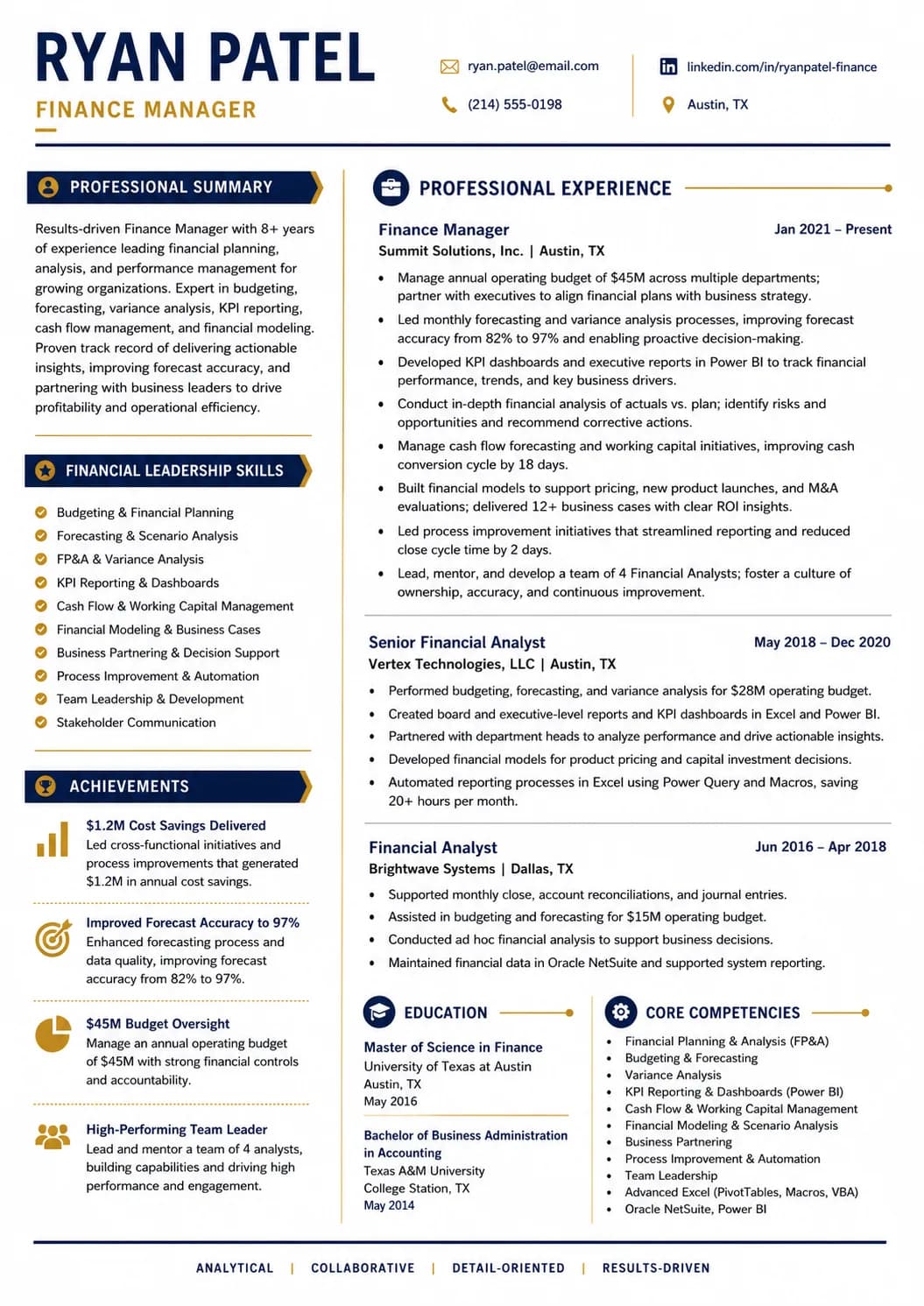
See how a finance manager resume can show budgeting, reporting, forecasting, controls, business partnering, and financial analysis.
CEO Resume Playbook
A strong CEO resume should show strategy, scale, financial accountability, governance, and measurable leadership impact in a way a board or search committee can understand quickly.
A CEO resume is judged differently from a normal management resume. A board, founder, investor, executive search partner, or hiring committee is not looking for a list of daily tasks. They are trying to answer whether the candidate can set direction, allocate resources, build a leadership team, manage risk, communicate with stakeholders, and deliver outcomes under uncertainty. They want to see the scale of the organization, the business model, the financial accountability, the strategic mandate, the people leadership challenge, and the quality of decisions behind the results. A good CEO resume example should make those signals visible without forcing the reader to read a long biography.
This guide focuses on business evidence, not executive buzzwords. You do not need to call yourself visionary in every section. You need to show what you led, what changed, what decisions you made, what operating system you built, and what outcomes followed. Founder work, COO experience, general management, country leadership, president roles, nonprofit executive work, board service, turnaround projects, capital raising, market expansion, and P&L ownership can all become strong CEO resume evidence when you connect them to strategy, governance, financial performance, stakeholder trust, and leadership team maturity. The target keyword for this page is CEO resume example, but the writing is built for practical decision-makers, not keyword padding.
Turn founder, GM, COO, president, business unit, or board-facing experience into clear CEO-level proof.
Write a CEO resume summary that sounds like a business case, not a personal mission statement.
Use CEO resume keywords for ATS and executive search without stuffing the page.
Place P&L scale, board exposure, governance training, strategy, and measurable outcomes where readers can find them quickly.
A CEO resume should answer the leadership mandate directly: what organization you can lead, what scale you have handled, what business challenge you solve, and what outcomes you can defend. That means your resume should show strategic planning, P&L management, board reporting, operating cadence, talent leadership, capital allocation, risk management, and stakeholder communication. A CEO resume example that only lists responsibilities is weak because most chief executives share similar responsibility words. The stronger version explains how you set direction, made tradeoffs, aligned teams, improved performance, communicated with the board, and protected long-term value.
Read the mandate and highlight company stage, ownership model, growth challenge, turnaround need, capital environment, stakeholder map, and industry risk.
Match your summary, skills, and experience bullets to the executive work the organization needs most, as long as the match is honest.
Use a clean format with standard headings so ATS tools, search consultants, and senior readers can scan the resume quickly.
What boards and executive recruiters look for first
Most senior readers look first for fit with the mandate. They want to see company stage, revenue or budget scale, P&L accountability, team size, market exposure, growth or turnaround context, board interaction, and proof that the candidate can manage complexity. In simple terms, they are asking whether you can set direction and make the organization execute. For a CEO resume, this proof should appear in the summary, experience bullets, selected achievements, skills, credentials, and board or advisory details. Do not leave your best evidence buried in a long paragraph. Spread it naturally across the page so both ATS tools and human readers can see leadership scope immediately.
High-priority proof points
Strategy, business model clarity, and market positioning
P&L accountability, revenue growth, margin, cash, and capital allocation
Board reporting, governance, risk management, and stakeholder trust
Executive team development, culture, succession, and organization design
Transformation, turnaround, M&A, expansion, or operating cadence
Good proof for first-time CEOs
Founder, COO, president, GM, or business unit leadership
Full P&L ownership or budget responsibility
Investor updates, board exposure, or governance training
Enterprise-wide transformation projects and operating reviews
Market expansion, customer retention, hiring plans, or cross-functional execution
Writing for both ATS and human readers
Many executive opportunities still pass through applicant tracking systems, retained search databases, board portals, or investor-side talent files. Those systems may parse your resume, and senior readers may also search for specific mandate terms. This is why an ATS-friendly CEO resume should use normal executive language: strategic planning, P&L management, board reporting, revenue growth, capital allocation, operational excellence, transformation leadership, stakeholder management, corporate governance, risk management, M&A integration, executive leadership, market expansion, and succession planning. The goal is not to trick the system. The goal is to describe your real leadership history with the same words boards and search partners use when they assess CEO fit.
Statistical Insight
If your resume says only that you are visionary, results-driven, or strategic, the reader still does not know what you can do. A better CEO resume shows the work behind those qualities. Instead of saying you set strategy, show the market decision, operating plan, capital tradeoff, product focus, or turnaround plan that changed the business. Instead of saying you build teams, show executive hiring, succession planning, decision rights, culture repair, or leadership cadence. The best CEO resume example turns executive claims into observable business actions.
Start with one strong master resume, then adjust it for each mandate. A startup CEO resume, nonprofit CEO resume, private equity portfolio CEO resume, public company CEO resume, family business CEO resume, and turnaround CEO resume should not all sound the same. The core structure can stay similar, but the emphasis should change based on company stage, ownership model, capital structure, stakeholder environment, and strategic challenge. Read the mandate first, mark repeated words, then decide which parts of your background match honestly. Update your summary, skills, and bullets so the reader can see fit before they ask for a call.
Use the mandate wording for strategy, P&L, board reporting, growth, turnaround, capital allocation, governance, transformation, or culture when it matches your experience.
Use action words such as led, scaled, repositioned, allocated, transformed, negotiated, integrated, rebuilt, governed, appointed, expanded, and stabilized.
A good CEO resume is not a complete autobiography. It is a focused leadership document that helps a search committee answer one question: can this person lead this organization through this next chapter? Keep the resume clear, use action words, include numbers where they are accurate, and connect leadership choices to outcomes. Company revenue, budget, headcount, market scope, gross margin, EBITDA, ARR, cash runway, customer retention, geographic expansion, acquisition count, or board cadence can all make a bullet stronger. These details are powerful because they define scale and make the story interview-defensible. For CEO hiring, context is as important as the result. A 20% revenue lift in a small founder-led company, a margin recovery in a private equity portfolio company, and a stable budget outcome in a nonprofit all mean different things. Explain the business situation enough that the achievement is understandable, but do not overload the resume with confidential detail. Use ranges when exact numbers are sensitive, and avoid claims that would require private board materials to verify. Strong CEO writing makes the decision path visible: what problem existed, what tradeoff you made, what operating mechanism you introduced, who needed alignment, and what changed after execution. That level of detail helps a recruiter, board member, investor, or founder see judgment rather than just activity. It also gives you stronger interview material because each bullet can become a clear story about strategy, constraints, stakeholders, and results.
Choosing the best CEO resume format and template
The best CEO resume format is clean, executive, and easy to scan. Senior leadership is complex, but the resume should not feel crowded or theatrical. A board member or search consultant may review many leadership profiles in one sitting, so your layout should help the reader find your executive profile, experience, achievements, board exposure, credentials, and skills without effort. For most CEO candidates, reverse-chronological order is the safest choice because it highlights the most recent leadership scope first. If you are a first-time CEO candidate, you can still use that format while placing P&L ownership, founder experience, COO scope, GM roles, board exposure, or enterprise transformation higher so your strongest proof is not buried.
For the ATS
Use standard headings such as Executive Profile, Experience, Education, Certifications, Skills, and Board Experience.
Save the final resume as a PDF when the search firm or board allows it, or follow the portal instructions exactly.
Spell out important executive terms such as P&L, mergers and acquisitions, board reporting, corporate governance, and strategic planning at least once.
For boards and search committees
Leave enough white space so the resume feels confident rather than overloaded.
Keep company names, titles, dates, scale, outcomes, and ownership model easy to find.
Choose a professional template that supports executive evidence instead of distracting from it.
Do
Use reverse-chronological order when you have CEO, president, COO, founder, GM, or P&L leadership experience because your most recent enterprise scope usually matters most.
Keep the layout straightforward so a reader can find your mandate fit, leadership scale, financial accountability, board exposure, and strongest outcomes quickly.
Don't
Do not use tables, charts, text boxes, heavy graphics, or unusual fonts that can make the resume harder to parse.
Do not stretch a CEO resume into a long biography unless the search firm asks for a full executive dossier, board bio, or detailed transaction history.
Picking the right CEO resume template
Most executives move faster with a tested resume template, but the template must stay subordinate to the evidence. Pick one that keeps the executive profile near the top, gives enough room for achievement bullets, and makes company scale easy to see. Avoid templates that use tiny fonts, decorative bars, heavy icons, complex columns, or design elements that make the resume look like a marketing flyer. A CEO resume template should support credibility, not compete with it. The best template for a CEO resume example is usually modern, restrained, ATS-friendly, and built around clear headings, strong white space, and concise business outcomes.
Browse our resume templates or open the resume builder when you are ready to turn this CEO resume example into your own finished draft. Start with the structure, then replace every sentence with your real leadership scope, company scale, P&L ownership, board exposure, strategic outcomes, credentials, and CEO resume skills.
CEO resume summary example: show enterprise value fast
The CEO resume summary is the short executive profile at the top of the page. It should show enterprise value fast. A strong summary names the leadership context, industry, company stage, and business outcomes that matter most for the target mandate. It can also mention P&L ownership, revenue scale, board communication, transformation, capital allocation, fundraising, M&A, risk management, or years of executive leadership when those details help. Keep it short enough to scan, but specific enough that it does not sound like every other CEO resume.
The main goals of the summary
Name the organization type, company stage, industry, ownership model, or leadership mandate you fit best.
Highlight the CEO strengths that matter most for the role.
Keep the tone measured and specific. Strong CEO resume summaries use real business language, not broad claims about inspiration or passion. A first-time CEO candidate might lead with founder work, COO scope, P&L ownership, operating cadence, and investor updates. A mid-career CEO might lead with revenue growth, retention, executive team rebuilding, board communication, and market expansion. A senior CEO might lead with multi-company leadership, M&A integration, capital allocation, governance, succession planning, turnaround work, and enterprise value creation. The summary should match the candidate’s actual level.
For a first-time CEO candidate, mention founder, COO, president, GM, or P&L leadership experience.
For an experienced CEO, mention company scale, strategic mandate, financial results, board communication, and leadership team outcomes.
For a career-change CEO candidate, connect past executive, functional, operational, commercial, or product leadership to enterprise accountability.
Expert Tip
Skip empty phrases like “visionary leader,” “dynamic executive,” or “proven change agent” unless the surrounding resume proves them. Boards expect strategy, judgment, and communication. Use the limited space to explain where you create value. A better summary says that you are a CEO with B2B SaaS growth and board reporting experience, or a nonprofit executive skilled in fundraising and governance, or a turnaround leader with margin recovery and restructuring experience. This kind of wording helps both ATS tools and real decision-makers.
A simple formula works well: role or executive level + company context + top leadership strengths + business outcome. For example, a first-time CEO resume summary can say that the candidate has founder and COO experience with P&L ownership, investor updates, hiring plans, and operating cadence. A senior CEO resume summary can mention revenue scale, M&A integration, board trust, capital allocation, executive succession, and multi-year transformation. The formula keeps the summary clear without sounding like a generic leadership profile.
When the mandate uses clear language, mirror it. If the role asks for turnaround leadership, write turnaround leadership instead of broad change leadership. If it asks for board reporting, use that exact phrase when it matches your work. If it asks for private equity, fundraising, M&A integration, international expansion, risk management, or operational excellence, include those terms only if you can support them with real experience. This is how you write for ATS without stuffing keywords. The resume still sounds natural because the words are connected to your real executive story. For CEO hiring, context is as important as the result. A 20% revenue lift in a small founder-led company, a margin recovery in a private equity portfolio company, and a stable budget outcome in a nonprofit all mean different things. Explain the business situation enough that the achievement is understandable, but do not overload the resume with confidential detail. Use ranges when exact numbers are sensitive, and avoid claims that would require private board materials to verify. Strong CEO writing makes the decision path visible: what problem existed, what tradeoff you made, what operating mechanism you introduced, who needed alignment, and what changed after execution. That level of detail helps a recruiter, board member, investor, or founder see judgment rather than just activity. It also gives you stronger interview material because each bullet can become a clear story about strategy, constraints, stakeholders, and results.
Adaptable resume summary example
CEO and general manager with experience leading B2B technology and services organizations through growth, operating discipline, and leadership team development. Skilled in strategic planning, P&L management, board reporting, capital allocation, customer retention, market expansion, and cross-functional execution. Known for turning broad strategy into operating cadence, accountable teams, and measurable revenue, margin, and stakeholder outcomes.
CEO experience resume example: prove strategy, scale, and outcomes clearly
The experience section is where a CEO resume becomes credible. It should prove that you can lead through real business constraints, not just speak about leadership. For first-time CEO candidates, this can include founder experience, COO roles, president roles, general management, business unit ownership, country leadership, turnaround projects, or board-facing transformation work. For experienced CEOs, it should show stronger company accountability, strategy, P&L performance, board communication, leadership team development, risk management, and stakeholder trust. For senior CEOs, it should also show multi-year value creation, M&A, capital allocation, succession planning, governance, and complex transformation. The title matters, but the scale and outcomes behind the title matter more.
Statistical Insight
Senior readers care about the work behind the title. If you set strategy, owned P&L, managed board materials, raised capital, led a turnaround, integrated acquisitions, rebuilt the leadership team, improved margins, stabilized culture, or managed external stakeholders, that experience counts. The key is to write it clearly. A bullet like “led company strategy” is too thin. A stronger bullet says “reset the B2B market focus, shifted sales coverage to enterprise accounts, and introduced monthly operating reviews that increased ARR from $14.2M to $22.8M.” The second version gives strategic choice, operating mechanism, and measurable result.
Use reverse-chronological order so your most recent and highest-scope experience appears first. For each role, include the position title, company, location, dates, and short bullets. Start each bullet with an executive action such as led, scaled, rebuilt, repositioned, transformed, integrated, stabilized, negotiated, launched, appointed, allocated, governed, expanded, or improved. Then add business context. Good context includes company size, revenue, budget, headcount, geography, ownership model, market, product line, board relationship, capital structure, or transformation challenge. Numbers can help, but only use them when they are true and explainable.
Position title
Company, organization, portfolio company, founder project, or business unit name
Location and dates
Company scale, industry, ownership model, and strategic mandate
Short bullets that show what you led, changed, governed, scaled, stabilized, or improved
The best CEO resume bullets use clear executive actions. Instead of saying oversaw operations, explain the operating cadence, decision rights, cost program, or customer outcome. Instead of saying improved culture, explain leadership team changes, communication rhythms, succession planning, or engagement actions. Instead of saying grew the business, explain the growth lever: pricing, market focus, product expansion, partnerships, retention, M&A, or sales leadership. A CEO resume example should not make the candidate sound bigger than the truth. It should make the truth sharp enough for a board interview. For CEO hiring, context is as important as the result. A 20% revenue lift in a small founder-led company, a margin recovery in a private equity portfolio company, and a stable budget outcome in a nonprofit all mean different things. Explain the business situation enough that the achievement is understandable, but do not overload the resume with confidential detail. Use ranges when exact numbers are sensitive, and avoid claims that would require private board materials to verify. Strong CEO writing makes the decision path visible: what problem existed, what tradeoff you made, what operating mechanism you introduced, who needed alignment, and what changed after execution. That level of detail helps a recruiter, board member, investor, or founder see judgment rather than just activity. It also gives you stronger interview material because each bullet can become a clear story about strategy, constraints, stakeholders, and results.
Adaptable resume employment history example
Chief Executive Officer, BrightPath Analytics
San Francisco, California | Mar 2021 - Present
Led a 135-person B2B SaaS company through a focused growth plan, increasing ARR from $14.2M to $22.8M while improving gross retention through clearer customer success accountability.
Built quarterly board materials, operating reviews, and KPI dashboards that connected product priorities, cash discipline, pipeline health, and hiring plans to company strategy.
Rebuilt the executive team across sales, product, finance, and people operations, clarifying decision rights and reducing repeated escalation cycles during product launches.
General Manager, Northstar Digital Services
Oakland, California | Jun 2017 - Feb 2021
Owned P&L for a $38M services business across three regions, leading pricing, delivery, customer retention, and operating review cadence.
Introduced margin review routines, client segmentation, and delivery capacity planning that improved EBITDA margin by 5 points over two fiscal years.
Partnered with finance, HR, legal, and sales leaders to improve forecasting, strengthen compliance practices, and prepare acquisition diligence materials.
CEO skills section example: show how you lead the enterprise
The CEO skills section should reflect enterprise leadership, not a list of personality traits. It should help a search consultant, board member, founder, investor, or ATS tool see that you can set direction, manage financial responsibility, communicate with stakeholders, build executive teams, allocate capital, and lead complex change. Good CEO resume skills are connected to real executive work: strategic planning, P&L management, board reporting, capital allocation, revenue growth, operational excellence, corporate governance, stakeholder management, executive leadership, transformation leadership, M&A integration, risk management, succession planning, and culture building.
Keep a longer master list outside your resume, then choose the skills that fit each CEO mandate. A nonprofit CEO may emphasize fundraising, board relations, program sustainability, public partnerships, and compliance. A startup CEO may emphasize product-market fit, fundraising, hiring, customer discovery, and cash runway. A private equity portfolio CEO may emphasize EBITDA, pricing, integration, cash flow, operating reviews, and value creation plans. A public company CEO may emphasize investor communication, regulatory discipline, governance, media visibility, and enterprise risk. The best CEO resume skills are specific enough to show fit but broad enough to reflect the whole organization.
Statistical Insight
Boards and search committees often prioritize skill groups such as:
Strategic planning, market positioning, and business model clarity
P&L management, financial discipline, capital allocation, and cash planning
Board reporting, corporate governance, risk management, and stakeholder communication
Executive team development, organization design, culture, and succession planning
Transformation, turnaround, M&A integration, operating cadence, and value creation
A strong CEO skills section mixes strategic, financial, operational, governance, and people leadership skills. Do not separate skills in a way that makes the page feel scattered. Group them if your template allows it, or list the most important ones first. The most useful CEO resume skills are usually the ones that also appear in your experience bullets. If you list capital allocation, show a bullet where you made investment tradeoffs. If you list board reporting, show a bullet where board materials helped directors make a decision. This makes your skills believable instead of decorative. For CEO hiring, context is as important as the result. A 20% revenue lift in a small founder-led company, a margin recovery in a private equity portfolio company, and a stable budget outcome in a nonprofit all mean different things. Explain the business situation enough that the achievement is understandable, but do not overload the resume with confidential detail. Use ranges when exact numbers are sensitive, and avoid claims that would require private board materials to verify. Strong CEO writing makes the decision path visible: what problem existed, what tradeoff you made, what operating mechanism you introduced, who needed alignment, and what changed after execution. That level of detail helps a recruiter, board member, investor, or founder see judgment rather than just activity. It also gives you stronger interview material because each bullet can become a clear story about strategy, constraints, stakeholders, and results.
Adaptable resume skills section example
Strategic planning
P&L management
Board reporting
Capital allocation
Revenue growth
Executive leadership
Education resume example: keep executive training and credentials easy to find
Education matters on a CEO resume when it supports the mandate, industry, governance environment, or leadership credibility. Include degrees, executive education, MBA or EMBA credentials, board director education, industry training, finance programs, leadership institutes, or sector-specific qualifications when they strengthen the business case. For a first-time CEO candidate, education may help explain readiness for a wider mandate, especially if it includes governance, finance, strategy, or industry specialization. If a program is in progress, write the expected completion date clearly. Do not overstate credentials, because senior hiring conversations often verify details.
Once you have extensive CEO experience, company outcomes usually lead the page. But education and credentials still need to be easy to find. This is especially important in financial services, healthcare, education, government contracting, engineering, energy, nonprofit, and regulated industries where governance, licensing, compliance, or technical credibility may matter. Use exact wording for degrees, director programs, leadership courses, and certifications when possible. A small wording mistake can create unnecessary doubt, while clear credential wording helps readers confirm that your background fits the role requirements.
Adaptable resume education example
MBA, University of California, Berkeley, Haas School of Business | Berkeley, California | 2017
Executive education, board, and governance credentials
Senior readers should be able to spot relevant executive credentials quickly. Include board director education, corporate governance programs, executive leadership programs, financial literacy courses, risk management training, change leadership programs, cybersecurity governance, ESG or sustainability governance, M&A training, industry licenses, or sector-specific compliance credentials that support the target CEO mandate. If the role sits in a regulated industry, the right credential may carry more weight than a generic leadership course. If a credential is pending or in progress, state that clearly and include the expected completion date when you have one.
Corporate Governance Executive Program | 2024
Executive Leadership Program, Stanford Graduate School of Business | 2022
Before applying, make sure your credential wording, board experience, industry training, and leadership claims match the mandate. This matters for both ATS tools and human readers. If the organization asks for corporate governance, nonprofit board relations, financial services licensing, healthcare compliance, enterprise risk, ESG reporting, M&A integration, or investor communication, use exact wording only when it fits your background. Do not exaggerate. Trust is one of the most important parts of a CEO resume, and accuracy is part of trust.
Adaptable resume certifications example
Corporate Governance Executive Program | 2024
Executive Leadership Program, Stanford Graduate School of Business | 2022
Bullet upgrade
Weak vs strong CEO resume bullets
Use the stronger version as the model: start with a clear executive action, add business context, and include the outcome or decision quality that proves the work mattered. CEO resume bullets should show the situation, the leadership choice, the operating mechanism, and the business result. This matters because executive readers will challenge vague claims quickly. A bullet should help them understand the scope and give you a credible interview story. For CEO hiring, context is as important as the result. A 20% revenue lift in a small founder-led company, a margin recovery in a private equity portfolio company, and a stable budget outcome in a nonprofit all mean different things. Explain the business situation enough that the achievement is understandable, but do not overload the resume with confidential detail. Use ranges when exact numbers are sensitive, and avoid claims that would require private board materials to verify. Strong CEO writing makes the decision path visible: what problem existed, what tradeoff you made, what operating mechanism you introduced, who needed alignment, and what changed after execution. That level of detail helps a recruiter, board member, investor, or founder see judgment rather than just activity. It also gives you stronger interview material because each bullet can become a clear story about strategy, constraints, stakeholders, and results.
Weak
Led the company and managed the team.
Stronger
Led a 120-person B2B services company through a margin recovery plan by resetting pricing discipline, restructuring delivery teams, and introducing monthly operating reviews that improved EBITDA margin by 6 points over 18 months.
The stronger bullet gives company scale, business context, leadership actions, operating rhythm, and measurable impact. That is much stronger than saying you led the company.
Weak
Worked with the board on strategy.
Stronger
Prepared quarterly board materials that connected market risks, cash runway, hiring plans, customer retention, and product investment tradeoffs so directors could approve a focused 12-month growth plan.
This version shows what was discussed with the board and why it mattered. Board communication is stronger when it is tied to decisions, risk, capital, and strategic alignment.
Weak
Increased revenue.
Stronger
Expanded annual recurring revenue from $8.4M to $12.1M by narrowing ICP focus, rebuilding the sales leadership cadence, improving renewal accountability, and launching two enterprise partnership channels.
The stronger version explains how revenue growth happened. It avoids an empty growth claim by showing commercial strategy, execution levers, and a defensible result.
ATS keyword bank
CEO resume keywords for ATS
Executive recruiters, boards, founders, private equity teams, and applicant tracking systems often scan for exact leadership language. Use these CEO resume keywords only when they honestly match your background. Good keywords are not magic words. They are normal executive terms that help the reader understand fit: strategic planning, P&L management, board reporting, revenue growth, capital allocation, operational excellence, change management, stakeholder management, executive leadership, and corporate governance.
Use CEO resume keywords only when they match your real background. Do not stuff the page with the same phrase again and again. The safest method is to mirror the mandate language for company stage, revenue ownership, board relationship, growth challenge, risk profile, capital strategy, market expansion, and transformation goals, then place those words naturally in the summary, skills, experience bullets, credentials, and selected achievements.
Matching application
CEO cover letter tips
Pair this resume with a short CEO cover letter or executive note that explains why your leadership history fits the mandate. Do not repeat the whole resume. Use the letter to connect one or two results to the company’s situation, ownership model, strategic challenge, and stakeholders. A CEO cover letter should sound like a business case, not a personal mission statement.
Name the company stage, ownership model, sector, growth challenge, turnaround need, or stakeholder environment you are targeting in the first paragraph.
Connect one strong resume example to strategy, P&L ownership, board communication, operating discipline, culture, transformation, or measurable value creation.
Explain why your executive leadership style fits the mandate instead of repeating your CEO resume summary.
Before you send your CEO resume, review it against the mandate one last time. Look for missing company-stage terms, P&L scale, board language, capital or cash-flow context, stakeholder details, transformation evidence, governance proof, and measurable outcomes. Small changes can make the resume feel far more relevant to the people deciding whether to advance a senior leadership conversation.
Did you name the exact CEO context you are targeting, such as startup, scale-up, nonprofit, private equity portfolio company, family business, turnaround, public company, or business unit CEO?
Did you show company scale, revenue range, team size, market scope, P&L ownership, capital responsibility, or operating model where you can do so ethically?
Did your CEO resume summary match the mandate instead of sounding like a broad leadership biography?
Did you include honest ATS and executive-search keywords from the posting, such as strategic planning, P&L management, board reporting, growth strategy, transformation, governance, capital allocation, or stakeholder management?
Did your experience bullets show decisions, tradeoffs, leadership systems, operating cadence, and measurable business impact instead of only listing responsibilities?
Did you mention tools, frameworks, or environments such as OKRs, KPI dashboards, ERP, CRM, investor reporting, board packs, M&A diligence, enterprise risk, or operating reviews only if you used them?
Is the layout simple enough for ATS parsing and mature enough for board members, executive recruiters, founders, investors, or hiring committees to scan in less than one minute?
Did you save the resume as a PDF unless the executive search firm, company, board, or application portal asks for another file type?
Before applying, compare the CEO resume against the actual mandate, not only the title. Look for repeated words about company stage, growth, turnaround, profitability, fundraising, governance, board communication, culture, product-market fit, market expansion, compliance, acquisition integration, or operational discipline. A strong CEO resume example is not copied word for word. It is tailored so the reader can see why the candidate fits this exact organization, ownership model, stakeholder environment, and leadership challenge. For CEO hiring, context is as important as the result. A 20% revenue lift in a small founder-led company, a margin recovery in a private equity portfolio company, and a stable budget outcome in a nonprofit all mean different things. Explain the business situation enough that the achievement is understandable, but do not overload the resume with confidential detail. Use ranges when exact numbers are sensitive, and avoid claims that would require private board materials to verify. Strong CEO writing makes the decision path visible: what problem existed, what tradeoff you made, what operating mechanism you introduced, who needed alignment, and what changed after execution. That level of detail helps a recruiter, board member, investor, or founder see judgment rather than just activity. It also gives you stronger interview material because each bullet can become a clear story about strategy, constraints, stakeholders, and results.
Before You Start Writing
Key takeaways
Tailor each CEO resume to the company stage, ownership model, industry, mandate, and stakeholder environment.
Use a clean, board-ready layout that works for both ATS tools and executive search review.
Write a summary that shows leadership scope, business impact, and executive judgment instead of generic ambition.
Use founder, GM, COO, president, VP, board, advisory, or transformation work as proof when you are moving into a first CEO role.
Balance strategy, P&L ownership, operating discipline, stakeholder trust, governance, and people leadership.
Make company scale, financial accountability, board exposure, credentials, and measurable outcomes easy to verify.
Start with this CEO resume example, then build a matching executive cover letter that speaks directly to the company stage, board, founder, investor group, industry, or leadership mandate you want. The builder can help you turn the structure into a clean resume faster, but your real strategic proof is what makes the application strong.