Resume ExampleEducationMid Level

Art Teacher Resume Examples & Writing Guide

Use this art teacher resume example to write a clear, ATS-friendly resume that shows visual arts curriculum planning, studio classroom management, student portfolio development, art media instruction, assessment, exhibitions, and license status.

Experience Level
Mid Level
Category
Education
Reader Rating
4.7 / 5
  • Tailor every art teacher resume to the grade level, visual arts course, school, and posting.
  • Use a clean layout that works for both ATS tools and busy school hiring teams.
  • Write a summary that shows studio classroom value, student support, media knowledge, and license readiness.
Resume Example (Text Format)

Maya Reynolds

Art Teacher

maya.reynolds@email.com | (443) 555-1892 | Baltimore, Maryland | linkedin.com/in/maya-reynolds-art

Profile

Entry-level art teacher with student teaching, museum education, and after-school workshop experience in elementary and middle school visual arts. Skilled in lesson planning, studio classroom management, drawing, painting, mixed media, digital art basics, portfolio development, Google Classroom, and family updates. Ready to support student creativity with safe routines, clear demonstrations, fair rubrics, and patient critique.

Work Experience

Student Art Teacher, Greenfield Elementary School

Baltimore, Maryland | Jan 2024 - May 2024

  • Designed and taught drawing, painting, and collage lessons aligned with district visual arts standards and mentor teacher feedback.
  • Supported small-group art instruction, adapted demonstrations for varied skill levels, and used sketchbook checks to monitor progress.
  • Organized materials, reinforced studio cleanup routines, and collaborated with mentor teachers on positive classroom management expectations.

Youth Art Instructor, Bright Futures Arts Center

Baltimore, Maryland | 2022 - 2024

  • Led one-on-one and small-group art sessions for K-8 students using drawing exercises, color theory activities, and mixed-media projects.
  • Built simple progress notes and parent updates to explain student strengths, project goals, and at-home practice ideas.
  • Used games, visual prompts, guided practice, and confidence-building critique to improve participation and creative risk-taking.

Education

  • B.A. in Art Education, Towson University | Towson, Maryland | 2024

Languages

  • Spanish

Certifications

  • Maryland Initial Professional License Eligible, Visual Arts
  • CPR / First Aid Certified | 2024

Skills

  • Visual arts curriculum
  • Studio classroom management
  • Drawing and painting
  • Student assessment
  • Google Classroom
  • Portfolio development

A strong art teacher resume should show that you can plan visual arts lessons, manage a safe studio classroom, teach creative techniques, support students with different skill levels, assess artwork fairly, and communicate with families and staff. This is true whether you are writing an entry-level art teacher resume, a mid-career art teacher resume, or a senior art teacher resume. Schools are not only looking for someone who makes good art. They are looking for someone who can turn art standards into clear lessons, keep materials and tools organized, help students build confidence, guide critique, and connect creative work to learning goals. That is why this art teacher resume example focuses on proof. It shows how to turn student teaching, studio workshops, museum education, after-school programs, substitute teaching, and full-time visual arts teaching into clear resume content.

Quick breakdown

Why this art teacher resume works

1

It makes the candidate easy to understand in a few seconds: what art levels they teach, what media they can support, and why they are ready to manage a safe, productive studio classroom.

2

It uses art teacher resume keywords naturally, so the resume can work for ATS tools and still sound human to a principal, department chair, or arts coordinator.

3

It turns teaching experience into proof by showing lesson planning, studio routines, portfolio development, critique, exhibitions, differentiated instruction, and student progress.

4

It keeps license status, education, art media strengths, classroom skills, and real student outcomes easy to find instead of hiding them under vague creative language.

Fast template guide

What to copy from this art teacher resume example

Do not copy the resume word for word. Copy the structure, the section order, and the level of detail. A strong art teacher resume example teaches you what to show: grade level, visual arts course fit, lesson planning, studio safety, media instruction, student support, classroom management, assessment rubrics, critique, family communication, exhibitions, portfolio work, and license status. Your own version should use your real school names, placements, student groups, media strengths, tools, and results.

A clear header that names the target art teaching role, grade band, certification status, and contact details without crowding the top of the page.

A focused art teacher resume summary that explains visual arts teaching fit, not a broad statement about being creative.

Student teaching, classroom teaching, museum education, after-school art programs, or studio instruction written as real teaching proof with grade levels, media, curriculum, and student support details.

Teaching license, visual arts endorsement, art education degree, portfolio link, or certification eligibility placed where a school can verify it quickly.

Art teacher resume skills such as visual arts curriculum, drawing, painting, ceramics, digital art, classroom management, studio safety, critique facilitation, assessment rubrics, and art history connections written in plain school language.

Build the right structure

Art teacher resume sections to include

A strong art teacher resume should include the sections employers expect to scan quickly, plus optional sections that help you prove readiness when your experience is still growing. The goal is not to add every possible section or turn the resume into a full portfolio. The goal is to build a page that lets a school understand your art teaching fit, verify your education and license, see the studio classroom work you can already do, and find a portfolio link when it helps.

Must-have sections

  • Contact information
  • Art teacher resume summary or objective
  • Teaching experience, student teaching, art tutoring, museum education, or studio instruction experience
  • Education
  • Teaching license, certification, visual arts endorsement, or eligibility
  • Art teacher skills

Optional sections that strengthen the resume

  • Student teaching
  • Practicum experience
  • After-school art instruction
  • Museum or gallery education
  • Portfolio link
  • Student exhibitions
  • Relevant coursework
  • Professional development
  • Art education technology
  • Languages
  • Teaching philosophy

An art teacher resume should not read like a general artist bio or a generic classroom resume. Schools need to see visual arts teaching proof, license status, education, grade-level fit, studio management, media knowledge, and the way you support students with different skill levels. For a new art teacher, student teaching, practicum work, camps, museum programs, art tutoring, substitute teaching, youth workshops, and volunteer instruction can all count when you write them with clear classroom details. For an experienced art teacher, the resume should move faster into curriculum design, student portfolios, assessment rubrics, safe studio routines, exhibitions, cross-curricular projects, and department leadership. The best art teacher resume example keeps these sections simple because hiring teams need to scan many applications quickly.

Smarter ordering

Best art teacher resume section order

The best section order depends on your experience level. A new art teacher should not use the same structure as a senior candidate with years of studio classroom results. Place your strongest proof where the reader will see it first. For a new art teacher, that may be education, student teaching, practicum, art tutoring, museum programs, and portfolio work. For an experienced art teacher, it is usually classroom experience, student portfolios, studio routines, curriculum depth, and grade-level or course expertise.

Entry-level art teacher

  1. Contact information
  2. Art teacher resume objective or short summary
  3. Education and visual arts license eligibility
  4. Student teaching, practicum, art tutoring, museum education, or studio support
  5. Art teacher skills
  6. Relevant coursework, portfolio link, volunteer art programs, or classroom projects
  7. Professional development or art education technology

Experienced art teacher

  1. Contact information
  2. Art teacher resume summary
  3. Art teaching experience
  4. License, certifications, and visual arts endorsements
  5. Art teacher skills
  6. Education
  7. Professional development, exhibitions, awards, or department leadership

Career-change art teacher

  1. Contact information
  2. Transferable art teacher resume summary
  3. Teaching-related art experience
  4. Transferable creative, training, or youth work experience
  5. Education and certification pathway
  6. Art teacher skills
  7. Portfolio, workshops, camps, tutoring, or community arts work

Put the strongest proof near the top. A new art teacher can lead with education, license eligibility, student teaching, and art media strengths because those details prove readiness. An experienced art teacher should lead with classroom results, grade-level fit, studio routines, curriculum depth, student portfolio outcomes, and exhibition work. A career-change art teacher should connect past creative work to teaching duties such as planning workshops, coaching artists, managing materials, communicating with families, supervising groups, assessing work, and building inclusive learning experiences, then show the certification pathway clearly.

Choose an art teacher resume example by experience level

Use this template

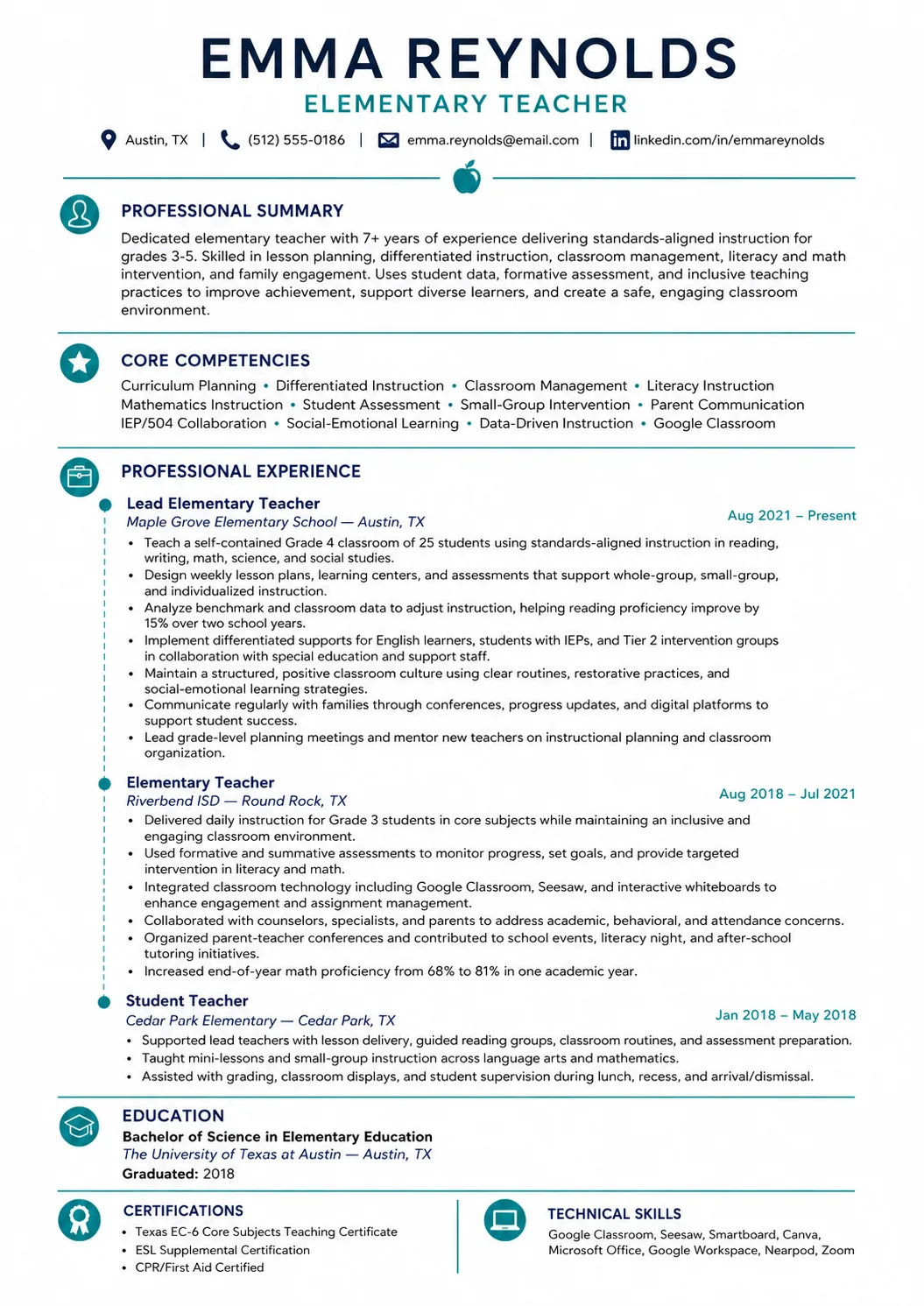
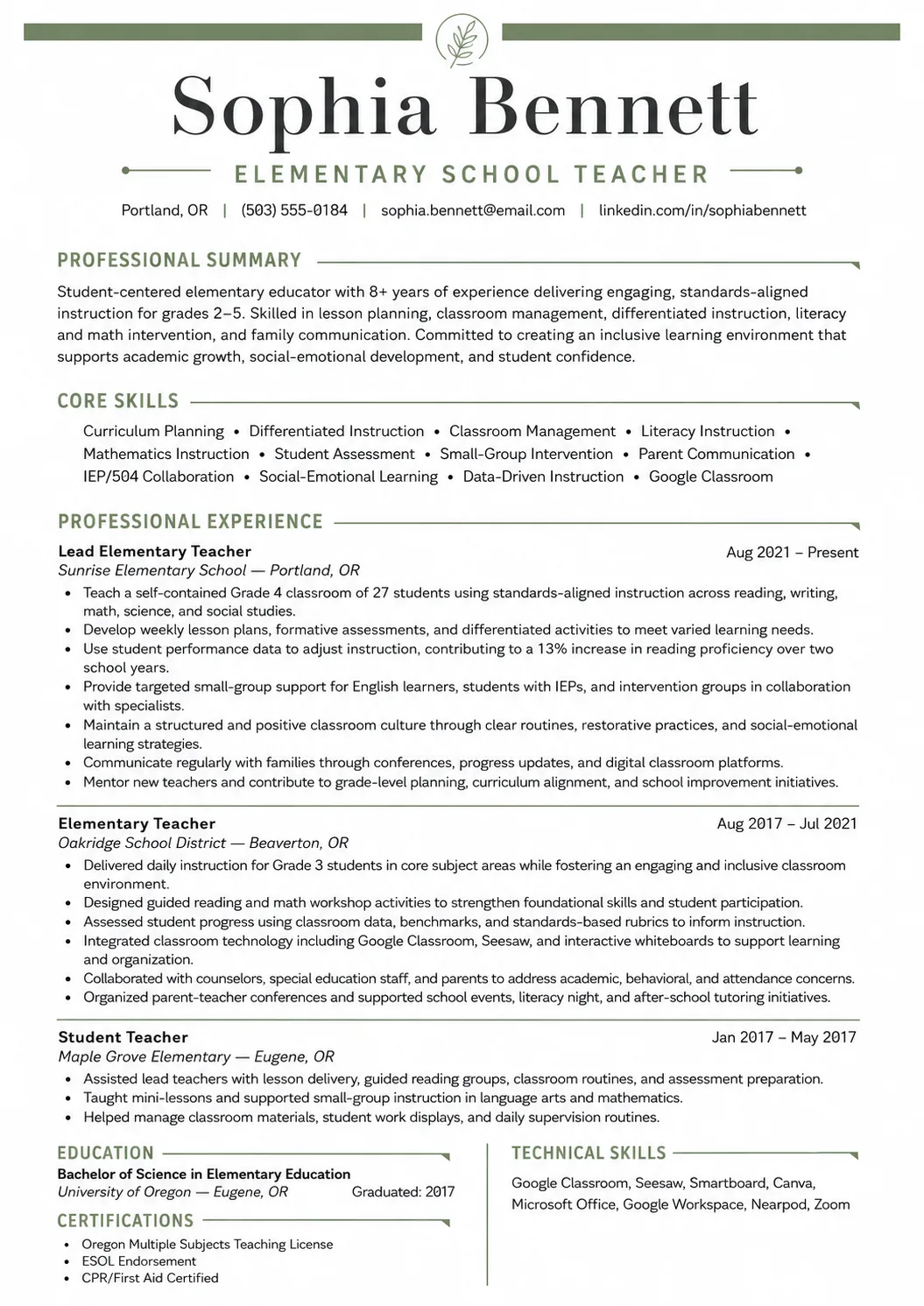
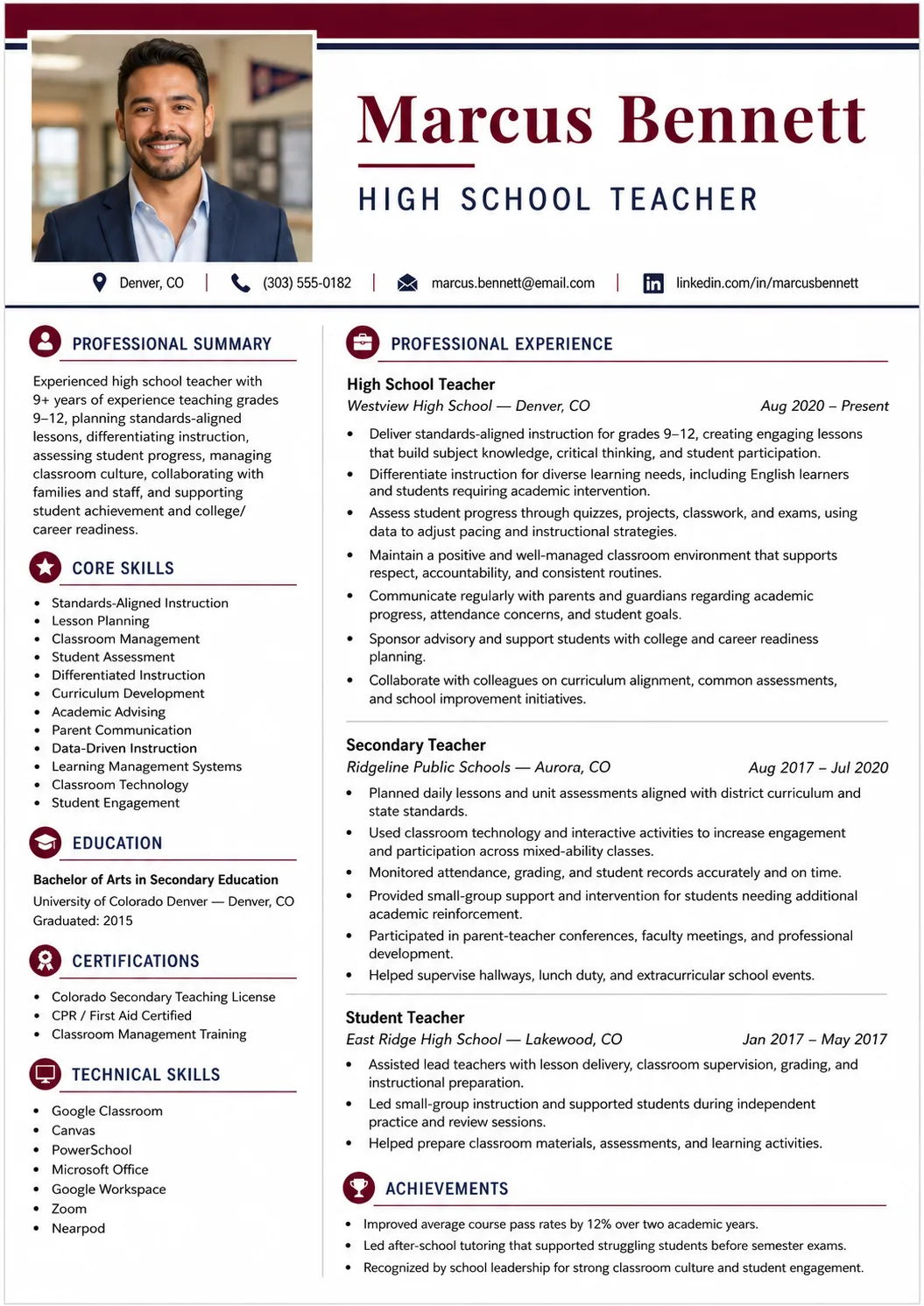
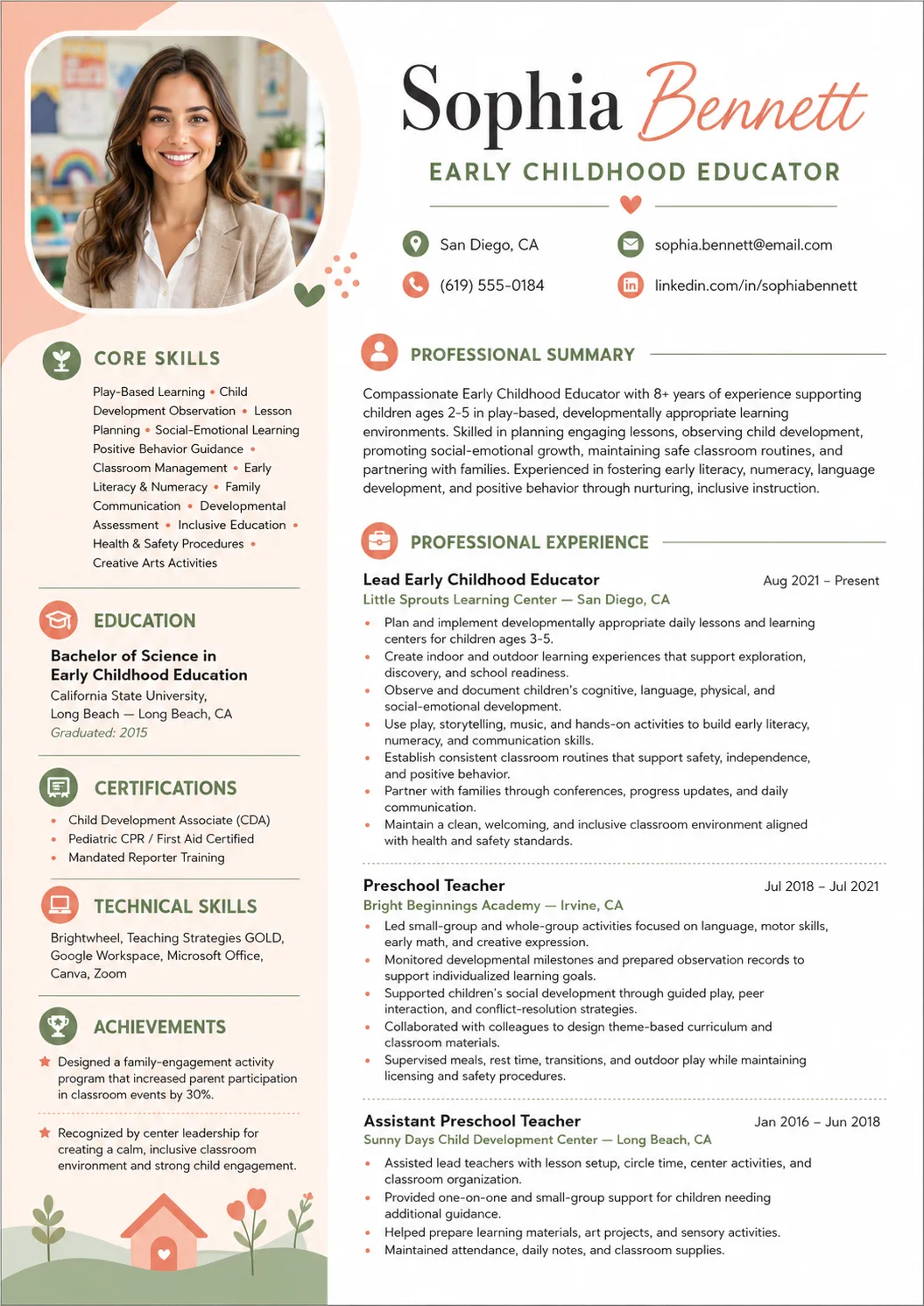
Use this mid-career art teacher example to study how classroom ownership, studio routines, student portfolios, assessment rubrics, media instruction, exhibitions, and family communication take priority over student teaching details.

Art Teacher Resume Playbook

A strong art teacher resume should show visual arts instruction, safe studio management, student creativity, and clear license status in a way a school can understand quickly.

A school hiring team does not read an art teacher resume the same way it reads a normal office resume or a fine artist bio. A principal, department chair, arts coordinator, district recruiter, or school HR team is usually scanning for very specific proof. They want to know the grade level or visual arts courses you can teach, the media and techniques you can demonstrate, the studio routines you can manage, the curriculum or standards you can work with, and whether your license or eligibility is clear. They also want to see if you can support students who have different skill levels, use assessment rubrics fairly, keep materials and tools safe, communicate with families, and help students talk about their creative choices. A good art teacher resume example should make all of that easy to see without forcing the reader to dig.

That is why this guide focuses on plain proof, not fancy creative language. You do not need dramatic wording to write a strong art teacher resume. You need specific classroom and studio details. Student teaching, practicum work, art tutoring, museum education, after-school art clubs, summer camps, community workshops, substitute teaching, gallery programs, and full-time art teaching can all become strong resume evidence when you connect them to visual arts curriculum, classroom management, studio safety, differentiated instruction, critique, portfolio development, parent communication, and student work outcomes. The target keyword for this page is art teacher resume example, but the content is written to help a real person build a better resume, not just to repeat a keyword.

  • Turn student teaching, art tutoring, museum education, workshops, and studio support into strong resume proof.
  • Write an art teacher resume summary that sounds specific, calm, creative, and useful.
  • Use art teacher resume keywords for ATS without stuffing the page.
  • Place education, license status, visual arts endorsements, certifications, and portfolio details where schools can find them quickly.

How to write an art teacher resume

A strong art teacher resume should make three things clear within a few seconds: what art levels you teach, what media or course areas you can support, and why the school can trust you in a studio classroom. That means your resume should show grade-level fit, visual arts curriculum, studio routines, student support, assessment, critique, communication, and license status. An art teacher resume example that only lists duties is weak because many art teachers share similar duties. The stronger version explains how you planned lessons, demonstrated techniques, adapted projects, managed materials, supported safety, tracked progress, worked with families, and helped students move from basic skills toward stronger creative decisions.

  1. Read the job posting and highlight the grade level, visual arts course, license, curriculum, student support needs, studio equipment, media areas, and technology tools.
  2. Match your summary, skills, and experience bullets to the art teaching work the school cares about most, as long as the match is honest.
  3. Use a clean format with standard headings so ATS tools and busy school hiring teams can scan the resume quickly.

What schools look for first

Most schools look for proof that you can run the daily art classroom. They want to see visual arts lesson planning, studio classroom management, student engagement, assessment, differentiation, safety, and communication. In simple terms, they want to know that you can turn art standards into lessons, set up materials before class, demonstrate techniques clearly, keep students focused, notice when students are struggling, protect tools and equipment, and adjust your teaching. For an art teacher resume, this proof should appear in the summary, skills, experience bullets, education, certifications, and portfolio details. Do not leave your best studio teaching details trapped inside one section. Spread them naturally across the page so both ATS tools and human readers can see them.

High-priority proof points

  • Visual arts curriculum and standards alignment
  • Studio classroom management and safe material routines
  • Differentiated instruction, critique, and student assessment
  • Portfolio development, exhibitions, and student reflection
  • Teaching license, visual arts endorsement, or eligibility

Good proof for new art teachers

  • Student teaching and art practicum placements
  • Museum education, art tutoring, camps, or after-school programs
  • Small-group instruction and guided studio practice
  • Digital art tools such as Google Classroom, Adobe, Canva, or Procreate
  • Community arts projects, gallery programs, mentoring, or volunteer teaching

Writing for both ATS and human readers

Many schools and districts collect applications through online systems. Those systems may parse your resume, and the people reading the resume may also search for clear terms from the job posting. This is why an ATS-friendly art teacher resume should use normal school and art education language: visual arts curriculum, classroom management, studio safety, differentiated instruction, student assessment, assessment rubrics, portfolio development, critique facilitation, drawing, painting, ceramics, digital art, art history, parent communication, Google Classroom, special education support, or grade-level instruction. The goal is not to trick the system. The goal is to describe your real background with the same words schools use when they hire art teachers.

Statistical Insight

If your resume says only that you are creative, passionate, or dedicated, the reader still does not know what you can do. A better art teacher resume shows the work behind those qualities. Instead of saying you inspire students, show how you guided sketchbook practice, adapted a sculpture project, created a critique routine, tracked portfolio growth, built a safe cleanup system, or communicated with families about student work. Instead of saying you are organized, show material preparation, storage systems, rubric use, exhibition planning, or classroom procedures. The best art teacher resume example turns soft claims into visible studio classroom actions.

Start with one strong master resume, then adjust it for each school. An elementary art teacher resume, middle school art teacher resume, high school art teacher resume, ceramics teacher resume, digital art teacher resume, and visual arts teacher resume should not all sound the same. The core structure can stay similar, but the wording should change based on grade level, media area, student needs, studio resources, and the school environment. Read the posting first, mark the repeated terms, and decide which parts of your background match honestly. Then update your summary, skills, and bullets so the school sees fit right away.

  1. Use the posting's wording for grade level, art standards, media area, classroom management, safety, assessment, and tools when it matches your experience.
  2. Use action words such as planned, taught, demonstrated, adapted, assessed, guided, prepared, displayed, coordinated, mentored, and improved.

A good art teacher resume is not a long list of every project you have ever taught or every medium you have ever tried. It is a focused document that helps a school answer one question: can this person help our students create, understand, and reflect in a safe art classroom? Keep the resume clear, use action words, include numbers where they are true, and connect your work to student learning. For example, class size, grade level, media type, art standard, critique method, rubric, exhibition, portfolio review, or family communication routine can all make a bullet stronger. These details are simple, but they make the resume feel real.

Choosing the best art teacher resume format and template

The best art teacher resume format is clean, simple, and easy to read. Art teaching is a creative job, but the resume still needs a professional structure. A school may have hundreds of applications, so your layout should help the reader find your summary, experience, education, certifications, portfolio link, and skills without effort. For most art teachers, reverse-chronological order is the safest choice because it highlights recent classroom and studio work first. If you are a new art teacher, you can still use that format while placing education, student teaching, practicum, art tutoring, museum education, or workshop experience higher so your strongest proof is not buried.

For the ATS

  • Use standard headings such as Summary, Experience, Education, Certifications, Portfolio, and Skills.
  • Save the final resume as a PDF when the school allows it, or follow the portal instructions exactly.
  • Spell out important licenses, visual arts endorsements, grade bands, media areas, and school tools at least once.

For principals and arts hiring teams

  • Leave enough white space so the page does not feel crowded.
  • Keep dates, school names, job titles, locations, license details, and portfolio links easy to find.
  • Choose a professional template that supports your writing instead of distracting from studio teaching proof.
Do

Use reverse-chronological order when you have art teaching experience, because your most recent classroom and studio work usually matters most.

Keep the layout straightforward so a reader can find your license, grade level, media strengths, portfolio, and strongest experience quickly.

Don't

Do not use tables, charts, text boxes, heavy graphics, or unusual fonts that can make the resume harder to read, even for an art role.

Do not stretch an art teacher resume beyond two pages unless the school asks for a full academic CV, teaching portfolio, or detailed exhibition record.

Picking the right art teacher resume template

Most art teachers move faster with a tested resume template. Pick one that keeps the summary near the top, gives enough room for classroom bullets, and makes license and portfolio details easy to spot. Avoid templates that use tiny fonts, heavy icons, complex columns, or design elements that take attention away from your teaching proof. A creative resume does not need to look like a poster. An art teacher resume template should support the content, not compete with it. The best template for an art teacher resume example is usually modern, simple, and ATS-friendly, with clear headings and enough white space for quick scanning.

Browse our resume templates or open the resume builder when you are ready to turn this art teacher resume example into your own finished draft. Start with the structure, then replace every sentence with your real classroom experience, grade level, media strengths, license details, portfolio link, and art teacher resume skills.

Art teacher resume summary example: show studio fit fast

The art teacher resume summary is the short paragraph at the top of the page. It should show studio classroom fit fast. A strong summary names the role or experience level, the grade band or course area, and the art teaching strengths that matter most for the job. It can also mention student portfolio development, studio safety, family communication, art education technology, license status, or years of experience when those details help. Keep it short enough to scan, but specific enough that it does not sound like every other art teacher resume.

The main goals of the summary

  • Name the students, grade band, art course, media area, or school setting you fit best.
  • Highlight the art teaching strengths that matter most for the job.

Keep the tone warm and professional, but stay specific. Strong art teacher resume summaries use real art education language, not broad claims about passion or creativity. A new art teacher might lead with student teaching, museum education, workshop experience, studio classroom management, and lesson planning. A mid-career art teacher might lead with grade-level experience, visual arts curriculum, assessment rubrics, portfolio development, and family communication. A senior art teacher might lead with curriculum leadership, exhibition planning, teacher mentoring, department work, or measurable student growth. The summary should match the level of the candidate.

  • For a new art teacher, mention student teaching, practicum work, art tutoring, museum education, workshops, substitute teaching, or studio support.
  • For an experienced art teacher, mention years of experience, grade level, visual arts course area, student portfolio outcomes, studio safety, and leadership.
  • For a career changer, connect past art practice, training, coaching, communication, workshop planning, or youth work to teaching.
Expert Tip

Skip empty phrases like “creative visionary,” “born artist,” or “inspires every student.” Schools expect creativity, care, and patience. Use the limited space to explain what you do in the art classroom. A better summary says that you are an elementary art teacher with student teaching experience in drawing, painting, and mixed media, or a high school art teacher with strong portfolio coaching and digital art experience, or a ceramics teacher skilled in kiln safety and studio routines. This kind of wording helps both ATS tools and real hiring teams.

A simple formula works well: role or experience level + grade or art course fit + top teaching skills + student support value. For example, an entry-level art teacher resume summary can say that the candidate has student teaching and museum education experience in elementary and middle school art classrooms, with skills in lesson planning, drawing, painting, studio routines, portfolio checks, and parent updates. A senior art teacher resume summary can mention visual arts curriculum leadership, teacher mentoring, assessment rubrics, exhibition planning, and student portfolio growth. The formula keeps the summary clear without sounding robotic.

When the posting uses clear language, mirror it. If the job asks for studio classroom management, write studio classroom management instead of creative learning environment. If it asks for differentiated instruction, use that exact phrase when it matches your work. If it asks for Google Classroom, Canvas, Adobe Creative Cloud, ceramics, digital art, portfolio development, critique, or parent communication, include those terms only if you can support them with real experience. This is how you write for ATS without stuffing keywords. The resume still sounds natural because the words are connected to your real art teaching story.

Adaptable resume summary example

Entry-level art teacher with student teaching, museum education, and after-school workshop experience in elementary and middle school visual arts. Skilled in lesson planning, studio classroom management, drawing, painting, mixed media, digital art basics, portfolio development, Google Classroom, and family updates. Ready to support student creativity with safe routines, clear demonstrations, fair rubrics, and patient critique.

Art teacher experience resume example: prove classroom and studio work clearly

The experience section is where your art teacher resume becomes believable. It should prove that you can work with students in real visual arts settings. For new art teachers, this can include student teaching, practicum placements, art tutoring, museum education, classroom aide work, camps, mentoring, after-school art programs, gallery workshops, or substitute teaching. For experienced art teachers, it should show stronger classroom ownership, student portfolios, curriculum work, assessment, studio routines, exhibitions, and family communication. For senior art teachers, it should also show leadership, mentoring, department planning, community arts partnerships, or training other staff. The title matters, but the studio classroom work behind the title matters more.

Statistical Insight

Schools care about the work behind the title. If you planned lessons, demonstrated techniques, supported behavior, tracked portfolio progress, prepared materials, managed tools, communicated with families, adjusted instruction, used assessment rubrics, guided critique, or helped students build creative confidence, that experience counts. The key is to write it clearly. A bullet like “helped students with art” is too thin. A stronger bullet says “supported small-group watercolor instruction for Grade 5 students by modeling brush control, using quick sketchbook checks, and giving individual feedback during studio time.” The second version gives grade level, medium, teaching method, and support type.

Use reverse-chronological order so your most recent and most relevant experience appears first. For each role, include the position title, school or program, location, dates, and short bullets. Start each bullet with a teaching action such as planned, taught, demonstrated, adapted, assessed, supported, guided, prepared, coordinated, displayed, mentored, communicated, or improved. Then add the art classroom context. Good context includes class size, grade level, medium, project type, student group, critique method, assessment rubric, technology, family contact, exhibition, or learning goal. Numbers can help, but only use them when they are true.

  • Position title
  • School, museum, program, studio, or organization name
  • Location and dates
  • Grade levels, art courses, media areas, or student groups you supported
  • Short bullets that show what you taught, demonstrated, assessed, displayed, or improved

The best art teacher resume bullets use clear teaching actions. Instead of saying helped students, explain how you helped them. Instead of saying managed the art room, explain the routines, material systems, tool safety rules, transitions, cleanup steps, or engagement strategies you used. Instead of saying improved creativity, explain the critique routine, portfolio review, feedback method, sketchbook practice, rubric, or exhibition process that supported progress. An art teacher resume example should not make the candidate sound bigger than the truth. It should make the truth easy to understand. That is what makes the experience section credible.

Adaptable resume employment history example

Student Art Teacher, Greenfield Elementary School

Baltimore, Maryland | Jan 2024 - May 2024

  • Designed and taught drawing, painting, and collage lessons aligned with district visual arts standards and mentor teacher feedback.
  • Supported small-group art instruction, adapted demonstrations for varied skill levels, and used sketchbook checks to monitor progress.
  • Organized materials, reinforced studio cleanup routines, and collaborated with mentor teachers on positive classroom management expectations.

Youth Art Instructor, Bright Futures Arts Center

Baltimore, Maryland | 2022 - 2024

  • Led one-on-one and small-group art sessions for K-8 students using drawing exercises, color theory activities, and mixed-media projects.
  • Built simple progress notes and parent updates to explain student strengths, project goals, and at-home practice ideas.
  • Used games, visual prompts, guided practice, and confidence-building critique to improve participation and creative risk-taking.

Art teacher skills section example: show what you do every day

The art teacher skills section should reflect daily studio classroom work. It should help a principal, arts coordinator, school recruiter, or ATS tool see that you can plan, teach, demonstrate, assess, manage, communicate, and support students. Good art teacher resume skills are not random personality words. They are skills connected to actual art teaching: visual arts curriculum, studio classroom management, drawing, painting, ceramics, sculpture, printmaking, digital art, art history integration, differentiated instruction, student assessment, portfolio development, critique facilitation, family communication, Google Classroom, inclusive learning, and studio safety.

Keep a longer master list outside your resume, then choose the skills that fit each school posting. A good art teacher resume does not need every medium you have ever used. It needs the skills that match the grade level, course area, and student needs in the job description. For example, an elementary art teacher may highlight art foundations, classroom routines, drawing, painting, collage, and family updates. A high school art teacher may highlight portfolio coaching, assessment design, critique, digital art, photography, ceramics, or AP Art and Design support. A special education setting may require adapted materials, sensory-aware routines, IEP collaboration, behavior support, and flexible assessment.

Statistical Insight

Schools often prioritize skill groups such as:

  • Visual arts curriculum, standards alignment, and media instruction
  • Studio classroom management, routines, tool safety, and student engagement
  • Student assessment, critique, portfolio development, and reflection
  • Parent, family, staff, and arts team communication
  • Differentiated instruction, inclusive learning, and adapted materials

A strong art teacher skills section mixes art media skills with classroom management, communication, and student support skills. Do not separate skills in a way that makes the page confusing. Group them if your template allows it, or list the most important ones first. The most useful art teacher resume skills are usually the ones that also appear in your experience bullets. If you list portfolio development, show a bullet where you reviewed student portfolios. If you list studio safety, show a bullet where you taught tool handling or cleanup procedures. If you list digital art, show a bullet where students used a digital platform or design tool. This makes your skills believable instead of decorative.

Adaptable resume skills section example
  • Visual arts curriculum
  • Studio classroom management
  • Drawing and painting
  • Student assessment
  • Google Classroom
  • Portfolio development

Education resume example: keep your degree and visual arts license easy to find

Education matters on every art teacher resume because schools need to verify your degree, teacher preparation program, certification path, visual arts endorsement, and license status. For an entry-level art teacher resume, education may sit near the top because it is one of the strongest signals of readiness. Include your degree, university, location, graduation date, major, minor, art education program, studio concentration, practicum, relevant coursework, honors, field placement, or student teaching when those details help. If you are still completing certification, write the expected date or eligibility clearly. Do not make the school guess.

Once you have more art teaching experience, your classroom results may lead the page. But education, certification, license details, and visual arts endorsement wording still need to be easy to find. This is especially important for public schools, K-12 visual arts roles, specialist art roles, digital art roles, ceramics roles, and roles that require a specific license area. Use exact wording for the license, endorsement, subject, and grade band when possible. A small wording mistake can create confusion, while clear wording helps both ATS tools and hiring teams confirm that you meet the role requirements.

Adaptable resume education example
  • B.A. in Art Education, Towson University | Towson, Maryland | 2024

Teaching licenses and art certifications

Schools should be able to spot your teaching license right away. Include state licenses, provisional licenses, initial professional licenses, visual arts endorsements, CPR or First Aid, child safety training, studio safety training, kiln safety, ceramics safety, Adobe certification, digital media training, museum education credentials, or any other certification that supports the job. If the role requires a certain license, place it near the top of the resume or in a dedicated certifications section. If your license is pending, eligible, or in progress, say that clearly and include the expected completion date when you have one.

  • Maryland Initial Professional License Eligible, Visual Arts
  • CPR / First Aid Certified | 2024

Before applying, make sure your license wording, grade band, visual arts endorsement area, and certification status match the posting. This matters for both ATS tools and human readers. If the school asks for K-12 visual arts, elementary art, secondary art, ceramics, digital media, photography, studio art, or special education collaboration, use the exact wording that fits your background. Do not exaggerate. Clear license wording builds trust, and trust is one of the most important parts of an art teacher resume.

Adaptable resume certifications example
  • Maryland Initial Professional License Eligible, Visual Arts
  • CPR / First Aid Certified | 2024

Bullet upgrade

Weak vs strong art teacher resume bullets

Use the stronger version as the model: start with a clear action, add art classroom context, and include the detail or outcome that proves the work mattered. Art teacher resume bullets should show what you taught, what media or concepts you used, who you supported, how you adjusted instruction, how you handled materials or safety, and how your work helped students create stronger artwork or understand visual ideas more clearly.

Weak

Taught students art.

Stronger

Designed and taught Grade 6-8 drawing and mixed-media lessons that introduced line, value, composition, and critique routines, then used simple rubrics and portfolio checks to track student progress.

The stronger bullet adds grade level, media, art concepts, assessment method, and student progress. That is much stronger than saying you taught art.

Weak

Managed art supplies and classroom behavior.

Stronger

Built clear studio routines for material checkout, cleanup, drying racks, and tool safety, reducing transition time and helping students complete painting and printmaking projects on schedule.

This version shows classroom management in an art room context. It explains routines, materials, safety, and the result for student work.

Weak

Helped with student art show.

Stronger

Coordinated a spring student art exhibition with 140 selected works, prepared labels and display plans, and communicated with families to increase student participation and community attendance.

The stronger version explains scale, responsibilities, communication, and student/community value. Exhibition work is more useful when it is tied to real planning and outcomes.

ATS keyword bank

Art teacher resume keywords for ATS

Schools, recruiters, and applicant tracking systems often scan for exact role language. Use these art teacher resume keywords only when they honestly match your background. Good keywords are not magic words. They are normal art education terms that help the school understand your fit: visual arts curriculum, studio classroom management, drawing, painting, ceramics, digital art, differentiated instruction, assessment rubrics, portfolio development, critique, art history integration, and grade-level instruction.

Visual arts curriculumStudio classroom managementDifferentiated instructionStudent portfolio developmentAssessment rubricsStudio safetyDrawing and painting instructionDigital art toolsArt history integrationGoogle Classroom

Use art teacher resume keywords only when they match your real background. Do not stuff the page with the same phrase again and again. The safest method is to mirror the posting language for grade level, course type, license, visual arts standards, media areas, classroom tools, student support needs, and studio safety requirements, then place those words naturally in your summary, skills, certifications, and experience bullets.

Matching application

Art teacher cover letter tips

Pair this resume with a short art teacher cover letter that explains why you fit the school, what art classroom proof matters most, and why your teaching style fits the students they serve. Do not repeat the whole resume. Use the cover letter to connect one or two resume details to the school’s needs, such as studio safety, student portfolio growth, digital art, ceramics, exhibition planning, or inclusive instruction.

Name the grade level, visual arts course, school type, or student group you are targeting in the first paragraph.

Connect one strong resume example to student portfolio development, studio classroom management, lesson planning, critique, or family communication.

Explain why your art teaching style fits the school instead of repeating your art teacher resume summary.

Final review

Art teacher resume checklist before applying

Before you send your art teacher resume, review it against the job posting one last time. Look for missing grade-level terms, visual arts endorsement wording, curriculum language, media requirements, studio safety needs, student support details, technology tools, portfolio expectations, exhibitions, and family communication details. Small changes can make the resume easier to read and more relevant.

  • Did you name the exact grade level, school type, visual arts course, or student group you want to teach?
  • Did you list your teaching license, visual arts endorsement, certification, or eligibility in clear words?
  • Did your art teacher resume summary match the job posting instead of sounding like a generic artist statement?
  • Did you include honest ATS keywords from the posting, such as visual arts curriculum, classroom management, differentiated instruction, portfolio development, or studio safety?
  • Did your experience bullets show teaching actions, media instruction, student support, assessment, critique, and communication?
  • Did you mention tools such as Google Classroom, Canvas, PowerSchool, Adobe Creative Cloud, Procreate, Canva, digital photography tools, or kiln and ceramics equipment only if you use them?
  • Is the layout simple enough for an ATS and easy for a principal, arts coordinator, or department chair to scan in less than one minute?
  • Did you save the resume as a PDF unless the school, district, or application portal asks for another file type?

Before applying, read the art teacher job posting one more time and compare it with your resume. Look for repeated words about grade level, visual arts standards, studio safety, classroom management, media instruction, digital art, curriculum, portfolio development, assessment, family communication, technology, exhibitions, and license needs. A strong art teacher resume example is not copied word for word. It is tailored so the school can see why your background fits this exact art classroom.

Before You Start Writing

Key takeaways

  • Tailor each art teacher resume to the grade level, school, visual arts course, and posting.
  • Use a clean, ATS-friendly layout that is easy to scan, even for a creative role.
  • Write a summary that shows classroom value, studio skill, student support, and license readiness.
  • Use student teaching, workshops, museum education, art tutoring, or community arts work as proof when you are early in your career.
  • Balance art media skills, classroom management, student support, assessment, critique, and communication.
  • Make education, license status, visual arts endorsement, certifications, and portfolio details easy to verify.

Ready to build

Build your art teacher resume with the same structure

Start with this art teacher resume example, then build a matching cover letter that speaks directly to the school, district, grade level, or visual arts opening you want. The builder can help you turn the structure into a clean resume faster, but your real studio classroom proof, media knowledge, and student work outcomes are what make the application strong.