Resume ExampleEducationMid Level

Academic Resume Examples & Writing Guide

Use these academic resume examples to show research, teaching, publications, grants, conference work, academic service, and higher education experience in a clear way.

Experience Level
Mid Level
Category
Education
Reader Rating
4.7 / 5
  • Tailor every academic resume to the department, role, discipline, and application instructions.
  • Use a clean layout that works for ATS tools, faculty committees, and higher education hiring teams.
  • Write a summary that shows research focus, teaching value, and academic contribution.
Resume Example (Text Format)

Dr. Elena Brooks

Academic Researcher and Lecturer

elena.brooks@email.com | (617) 555-1840 | Boston, Massachusetts | linkedin.com/in/elena-brooks-academic

Profile

Academic professional with 5+ years of experience in undergraduate teaching, mixed-methods research, student advising, and curriculum support. Skilled in research design, academic writing, conference presentations, LMS tools, data analysis, and clear student feedback.

Work Experience

Lecturer and Research Associate, Northbridge University

Boston, Massachusetts | Aug 2021 - Present

  • Designed and taught undergraduate seminars in education policy, research methods, and student development for classes of 24-38 students.
  • Coordinated literature reviews, interview coding, survey analysis, and manuscript drafts for three higher education research projects.
  • Advised students on research proposals, academic writing, conference submissions, and graduate school preparation.

Graduate Teaching Assistant, East Harbor College

Cambridge, Massachusetts | Aug 2018 - May 2021

  • Led weekly discussion sections, graded essays with rubrics, and provided feedback to support student learning outcomes.
  • Prepared course materials, exam review guides, and Blackboard updates for undergraduate courses in social science research.
  • Supported faculty research through source collection, annotated bibliographies, and conference presentation preparation.

Education

  • Ph.D. in Higher Education, East Harbor College | Cambridge, Massachusetts | 2021

Languages

  • Spanish

Certifications

  • Human Subjects Research Training | 2024
  • Certificate in College Teaching | 2020

Skills

  • Research methods
  • Academic writing
  • Curriculum design
  • Student advising
  • Data analysis
  • Learning management systems

A strong academic resume should show your education, research focus, teaching experience, scholarly work, and service in a clear way. Academic roles often ask for more detail than a standard business resume. Committees may want to see publications, conference presentations, grants, fellowships, student advising, course development, research methods, and campus service. This academic resume example is written for candidates who need a focused document for higher education roles, research roles, lecturer jobs, postdoc applications, academic advising, or early faculty opportunities. The goal is not to list every class, paper, and committee you have ever touched. The goal is to make your strongest academic proof easy to scan. If the role is teaching-heavy, lead with courses, curriculum, student support, and learning tools. If the role is research-heavy, lead with research focus, methods, publications, presentations, data, grants, and field contribution.

Quick breakdown

Why this academic resume works

1

It balances the two sides of many academic roles: teaching and research, without making either section hard to scan.

2

It uses academic resume keywords naturally, including publications, conference presentations, curriculum design, student advising, grants, research methods, and academic service.

3

It makes education, degrees, research focus, and scholarly output easy to find because those details often matter early in academic screening.

4

It works for academic applicants at different levels because the section order can shift for graduate students, lecturers, researchers, and senior academics.

Fast template guide

What to copy from this academic resume example

Do not copy the resume word for word. Copy the structure, the section order, and the level of detail. A strong academic resume example teaches you what to show: education, field, research focus, teaching experience, publications, presentations, grants, student advising, service, and academic tools. Your own version should use your real institutions, courses, research projects, methods, publication status, conference activity, and outcomes.

A clear header and profile that name your academic field, target role, research area, and teaching or higher education focus.

Education placed high on the page when degrees, graduate training, or doctoral work are central to the role.

Research, teaching, publications, presentations, grants, and academic service written as proof instead of a plain list of duties.

Skills such as curriculum design, student advising, qualitative research, quantitative analysis, grant writing, peer review, and LMS tools used naturally.

Experience bullets that show real academic work: courses taught, students supported, research projects managed, manuscripts prepared, and committees served.

Build the right structure

Academic resume sections to include

A strong academic resume should include the sections hiring committees expect to scan quickly, plus optional sections that prove scholarly or higher education depth. The goal is not to add every possible academic detail. The goal is to make your field, education, research, teaching, service, and fit easy to understand. For some jobs, a short academic resume is best. For faculty, postdoc, and research roles, a longer CV may be requested, so always follow the application instructions.

Must-have sections

  • Contact information
  • Academic resume summary or profile
  • Education and degrees
  • Academic experience, teaching experience, or research experience
  • Publications, presentations, or research output
  • Academic skills

Optional sections that strengthen the resume

  • Research interests
  • Teaching experience
  • Conference presentations
  • Publications
  • Grants and fellowships
  • Academic service
  • Student advising
  • Research methods
  • Languages
  • Awards
  • Professional memberships

An academic resume should not be built like a short generic job resume. Academic hiring teams often look for education, research focus, teaching experience, publications, presentations, grants, fellowships, student advising, and service. A traditional resume may be one or two pages, while an academic CV can be longer when the role asks for full scholarly history. For this page, the goal is to help candidates write a clear academic resume or short academic CV that works for lecturer, researcher, postdoc, academic advisor, higher education, and early faculty roles. Keep the structure simple, but make the evidence specific.

Smarter ordering

Best academic resume section order

The best section order depends on your academic level and the role type. A graduate student should not use the same structure as a senior academic with publications and grants. Place your strongest proof where the reader will see it first. For a new academic, that may be education, research assistance, teaching assistance, and conference work. For a mid-level academic, it is usually teaching, research, advising, publications, and service. For a senior academic, it may be funded research, publications, supervision, curriculum leadership, and academic service.

Entry-level academic

  1. Contact information
  2. Academic resume objective or short profile
  3. Education and research focus
  4. Teaching assistant, research assistant, or graduate project experience
  5. Publications, posters, or conference presentations
  6. Academic skills
  7. Awards, scholarships, memberships, or campus service

Mid-level academic

  1. Contact information
  2. Academic resume summary
  3. Academic experience
  4. Research, publications, and presentations
  5. Teaching and student advising
  6. Education
  7. Grants, service, awards, or professional memberships

Senior academic

  1. Contact information
  2. Academic profile
  3. Faculty, research, or academic leadership experience
  4. Selected publications, grants, and funded projects
  5. Teaching, supervision, and student outcomes
  6. Education
  7. Academic service, leadership, and professional recognition

Put the strongest proof near the top. A graduate student can lead with education, research focus, assistantships, and conference work. A mid-level academic should lead with teaching, research, publications, and student support. A senior academic should lead with scholarly impact, grants, supervision, curriculum leadership, academic service, and evidence of field contribution.

Choose an academic resume example by experience level

Use this template

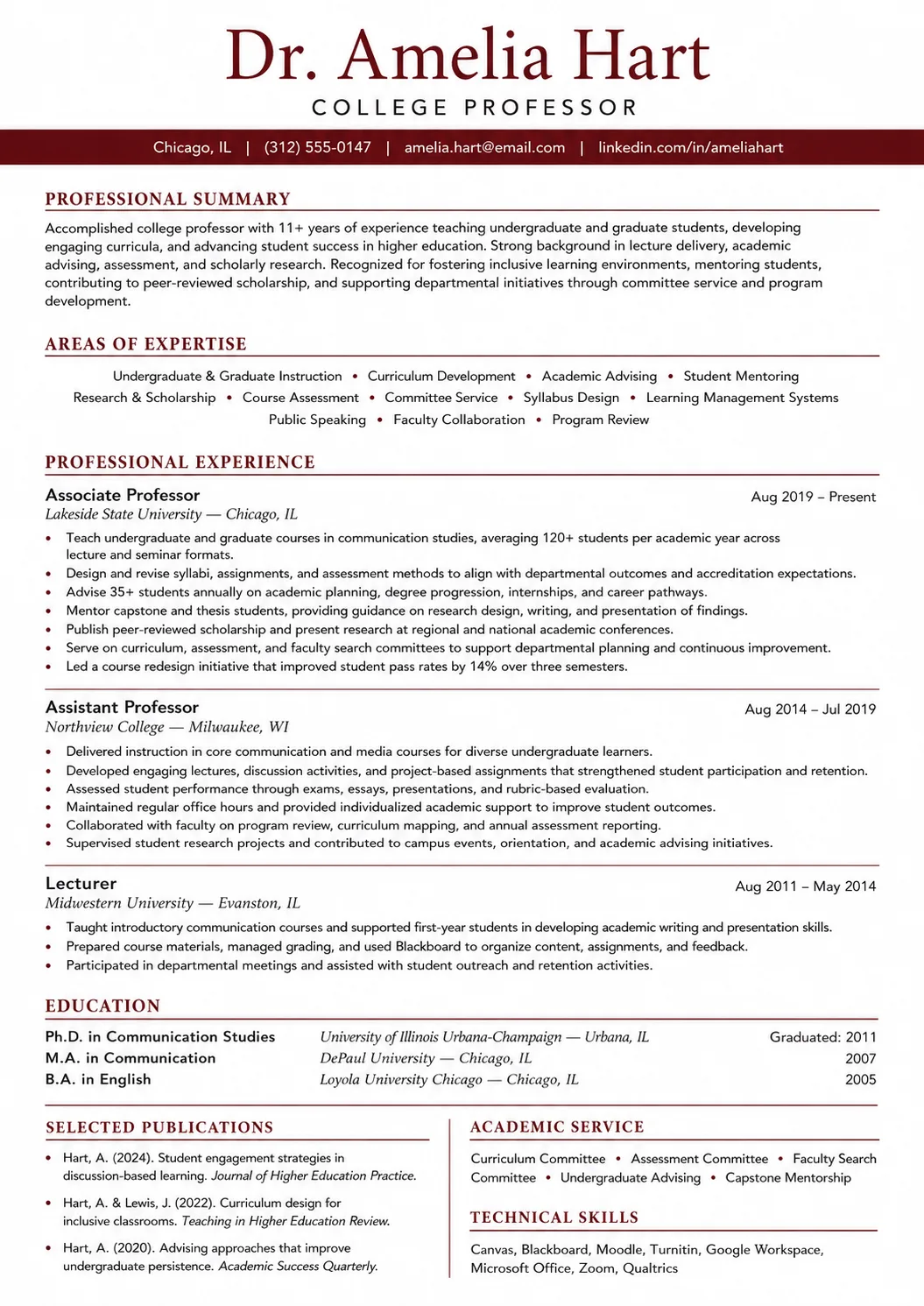
Use this mid-career academic example to study how teaching, research, advising, publications, presentations, and service should work together on one focused page.

Academic Resume Playbook

A strong academic resume should show education, research, teaching, publications, and service in a way a hiring committee can scan quickly.

Academic hiring teams read resumes differently from many corporate hiring teams. A department chair, faculty search committee, research director, graduate program lead, or higher education recruiter may look for details that would not appear on a normal one-page resume. They may want your highest degree, field, dissertation or thesis topic, research methods, publications, presentations, courses taught, learning tools, student advising, grants, fellowships, committee service, and professional memberships. That does not mean the resume should become messy. A good academic resume example makes the most important scholarly proof easy to see without forcing the reader to dig through every activity.

This guide focuses on clear academic evidence, not inflated language. You do not need to sound more senior than you are. You need to show the work that proves you can contribute to a department, program, research team, or student success office. Teaching assistantships, research assistantships, postdoctoral work, faculty appointments, academic advising, conference posters, publications, and campus service can all become strong resume proof when they are written with clear academic context. The target keyword for this page is academic resume example, but the content is written to help a real applicant build a better document, not just repeat a search phrase.

  • Turn teaching, research, publications, and service into clear academic resume proof.
  • Write an academic resume summary that shows field, focus, and role fit.
  • Use academic resume keywords for ATS without stuffing the page.
  • Place education, research methods, presentations, grants, and academic training where hiring teams can find them quickly.

How to write an academic resume

A strong academic resume should make three things clear within a few seconds: your field, your academic evidence, and why you fit the role. For some candidates, the strongest evidence is research. For others, it is teaching, student advising, curriculum work, publications, grants, or higher education service. A good academic resume example does not treat all academic work the same. It organizes the page around the role. A lecturer application should not bury courses taught. A research role should not hide methods, data, publications, or project outputs. A postdoc application should make the dissertation, research agenda, publication pipeline, and methods clear. A higher education role should show student support, program coordination, policy work, and communication.

  1. Read the posting and highlight the discipline, degree requirement, research area, teaching load, methods, tools, and application documents.
  2. Match your summary, skills, and experience bullets to the academic work the employer values most, as long as the match is honest.
  3. Use a clean format with standard headings so ATS tools, search committees, and higher education staff can scan the document quickly.

What academic hiring teams look for first

Many academic roles require a balance of teaching, research, writing, advising, and service. Postsecondary teaching roles often involve preparing course materials, teaching students, assessing work, conducting research, and publishing findings. Research roles may care more about methods, data, grants, and publications. Academic support roles may care more about student advising, program coordination, communication, and policy knowledge. Your resume should make the right type of proof visible. The strongest academic resume examples do not hide the most important evidence in a long paragraph. They use clear headings, targeted bullets, and field-specific terms so the reader can see your fit quickly.

High-priority proof points

  • Education, degree level, discipline, and research focus
  • Teaching experience, courses taught, student advising, and curriculum design
  • Research methods, data analysis, publications, and conference presentations
  • Grants, fellowships, awards, academic service, and committee work
  • Tools such as Canvas, Blackboard, Moodle, SPSS, R, Python, NVivo, Qualtrics, Zotero, or EndNote

Good proof for early academics

  • Graduate teaching assistant and research assistant work
  • Thesis, dissertation, capstone, lab, field, or archival projects
  • Conference posters, panels, workshops, guest lectures, and presentations
  • Literature reviews, annotated bibliographies, data collection, and coding work
  • Campus service, peer mentoring, tutoring, advising, and academic event support

Writing for both ATS and academic readers

Universities, colleges, research institutes, and education organizations may use applicant tracking systems before a committee reviews the resume. These systems can scan for degree requirements, job titles, research methods, teaching experience, software tools, publications, and keywords from the posting. Use plain academic language in the places where it fits: research methods, curriculum design, student advising, academic writing, publications, conference presentations, grant writing, peer review, IRB, LMS, qualitative research, quantitative research, and data analysis. The goal is not to trick the system. The goal is to describe your real academic background with the same words used in the posting.

Statistical Insight

If your resume says only that you are passionate about research or committed to education, the reader still does not know what you can do. A better academic resume shows the work behind those claims. Instead of saying you support students, show advising, office hours, feedback, mentoring, or learning support. Instead of saying you conduct research, show your method, data source, lab, archive, study population, analysis tool, manuscript, or conference output. The best academic resume example turns broad scholarly claims into evidence.

Start with one strong master resume or academic CV, then adjust it for each application. Academic roles vary widely. A lecturer resume, postdoc resume, research assistant resume, academic advisor resume, and professor resume should not all sound the same. The structure can stay similar, but the order and details should change based on the role. If the job is teaching-heavy, show teaching first. If it is research-heavy, show research, publications, and methods first. If it is student-support focused, show advising, program coordination, and communication earlier.

  1. Use the posting’s wording for discipline, methods, degree level, student population, teaching format, and tools when it matches your background.
  2. Use action words such as taught, researched, published, presented, advised, designed, analyzed, coded, reviewed, supervised, coordinated, and secured.

A good academic resume is not a list of every seminar, paper, or committee you have touched. It is a focused document that helps a department answer one question: does this person have the education, evidence, and academic fit for this role? Keep the writing clear, use action words, include scope where it is true, and connect your work to teaching quality, scholarly output, student support, or institutional contribution. Course titles, student counts, publication status, conference names, methods, grants, and tools can make your academic work feel real.

Choosing the best academic resume format and template

The best academic resume format is clean, structured, and easy to scan. Academic readers value evidence, not decoration. Use headings that match the role: Education, Academic Experience, Teaching Experience, Research Experience, Publications, Presentations, Grants, Service, Skills, and Professional Memberships. If the application asks for a CV, you may need more detail and a longer document. If it asks for a resume, keep the content more selective. In both cases, the reader should quickly find your degree, field, role fit, teaching, research, and output.

For the ATS

  • Use standard headings such as Summary, Education, Experience, Publications, Presentations, Certifications, and Skills.
  • Save the final resume as a PDF when the institution allows it, or follow the portal instructions exactly.
  • Spell out important degrees, research methods, teaching tools, publication types, and academic software at least once.

For committees and hiring teams

  • Leave enough white space so the page does not feel crowded.
  • Keep dates, institutions, role titles, courses, publications, and research outputs easy to find.
  • Choose a professional template that supports your academic evidence instead of distracting from it.
Do

Use reverse-chronological order when recent academic work is your strongest proof.

Keep the layout straightforward so a reader can find your degree, field, research focus, teaching work, and strongest output quickly.

Don't

Do not use heavy graphics, tiny fonts, complex tables, or unusual formatting that makes academic evidence harder to read.

Do not force a full academic CV into a one-page resume when the application clearly asks for publications, grants, and presentations.

Picking the right academic resume template

Most academic candidates move faster with a tested template. Choose one that keeps education and summary near the top, gives enough room for research and teaching bullets, and makes publications or presentations easy to find. Avoid templates that use too many icons or narrow columns. Academic content often needs more words than a basic business resume, so spacing matters. A good template should help the reader scan degrees, appointments, courses, research projects, publications, grants, and service without losing the main story.

Browse our resume templates or open the resume builder when you are ready to turn this academic resume example into your own finished draft. Start with the structure, then replace every sentence with your real education, research, teaching, publication, presentation, service, and skills.

Academic resume summary example: show scholarly fit fast

The academic resume summary is the short paragraph at the top of the page. It should show your field, role fit, and strongest academic proof quickly. A strong summary names your discipline or academic area, your level, and the evidence that matters most for the role. That evidence may include research methods, publications, courses taught, student advising, grants, presentations, academic writing, program coordination, or higher education service. Keep it short enough to scan, but specific enough that it does not sound like every other academic resume.

The main goals of the summary

  • Name the discipline, research area, teaching field, or higher education setting you fit best.
  • Highlight the academic strengths that matter most for the role.

Keep the tone professional and specific. Strong academic resume summaries use real academic language, not broad claims about loving learning or being committed to excellence. A graduate student might lead with research assistant work, teaching assistant work, methods training, and conference posters. A mid-level academic might lead with courses taught, publications, research projects, student advising, and curriculum work. A senior academic might lead with funded research, supervision, peer-reviewed publications, program leadership, and academic service.

  • For a new academic, mention graduate research, teaching assistance, thesis work, methods training, or conference activity.
  • For a mid-level academic, mention teaching experience, research output, advising, publications, and service.
  • For a senior academic, mention research impact, grants, supervision, curriculum leadership, publications, and institutional contribution.
Expert Tip

Skip empty phrases like “lifelong learner,” “passionate scholar,” or “dedicated academic professional.” Committees expect interest in the field. Use the limited space to show what you actually do: teach undergraduate courses, conduct mixed-methods research, publish peer-reviewed work, advise students, manage grant projects, coordinate programs, or support curriculum review. This kind of wording helps both ATS tools and real academic readers.

A simple formula works well: academic level + discipline or focus + strongest evidence + role value. For example, a graduate academic resume summary can say that the candidate has research assistant and teaching assistant experience in sociology, with skills in literature reviews, qualitative coding, Canvas, and conference poster preparation. A senior academic resume summary can mention peer-reviewed publications, grant collaboration, doctoral supervision, curriculum leadership, and department service. The formula keeps the summary clear without sounding robotic.

When the posting uses clear language, mirror it. If the job asks for student advising, write student advising. If it asks for qualitative research, use that exact phrase when it matches your work. If it asks for Canvas, Blackboard, Moodle, SPSS, R, Python, NVivo, Qualtrics, grant writing, or peer-reviewed publications, include those terms only if you can support them with real experience. This is how you write for ATS without stuffing keywords.

Adaptable resume summary example

Academic professional with 5+ years of experience in undergraduate teaching, mixed-methods research, student advising, and curriculum support. Skilled in research design, academic writing, conference presentations, LMS tools, data analysis, and clear student feedback.

Academic experience resume example: prove teaching and research work clearly

The experience section is where your academic resume becomes believable. It should prove that you can contribute to teaching, research, student support, writing, program work, or academic service in real settings. For early academics, this can include graduate teaching assistantships, research assistantships, lab work, field work, tutoring, peer mentoring, conferences, or department service. For mid-level academics, it should show stronger teaching ownership, research output, student advising, curriculum work, presentations, and publication activity. For senior academics, it should also show grants, supervision, committees, program leadership, peer review, and field contribution.

Statistical Insight

Academic employers care about the work behind the title. If you prepared lectures, graded with rubrics, advised students, conducted interviews, analyzed survey data, wrote literature reviews, prepared manuscripts, supported grant proposals, organized conferences, or served on committees, that experience counts. The key is to write it clearly. A bullet like “helped with research” is too thin. A stronger bullet says “coded 42 interview transcripts in NVivo and prepared weekly research memos for a mixed-methods study on student retention.” The second version gives method, tool, scope, and topic.

Use reverse-chronological order so your most recent and most relevant experience appears first. For each role, include the position title, institution or organization, location, dates, and short bullets. Start each bullet with an academic action such as taught, designed, researched, analyzed, published, presented, advised, mentored, reviewed, coordinated, secured, supervised, or evaluated. Then add the academic context. Good context includes course title, student count, research method, data type, publication status, conference name, grant amount, department, committee, or software tool.

  • Position title
  • Institution, department, lab, program, or research center name
  • Location and dates
  • Courses, research topics, student groups, or academic projects you supported
  • Short bullets that show what you taught, researched, published, presented, advised, or improved

The best academic resume bullets use clear academic actions. Instead of saying worked on research, explain the method, source, tool, or output. Instead of saying taught classes, name the course, level, format, and student support method. Instead of saying contributed to the department, name the committee, event, policy, curriculum review, or student success work. An academic resume example should not exaggerate. It should make real scholarly work easier to understand.

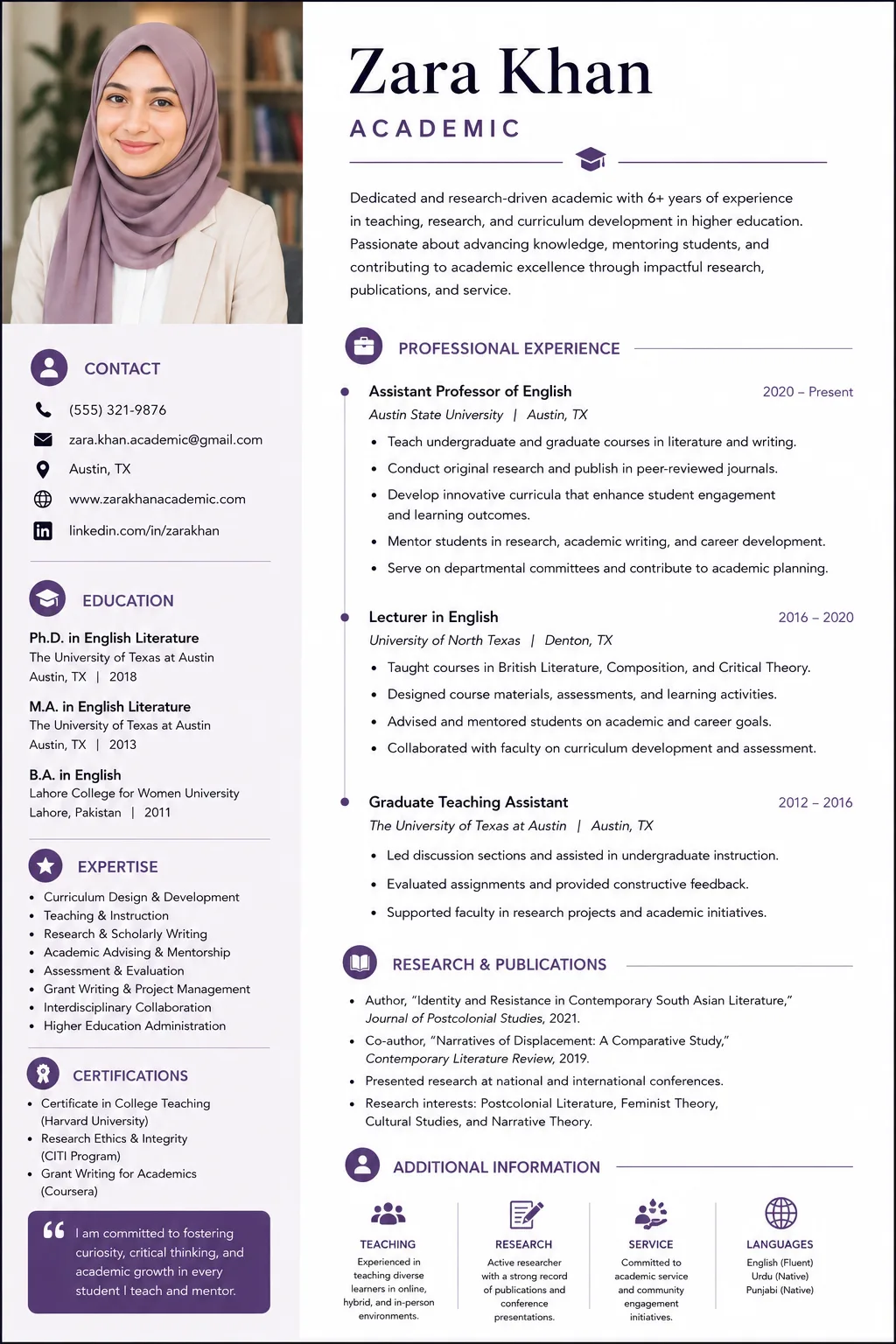
Adaptable resume employment history example

Lecturer and Research Associate, Northbridge University

Boston, Massachusetts | Aug 2021 - Present

  • Designed and taught undergraduate seminars in education policy, research methods, and student development for classes of 24-38 students.
  • Coordinated literature reviews, interview coding, survey analysis, and manuscript drafts for three higher education research projects.
  • Advised students on research proposals, academic writing, conference submissions, and graduate school preparation.

Graduate Teaching Assistant, East Harbor College

Cambridge, Massachusetts | Aug 2018 - May 2021

  • Led weekly discussion sections, graded essays with rubrics, and provided feedback to support student learning outcomes.
  • Prepared course materials, exam review guides, and Blackboard updates for undergraduate courses in social science research.
  • Supported faculty research through source collection, annotated bibliographies, and conference presentation preparation.

Academic skills section example: show what you do in higher education

The academic skills section should reflect the work you do in research, teaching, writing, advising, and service. It should help a search committee, recruiter, or ATS tool see your methods, tools, and academic strengths quickly. Good academic resume skills are not random personality words. They are connected to real scholarly and higher education work: literature reviews, qualitative research, quantitative analysis, curriculum design, student advising, academic writing, peer review, grant writing, data analysis, LMS tools, conference presentations, and program evaluation.

Keep a longer master list outside your resume, then choose the skills that fit each application. A research role may need methods, data, publications, IRB, and analysis tools. A teaching role may need curriculum design, assessment, learning outcomes, student feedback, and LMS tools. A higher education role may need advising, program coordination, retention support, policy knowledge, and student communication. The best academic resume examples do not use the same skills for every role. They select the skills that match the department, program, and posting.

Statistical Insight

Academic employers often prioritize skill groups such as:

  • Research methods, literature reviews, data collection, analysis, and academic writing
  • Teaching, curriculum design, assessment, rubrics, LMS tools, and student feedback
  • Student advising, mentoring, supervision, office hours, and learning support
  • Publications, conference presentations, peer review, grants, and scholarly communication
  • Academic service, committees, program coordination, community engagement, and professional memberships

A strong academic skills section mixes research skills, teaching skills, writing skills, tools, and service skills in a way that matches the role. If you list qualitative research, show a bullet where you coded interviews or conducted thematic analysis. If you list student advising, show a bullet where you advised students on research, academic planning, or applications. If you list grant writing, show a proposal, funded project, fellowship, or contribution. This makes your skills believable instead of decorative.

Adaptable resume skills section example
  • Research methods
  • Academic writing
  • Curriculum design
  • Student advising
  • Data analysis
  • Learning management systems

Education resume example: keep degrees and research training easy to find

Education matters on every academic resume because committees need to verify your degree level, field, institution, research training, and academic preparation. For many academic roles, your education section may sit near the top. Include your highest degree first, then your institution, location, graduation date or expected date, field, dissertation or thesis title if relevant, advisor if useful, and key honors or fellowships when they support the application. If you are still completing a degree, write the expected date clearly.

Once you have more academic experience, your publications, teaching, research, grants, and service may lead the page. But education still needs to be easy to find. This is especially important for faculty, postdoc, lecturer, research, and higher education roles that require a specific degree. Use exact degree wording when possible. A small mistake in degree status or expected completion date can create confusion. Clear education wording helps both ATS tools and committees confirm that you meet the role requirements.

Adaptable resume education example
  • Ph.D. in Higher Education, East Harbor College | Cambridge, Massachusetts | 2021

Academic certifications and research training

Academic credentials can include more than degrees. Include research ethics training, human subjects training, IRB training, lab safety, teaching certificates, graduate teaching programs, data analysis certificates, language credentials, instructional design training, software training, or discipline-specific credentials when they support the role. If a posting asks for a specific training requirement, place it where the reader can find it quickly. If a certificate is in progress, write the expected completion date honestly.

  • Human Subjects Research Training | 2024
  • Certificate in College Teaching | 2020

Before applying, make sure your degree wording, certification status, research training, methods, and software tools match the posting. This matters for both ATS tools and human readers. If the role asks for qualitative research, quantitative analysis, teaching experience, LMS tools, grant writing, IRB training, or student advising, use the exact wording that fits your background. Do not exaggerate. Clear academic credential wording builds trust.

Adaptable resume certifications example
  • Human Subjects Research Training | 2024
  • Certificate in College Teaching | 2020

Bullet upgrade

Weak vs strong academic resume bullets

Use the stronger version as the model: start with a clear academic action, add discipline or project context, and include the detail that proves the work mattered. Academic resume bullets should show what you taught, researched, wrote, presented, advised, reviewed, analyzed, coordinated, or improved. Avoid vague claims such as helped with research or taught students when you can name the course, method, output, student group, or scholarly result.

Weak

Taught undergraduate students.

Stronger

Designed and taught two sections of Introduction to Sociology for 64 undergraduate students, using weekly discussion prompts, rubric-based grading, and LMS feedback to support student progress.

The stronger bullet names the course level, student group, teaching methods, and support structure.

Weak

Worked on research projects.

Stronger

Coordinated interview coding and literature review updates for a mixed-methods education research project, using NVivo and Zotero to support manuscript preparation.

This version shows the research method, tools, project type, and output instead of a vague research claim.

Weak

Helped with academic events.

Stronger

Organized a graduate research symposium with 18 presenters by coordinating abstracts, session schedules, faculty moderators, and attendee communication.

The better version explains the academic activity, scale, coordination work, and result.

ATS keyword bank

Academic resume keywords for ATS

Universities, research centers, and higher education employers may use ATS tools before a department reads your resume. Use academic resume keywords only when they honestly match your background. Good keywords are normal academic terms: research methods, curriculum design, student advising, publications, conference presentations, grant writing, academic service, peer review, LMS, data analysis, qualitative research, quantitative research, IRB, and literature review. Field-specific words also matter, so adapt this list to your discipline.

Research methodsCurriculum designTeaching experienceStudent advisingPublicationsConference presentationsGrant writingAcademic serviceLearning management systemsPeer review

Use academic resume keywords only when they match your real background. Academic roles often use field-specific language, so mirror the posting for discipline, methods, student population, teaching format, research area, and software tools when the match is honest. Do not force keywords into every sentence. Place them naturally in your summary, skills, education, experience, publications, and research sections.

Matching application

Academic cover letter tips

Pair this resume with a focused academic cover letter that explains your fit for the department, program, lab, research center, or higher education role. Do not repeat the whole resume. Use the letter to connect your research, teaching, service, and future contribution to the job description. For academic roles, the cover letter can also explain your research agenda, teaching approach, publication pipeline, or interest in the institution.

Name the discipline, department, research area, teaching field, or student population you are targeting early in the letter.

Connect one strong academic resume example to teaching quality, research output, student support, publications, or service.

Explain why your academic work fits the department instead of repeating your resume summary.

Final review

Academic resume checklist before applying

Before you send your academic resume, review it against the posting and application instructions one last time. Look for missing degree details, research area, methods, publication status, conference work, teaching experience, student advising, service, grants, tools, and required documents. Small changes can make the resume easier to read and more relevant.

  • Did you name your academic field, discipline, research area, or teaching focus clearly?
  • Did you list your highest degree, institution, thesis or dissertation topic, and expected completion date if relevant?
  • Did your summary match the role, such as lecturer, researcher, postdoc, academic advisor, or faculty applicant?
  • Did you include honest academic keywords from the posting, such as curriculum design, student advising, publications, research methods, or grant writing?
  • Did your bullets show academic actions, not just broad claims about teaching or research?
  • Did you list tools such as Canvas, Blackboard, Moodle, SPSS, R, Python, NVivo, Zotero, EndNote, Qualtrics, or institutional research systems only if you use them?
  • Is the layout clean enough for hiring committees, ATS tools, and department staff to scan quickly?
  • Did you save the document as a PDF unless the university, college, or application portal asked for another format?

Before applying, compare your academic resume with the job posting, department page, and application instructions. Academic applications often vary by role. One position may want a short resume, another may ask for a full CV, and another may require separate teaching, research, diversity, or publication documents. A strong academic resume example is not copied word for word. It is tailored so the committee can see why your research, teaching, service, and education fit the role.

Before You Start Writing

Key takeaways

  • Tailor each academic resume to the department, role, field, and application instructions.
  • Use a clean layout that is easy for ATS tools, faculty committees, and higher education staff to scan.
  • Write a summary that shows academic focus instead of generic interest in education.
  • Lead with education, research, teaching, publications, or service based on what the role values most.
  • Balance scholarly proof with clear language, especially when non-specialist readers may screen the resume first.
  • Make degrees, research methods, publications, presentations, grants, and academic tools easy to verify.

Ready to build

Build your academic resume with the same structure

Start with this academic resume example, then build a matching cover letter that speaks directly to the department, research center, academic program, or higher education role you want. The builder can help you turn the structure into a clean resume faster, but your real academic proof is what makes the application strong.