Resume ExampleEducationMid Level

Academic Librarian Resume Examples & Writing Guide

Use these academic librarian resume examples to show research support, information literacy instruction, collection work, faculty liaison service, and library technology skills in a clear ATS-friendly way.

Experience Level
Mid Level
Category
Education
Reader Rating
4.8 / 5
  • Show your academic library focus: reference, instruction, liaison, systems, scholarly communication, or collections.
  • Use clear bullets for student research help, faculty collaboration, LibGuides, databases, and course-integrated instruction.
  • Keep MLIS, MLS, subject degrees, and specialized training easy for search committees to verify.
Resume Example (Text Format)

Jordan Ellis

Academic Librarian

jordan.ellis@email.com | (614) 555-4186 | Columbus, Ohio | linkedin.com/in/jordan-ellis-library

Profile

Academic librarian with 5 years of experience in reference services, information literacy instruction, faculty liaison work, and undergraduate research support. Skilled in course-integrated instruction, LibGuides, discovery tools, citation management, collection recommendations, and student-centered research consultations. MLIS-qualified with experience supporting first-year writing, social sciences, and online learning programs.

Work Experience

Reference and Instruction Librarian, North Valley University Library

Columbus, Ohio | Aug 2020 - Present

  • Deliver course-integrated information literacy sessions for first-year writing, sociology, psychology, and education courses using assignment-based search activities.
  • Provide in-person, chat, and appointment-based research consultations that help students build search strategies, evaluate sources, and use subject databases.
  • Maintain LibGuides, Canvas library modules, and citation support materials for high-enrollment undergraduate courses.
  • Serve as liaison to two academic departments by supporting faculty resource requests, collection recommendations, and library outreach.

Library Graduate Assistant, Midstate College Library

Columbus, Ohio | 2018 - 2020

  • Answered reference desk questions, helped students use discovery tools, and referred complex research needs to subject librarians.
  • Updated research guides, created handouts for database searching, and supported library instruction preparation.
  • Assisted with collection review projects by checking title lists, usage notes, and course relevance for assigned subject areas.

Education

  • Master of Library and Information Science, Kent State University | Kent, Ohio | 2020
  • B.A. in English, Ohio State University | Columbus, Ohio | 2017

Languages

  • Spanish

Certifications

  • Copyright for Libraries Professional Development Course | 2024
  • Research Data Management Workshop Series | 2023
  • Accessibility in Online Learning Training | 2023

Skills

  • Information literacy instruction
  • Reference services
  • Research consultations
  • Faculty liaison work
  • LibGuides
  • Alma and Primo
  • Zotero and EndNote
  • Collection development

A strong academic librarian resume should show that you can support teaching, research, access, and campus service. Search committees are not looking for a list of every database you have opened. They want to see how you help students find credible sources, how you teach information literacy, how you support faculty research, how you improve access to collections, and how you work with library systems and campus partners. The best academic librarian resume examples make those strengths clear in plain language. They connect library work to learning, scholarship, and user experience.

Quick breakdown

Why this academic librarian resume works

1

It shows the candidate as a teaching, research, and campus-service partner, not only a keeper of materials.

2

It uses academic library language that search committees, HR systems, and department heads can scan quickly.

3

It balances service desk work with higher-value proof such as course-integrated instruction, liaison outreach, scholarly communication, and collection decisions.

4

It makes library technology visible without letting tools replace the story of student and faculty support.

Fast template guide

What to copy from this example

Do not copy the resume word for word. Copy the structure, the section order, and the level of academic library detail. Your own academic librarian resume should show how you support students, faculty, collections, systems, and campus goals.

A clear headline that names the role type, such as Academic Librarian, Reference and Instruction Librarian, Research Librarian, Subject Librarian, or Scholarly Communications Librarian.

A focused profile that connects library service to student learning, faculty research, collection access, and campus priorities.

Experience bullets that prove information literacy instruction, research consultations, reference services, database support, collection development, and outreach.

A skills section that blends public-service strengths with library systems, discovery tools, citation managers, assessment, metadata awareness, and digital scholarship tools.

Education and credentials placed where academic library employers can quickly check MLIS, MLS, subject master's work, professional development, and relevant training.

Plain ATS wording that matches academic library job postings without overloading the resume with disconnected database names or library jargon.

Build the right structure

Academic librarian resume sections to include

A strong academic librarian resume should include the sections search committees expect, plus optional sections that show instruction, research support, scholarship, committee service, and library technology. The goal is to make your fit clear for both HR screening and library professionals.

Must-have sections

  • Contact information
  • Resume summary or professional profile
  • Academic library experience
  • Education
  • Certifications, professional development, or specialized training
  • Academic librarian skills

Optional sections that strengthen the resume

  • Information literacy instruction
  • Research consultations
  • Faculty liaison work
  • Collection development
  • Scholarly communications
  • Institutional repository work
  • Digital scholarship projects
  • Metadata or cataloging experience
  • Library systems and discovery tools
  • Conference presentations
  • Publications
  • Committee service
  • Languages
  • Awards
  • Professional memberships

For an academic librarian resume, the strongest sections show how you support teaching, research, access, and campus collaboration. If you are early in your library career, internships, graduate assistantships, practicum work, public library reference work, archives projects, tutoring, writing center work, and instructional support can all help when written in academic library language.

Smarter ordering

Best academic librarian resume section order

The best section order depends on your career stage and role type. An early-career librarian may lead with education and practicum work. A senior librarian should lead with program impact, campus partnerships, service leadership, and measurable improvements.

Entry-level academic librarian

  1. Contact information
  2. Resume summary
  3. Education
  4. Library internships, practicum work, graduate assistantships, or reference experience
  5. Instruction, research support, or digital project experience
  6. Skills
  7. Professional development, presentations, or memberships
Experienced academic librarian

  1. Contact information
  2. Resume summary
  3. Academic library experience
  4. Instruction, liaison, research support, and collection achievements
  5. Skills
  6. Education
  7. Professional development and service

Senior academic librarian or department lead

  1. Contact information
  2. Resume summary
  3. Leadership, strategy, and academic library experience
  4. Program outcomes, service improvements, and campus partnerships
  5. Committee service, publications, presentations, or grants
  6. Skills
  7. Education and professional credentials

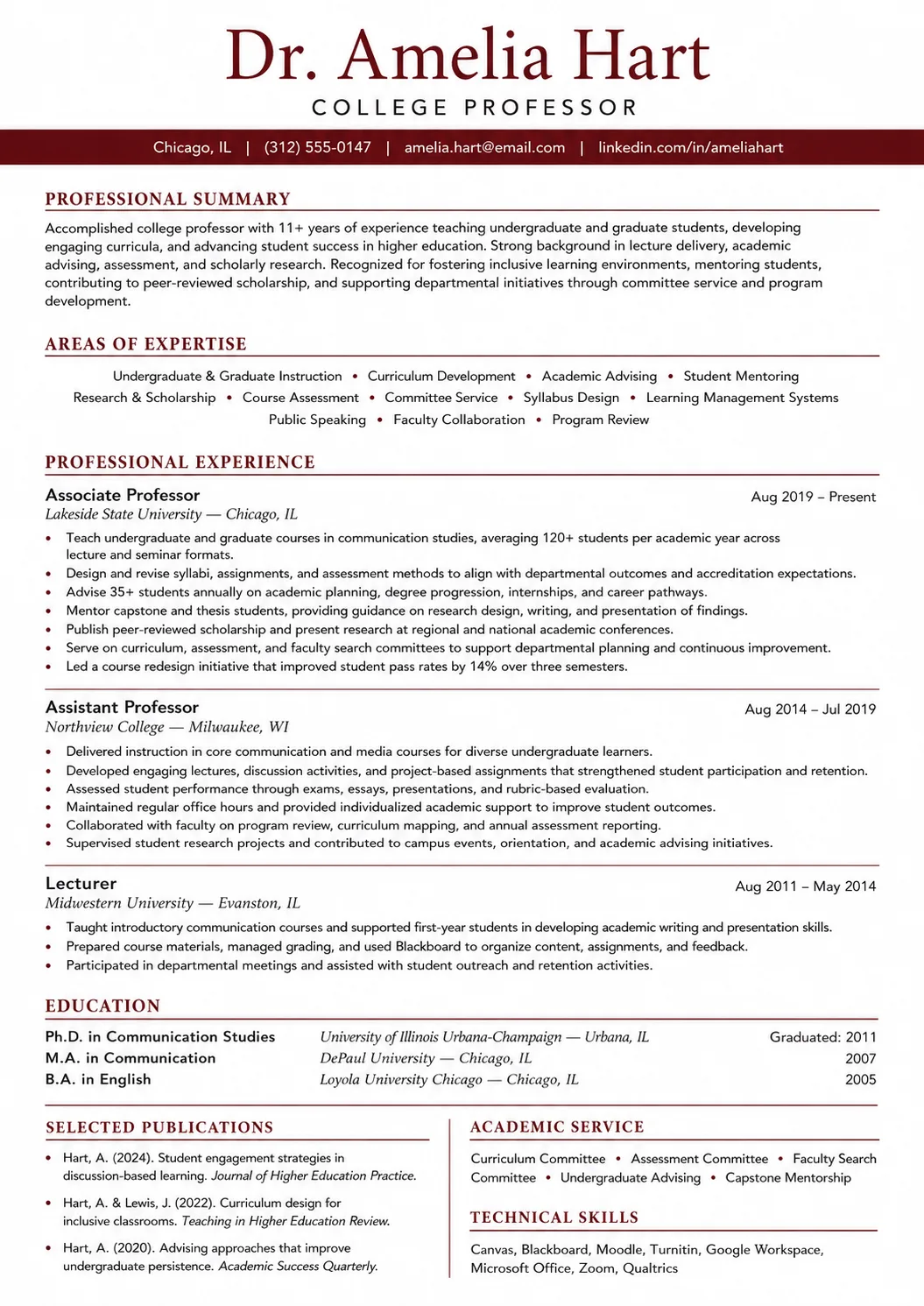
If you are new to academic libraries, move education, practicum work, and transferable teaching or research support higher. If you have more experience, lead with outcomes, liaison scope, instruction impact, systems improvements, committee work, and campus collaboration.

Choose an academic librarian resume example by experience level

Use this template

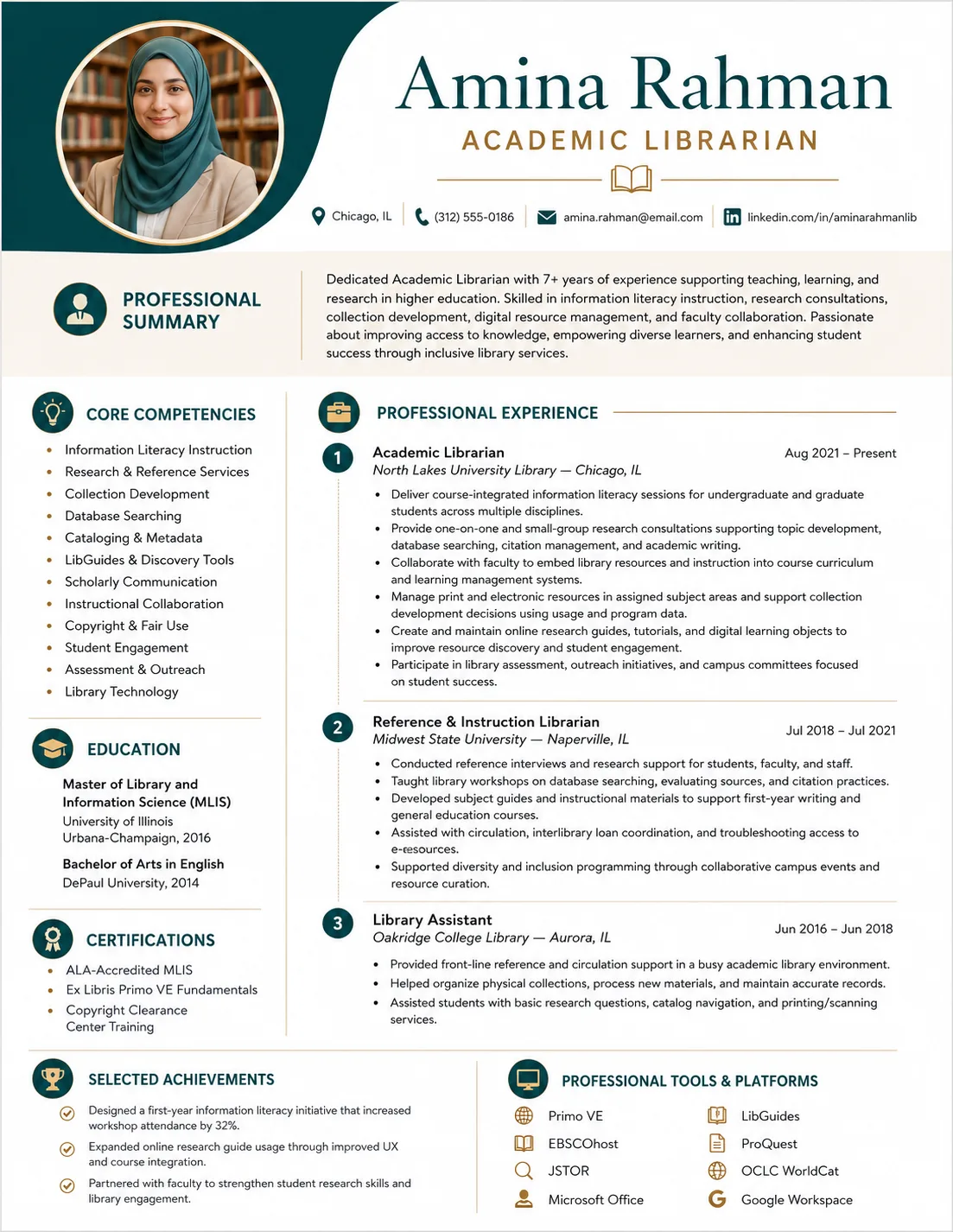
Use this mid-level academic librarian example to study how instruction, reference service, liaison work, and collection support can lead the resume.

Academic Librarian Resume Playbook

A strong academic librarian resume should show research support, information literacy instruction, and clear service to students and faculty.

Academic library hiring teams look for more than library experience. They want proof that you can support learning, research, access, and collaboration across a campus. Your resume should show how you teach students to find and evaluate information, how you guide faculty and graduate researchers, and how you improve services through tools, collections, outreach, and assessment.

Academic librarian roles vary widely. One posting may focus on reference and instruction. Another may focus on scholarly communication, metadata, systems, archives, data services, liaison work, or electronic resources. The safest resume strategy is to show a clear core: users served, services delivered, tools used, and results supported. This guide will show you how to:

  • Turn reference, instruction, liaison, systems, and collection work into clear resume proof.
  • Show research consultations, information literacy sessions, LibGuides, and faculty collaboration in plain academic library language.
  • Place MLIS, MLS, subject degrees, professional development, and specialized training where search committees can verify them fast.
  • Build an academic librarian resume that works for HR screening, ATS tools, and detailed review by library professionals.

How to write an academic librarian resume

A strong academic librarian resume should make five things easy to see: your library focus, your academic users, your instruction or research support experience, your technology comfort, and your education or credential fit. Search committees often read carefully, but your resume still needs a strong scan path. A busy reader should be able to spot your role type, MLIS or MLS status, instruction experience, research support, liaison areas, and systems knowledge without digging through long paragraphs.

  1. Read the posting closely and identify whether the role is mainly reference, instruction, liaison, systems, scholarly communication, archives, metadata, electronic resources, or a blended academic librarian role.
  2. Tailor your summary, skills, and bullets to the user groups and services the library names most often.
  3. Use a clean format so HR staff, ATS tools, library directors, faculty search committee members, and peer librarians can all understand your fit quickly.

What academic library employers look for first

Academic librarian hiring is usually a mix of credential screening, service fit, and committee review. The first screen may check whether you meet minimum education requirements. The next read looks for evidence that you can serve the institution's students, faculty, and programs. In a teaching-focused college, instruction and student support may matter most. In a research university, liaison service, advanced research consultations, scholarly communication, data services, and subject expertise may carry more weight. In a community college, clear teaching, access, inclusion, and student success support can be central.

High-priority proof points

  • Information literacy instruction and course support
  • Reference services and research consultations
  • Faculty liaison work and campus outreach
  • Collection development and electronic resource awareness
  • MLIS, MLS, equivalent qualification, or relevant subject expertise

Good proof for early-career librarians

  • Graduate assistantships and practicum work
  • Library internships or student worker roles
  • Teaching, tutoring, or writing center experience
  • Research assistant work and literature review support
  • Digital projects, archives work, metadata cleanup, or LibGuides

Honing your resume for the ATS

Academic librarian resumes still need ATS-friendly wording, especially when applications go through a university HR system. The best approach is simple: use the language of the posting when it matches your experience. If the role asks for information literacy, reference services, faculty liaison work, institutional repositories, scholarly communication, metadata, or electronic resources, place those terms in your summary, skills, and experience bullets. Do not hide your strongest terms inside a long paragraph.

Statistical Insight

Do not rely on job titles alone. A title like Librarian I, Library Assistant, Graduate Assistant, or Subject Librarian may not explain your value. Your bullets should show the work: taught sessions, answered research questions, built guides, supported faculty, improved access, assessed services, or maintained systems.

Start with a master resume that includes every library tool, user group, project, committee, training, and campus partnership you can support. Then create a targeted version for each role. A reference and instruction role should push teaching, consultations, LibGuides, Canvas modules, and assessment. A scholarly communication role should highlight repositories, author rights, open access, OER, copyright support, and faculty workshops. A systems role should show integrated library systems, discovery layers, authentication, troubleshooting, documentation, and vendor coordination.

  1. Match your resume headline and summary to the exact academic librarian role type named in the posting.
  2. Use evidence-based bullets that connect library actions to students, faculty, collections, systems, or campus priorities.

Academic library search committees often value clear judgment. That means your resume should not overclaim. If you supported scholarly communication but did not lead the program, say supported. If you co-taught sessions, say co-taught. If you helped maintain Alma records but were not the systems administrator, write the exact support work. Honest scope makes the resume more credible.

Choosing the best resume format and template

The best academic librarian resume format is clean, structured, and detailed without becoming crowded. Academic library resumes can be longer than many private-sector resumes when the role expects publications, presentations, committee service, grants, teaching, or subject expertise. Still, most applicants should keep the main resume focused. Use a full CV only when the posting asks for one or when faculty-status librarian roles expect a more academic format.

For the ATS

  • Use standard headings such as Summary, Experience, Education, Skills, Professional Development, Presentations, and Publications.
  • Spell out key terms such as Master of Library and Information Science, information literacy instruction, institutional repository, and scholarly communication.
  • List systems and tools in normal text instead of images, icons, tables, or complex columns.

For search committees

  • Make your role focus clear in the first third of the page.
  • Connect each job to users served, services delivered, tools used, and improvements supported.
  • Use enough detail for librarians to understand your scope, but avoid long blocks that slow down review.
Do

Use a professional layout that separates library experience, education, skills, and academic service clearly.

Add separate sections for presentations, publications, committee service, or professional development when those items support the role.

Don't

Do not use a design that looks creative but makes dates, degrees, systems, or committees hard to scan.

Do not list every database in one long skills block. Choose the tools that match the role and that you can discuss with confidence.

Picking the right resume template

Choose a template that can handle both practical library work and academic detail. If you are applying for a reference and instruction librarian role, the template should give space for teaching, research consultations, and campus outreach. If you are applying for scholarly communication, systems, archives, or electronic resources, the template should let you show projects and tools clearly. Avoid layouts that force every achievement into one tiny column.

Browse our resume templates or start in the resume builder when you are ready to turn this academic librarian resume guide into a finished draft.

Academic librarian summary resume example: show research and instruction fit

The summary is your quick positioning statement. It should tell the search committee what kind of academic librarian you are and what you can help the institution do. Good summaries are specific. They name the role focus, user group, tools, and service strengths. Weak summaries use broad phrases like organized professional, lifelong learner, or passionate about books. Those lines do not show how you help a campus.

The main goals of the summary

  • Name your academic library focus, such as reference and instruction, research support, scholarly communication, systems, archives, metadata, or subject liaison service.
  • Show the users you support, such as undergraduates, graduate students, faculty, online learners, first-year students, health sciences researchers, or assigned departments.

Keep the summary practical and direct. A hiring team should be able to read it and understand where you fit in the library. If the role is for a teaching-focused librarian, mention information literacy instruction, course-integrated sessions, active learning, and learning management systems. If the role is for a research librarian, mention consultations, literature searching, citation management, systematic review support, or subject databases. If the role is for a liaison librarian, mention faculty collaboration, outreach, curriculum support, and collection development.

  • For entry-level academic librarians, include MLIS or MLS status, practicum work, graduate assistantships, and transferable teaching or research support.
  • For mid-level librarians, include instruction, consultations, liaison scope, service improvement, and tools such as LibGuides or discovery systems.
  • For senior librarians, include program leadership, assessment, committee work, team mentoring, campus partnerships, and strategic service improvements.
Expert Tip

A strong summary can mention credentials, but it should not become only an education line. Pair MLIS or MLS with service proof, such as instruction, research consultations, collection work, or systems support.

Here is a simple pattern: Academic librarian with X years of experience in [role focus], [service area], and [campus user group]. Skilled in [tools or methods] with experience supporting [student learning, faculty research, access, collections, or systems]. This pattern works because it gives the reader role, scope, tools, and value in a few lines.

Tailor the summary for each posting. A generic academic librarian summary will not perform as well as one that speaks directly to the library's needs. For example, a community college role may value first-generation student support, instruction, accessibility, and student success language. A health sciences role may value advanced database searching, evidence-based practice, systematic review methods, and research consultations.

Adaptable resume summary example

Academic librarian with 5 years of experience in reference services, information literacy instruction, faculty liaison work, and undergraduate research support. Skilled in course-integrated instruction, LibGuides, discovery tools, citation management, collection recommendations, and student-centered research consultations. MLIS-qualified with experience supporting first-year writing, social sciences, and online learning programs.

Academic librarian experience resume example: prove service and campus value

The experience section is where your academic librarian resume becomes credible. Search committees want to see what you actually did: taught sessions, answered research questions, supported faculty, improved guides, reviewed collections, maintained systems, managed repository records, assessed services, or built outreach. Do not stop at responsibilities. Show the context and the service value behind the work.

Statistical Insight

In academic libraries, impact is not always a sales number or revenue metric. Strong proof can be clearer access, better instruction materials, smoother referrals, improved research support, stronger faculty partnerships, cleaner metadata, or more useful collection decisions.

Use reverse chronological order for most resumes. For each role, include the institution, dates, and scope. Then write bullets that show actions and context. A strong bullet might name the course level, department, user group, service channel, system, or project. For example, saying you delivered library instruction is okay. Saying you delivered course-integrated information literacy sessions for first-year writing courses using assignment-based search exercises is better.

  • Position title and library, college, university, archive, or research center name
  • Location and dates
  • Main user groups, departments, subject areas, or service points supported
  • Instruction, reference, liaison, systems, collection, repository, or outreach work
  • Clear bullets that show tools, methods, collaboration, and service improvements

Use numbers when they are accurate and helpful, but do not force them. If you taught 45 sessions, supported three departments, maintained 20 research guides, or answered chat reference during peak hours, include that. If you do not have numbers, use specific context instead: graduate-level literature reviews, first-year writing courses, faculty OER consultations, institutional repository deposits, or collection review for a new program.

Adaptable resume employment history example

Reference and Instruction Librarian, North Valley University Library

Columbus, Ohio | Aug 2020 - Present

  • Deliver course-integrated information literacy sessions for first-year writing, sociology, psychology, and education courses using assignment-based search activities.
  • Provide in-person, chat, and appointment-based research consultations that help students build search strategies, evaluate sources, and use subject databases.
  • Maintain LibGuides, Canvas library modules, and citation support materials for high-enrollment undergraduate courses.
  • Serve as liaison to two academic departments by supporting faculty resource requests, collection recommendations, and library outreach.

Library Graduate Assistant, Midstate College Library

Columbus, Ohio | 2018 - 2020

  • Answered reference desk questions, helped students use discovery tools, and referred complex research needs to subject librarians.
  • Updated research guides, created handouts for database searching, and supported library instruction preparation.
  • Assisted with collection review projects by checking title lists, usage notes, and course relevance for assigned subject areas.

Academic librarian skills section example: show tools, teaching, and research support

The skills section should help the reader quickly understand your academic library toolkit. It should include role-specific terms, but it should not become a warehouse of every database and platform you have ever used. Pick the skills that match the posting and the work you can prove in your bullets.

A strong academic librarian skills section often includes a mix of service skills, teaching skills, research tools, library systems, and collaboration. For a reference and instruction librarian, information literacy, research consultations, LibGuides, citation management, and LMS tools may matter most. For systems or electronic resources roles, Alma, Primo, OpenAthens, EZproxy, link resolver support, troubleshooting, vendor communication, and documentation may be more important.

Statistical Insight

Academic library skill groups often include:

  • Reference, research consultations, and advanced search strategy
  • Information literacy instruction, active learning, and curriculum support
  • Faculty liaison work, outreach, collection development, and assessment
  • Library systems, discovery layers, LibGuides, repositories, and access tools
  • Scholarly communication, OER, copyright support, citation management, and research data support

Place your most relevant tools near the top of the skills list, but do not rely on tool names alone. A search committee cares whether you can use the tool to solve a library problem. For example, LibGuides is stronger when your experience section says you created course-specific research guides for high-enrollment classes. Alma is stronger when your bullets show records, fulfillment, acquisitions, or troubleshooting support.

Adaptable resume skills section example
  • Information literacy instruction
  • Reference services
  • Research consultations
  • Faculty liaison work
  • LibGuides
  • Alma and Primo
  • Zotero and EndNote
  • Collection development

Education resume example: keep MLIS, MLS, and subject training clear

Education is a high-value section on an academic librarian resume. Many academic librarian roles require or strongly prefer an MLIS, MLS, MIS, or equivalent library and information science qualification. In the United States, many postings refer to an ALA-accredited program. Outside the United States, the expected credential may be worded differently. Follow the posting language and list your degree clearly.

Subject expertise can also matter. A science librarian may benefit from a biology, chemistry, engineering, or health sciences background. A humanities librarian may benefit from graduate study in literature, history, languages, or digital humanities. A business librarian may show business research tools, data, or market research knowledge. Add subject degrees and coursework when they help the hiring team see why you fit the liaison area.

Adaptable resume education example
  • Master of Library and Information Science, Kent State University | Kent, Ohio | 2020
  • B.A. in English, Ohio State University | Columbus, Ohio | 2017

Credentials and professional development

Academic librarianship changes with teaching practice, publishing models, access systems, research workflows, and digital scholarship. Professional development can strengthen your resume when it is tied to the role. Good examples include information literacy instruction, systematic review searching, copyright, open access, OER, research data management, metadata, digital preservation, accessibility, Universal Design for Learning, assessment, or project management. Keep this section selective and relevant.

  • Copyright for Libraries Professional Development Course | 2024
  • Research Data Management Workshop Series | 2023
  • Accessibility in Online Learning Training | 2023

List the training name, provider if useful, and year. If you have many workshops, group them under a short heading instead of creating a long list. Search committees value ongoing learning, but they still need to see your main experience first.

Adaptable resume certifications example
  • Copyright for Libraries Professional Development Course | 2024
  • Research Data Management Workshop Series | 2023
  • Accessibility in Online Learning Training | 2023

Bullet upgrade

Weak vs strong academic librarian resume bullets

Use the stronger version as the model: start with a clear library action, add the user group or academic setting, and show the service, tool, or outcome that made the work valuable.

Weak

Helped students with research.

Stronger

Provided one-on-one research consultations for undergraduate and graduate students, helping them build search strategies, evaluate sources, and use subject databases for course assignments.

The stronger bullet names the audience, the service, and the research skills supported.

Weak

Taught library classes.

Stronger

Designed and delivered course-integrated information literacy sessions for first-year writing and sociology courses, using active search exercises and source evaluation examples tied to assignments.

This version shows instruction design, course connection, teaching method, and academic context.

Weak

Managed library resources.

Stronger

Reviewed usage data, faculty requests, and curriculum needs to recommend database renewals, title cancellations, and new collection purchases for assigned subject areas.

The better version explains how collection decisions were made and why they mattered.

Weak

Worked at the reference desk.

Stronger

Handled in-person, chat, and email reference questions while documenting recurring research needs and updating LibGuides to reduce repeat confusion.

This bullet connects daily service work to service improvement.

Weak

Supported faculty.

Stronger

Partnered with faculty to embed library modules, citation support, and research guides into Canvas courses for high-enrollment undergraduate classes.

The strong version explains the partnership, tools, and student-facing value.

ATS keyword bank

Academic librarian resume keywords for ATS

Academic library job postings often use specific terms for instruction, reference, systems, scholarly communication, and liaison work. Use these keywords only when they match your real experience and when you can discuss them clearly in an interview.

Academic librarianshipReference servicesInformation literacy instructionResearch consultationsLibrary instructionFaculty liaisonSubject liaisonCollection developmentScholarly communicationOpen educational resourcesInstitutional repositoryDigital scholarship

Mirror the posting wording for role focus, library systems, subject areas, instruction needs, and campus priorities whenever it accurately matches your experience. Do not list databases or platforms you cannot discuss in an interview.

Matching application

Academic librarian cover letter tips

Pair this resume with a focused cover letter that explains why your library experience fits the institution, department, and user community. A good academic librarian cover letter should not repeat the resume. It should connect your strongest examples to the library's mission and the posting's priorities.

Name the role focus early, such as reference and instruction, scholarly communication, subject liaison service, systems, or archives.

Connect one resume example to student learning, faculty research, access, digital scholarship, or collection support.

Show that you understand the institution type, whether it is a research university, liberal arts college, community college, health sciences library, or online learning environment.

Final review

Academic librarian resume checklist before applying

Before you send your academic librarian resume, compare it with the job posting one last time. Search committees often read closely, but first impressions still matter. Your strongest role fit should appear quickly.

  • Did you use the exact role title from the posting, such as Academic Librarian, Reference Librarian, Instruction Librarian, Research Librarian, Subject Librarian, or Scholarly Communications Librarian?
  • Did you name the academic setting, such as university, community college, research library, health sciences library, law library, or teaching-focused college?
  • Did your summary connect your work to student learning, faculty research, access, or campus service?
  • Did you include MLIS, MLS, equivalent library degree, subject expertise, or degree-in-progress status where the employer can find it fast?
  • Did your bullets show specific services, such as research consultations, information literacy sessions, LibGuides, citation support, collection recommendations, or repository work?
  • Did you match ATS terms from the posting only when they honestly fit your background?
  • Did you include relevant tools such as Alma, Primo, Sierra, WorldShare, LibGuides, Springshare, EZproxy, OpenAthens, DSpace, Digital Commons, Zotero, EndNote, Canvas, Blackboard, or Moodle when you have used them?
  • Did you show collaboration with faculty, students, departments, committees, or campus partners?
  • Did you keep the format clean and readable for both HR screening and search committee review?

Academic librarian resumes are often read by both HR staff and library search committees. Make sure your strongest credentials, academic library functions, and campus impact are visible in the first page.

Before You Start Writing

Key takeaways

  • Match the exact academic librarian role type and institution language from the posting.
  • Lead with research support, instruction, liaison work, collection work, or systems experience based on the role.
  • Keep MLIS, MLS, subject degrees, and specialized training easy to find.
  • Use clear bullets that show what users you served, what tools you used, and what service improved.
  • Include library systems and databases only when you can explain your experience with them.
  • Show collaboration with faculty, students, committees, and campus partners.
  • Keep the resume readable for both HR screening and library search committees.

Ready to build

Build your academic librarian resume with the same structure

Start with the resume, then build a matching cover letter that speaks directly to the college, university, library department, and academic librarian role you want.